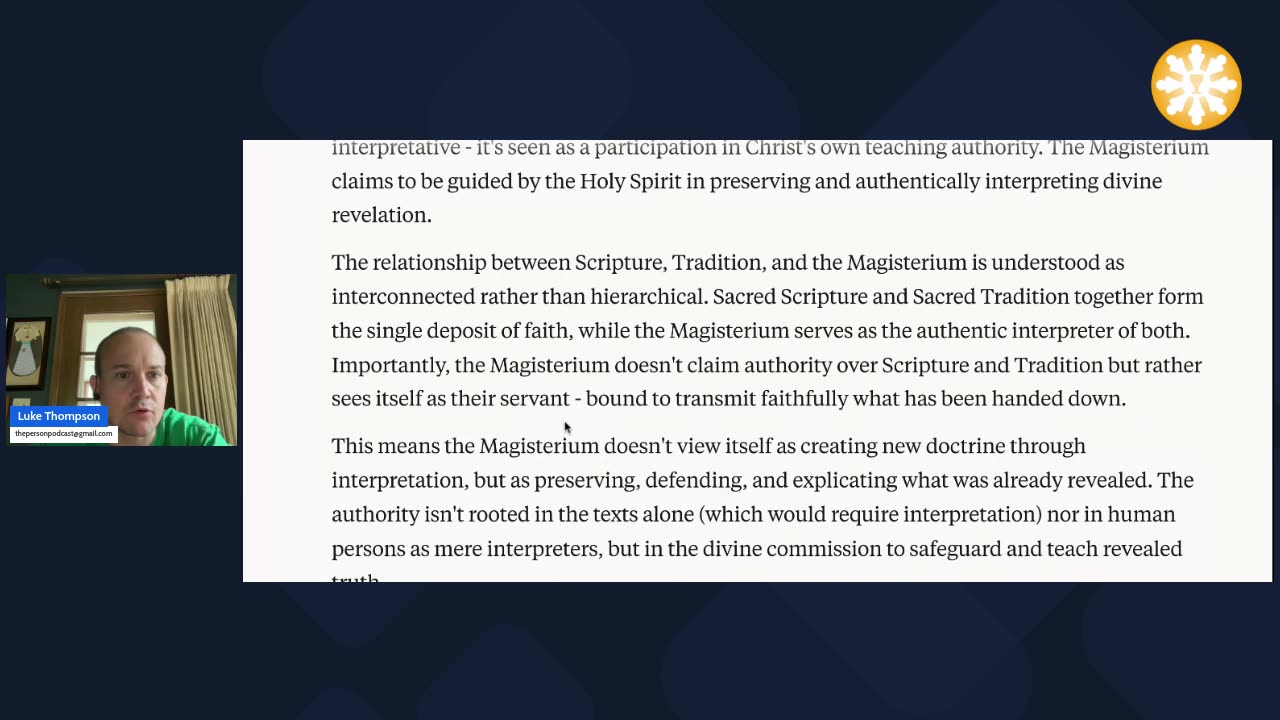
Roman Catholic Magisterium & Personalist Conscience
Claude.ai question and response:
is the Magisterium of the Roman Catholic church compatible with a personalist understanding of belief and holding to differing convictions?Additionally, What if authority differs from power in that submission can only be voluntarily assented to? Which would be connected to Jesus's exhortation to the Disciples to not "lord it over" their followers. Is it possible to disagree (have a different opinion) than the Magisterium and still be a practicing member of the Roman Catholic Church? And in specific instances of disagreement who gets to decide the boundaries?And lastly, What are the Infallible definitions and definitive doctrines that require absolute assent?
The relationship between Catholic Magisterial authority and personalist approaches to conscience and belief raises profound theological questions that Catholic theologians continue to debate.
Magisterium and Personalist Conscience
Catholic teaching does recognize the primacy of a well-formed conscience, even while maintaining Magisterial authority. The Second Vatican Council's Gaudium et Spes affirmed that conscience is "the most secret core and sanctuary of a man" where one encounters God's voice. This creates a creative tension: Catholics are called to form their consciences according to Church teaching, yet conscience retains ultimate subjective authority in moral decision-making.
Theologians like Bernard Häring and Josef Fuchs developed personalist approaches that emphasize the individual's authentic response to God's call while remaining within Catholic orthodoxy. However, this differs from purely autonomous approaches to belief formation.
Authority vs. Power and Voluntary Assent
Your distinction between authority and power resonates with Catholic theology. Jesus's teaching about not "lording over" others (Matthew 20:25-26) is foundational to understanding legitimate ecclesial authority as service rather than domination.
The Church teaches that authentic authority invites rather than coerces assent. Canon 748 §2 explicitly states that "No one is ever permitted to coerce persons to embrace the Catholic faith against their conscience." This suggests that even within the Church, the ideal is voluntary recognition of authority based on its authenticity and service to truth.
Disagreement and Church Membership
Practically speaking, many Catholics do disagree with certain Church teachings while remaining practicing members. The Church itself recognizes degrees of assent required for different teachings:
Infallible definitions require absolute assent
Definitive doctrines require firm assent
Authoritative but non-definitive teachings require "religious submission of will and intellect," which theologians interpret as a serious obligation to accept teaching unless one has compelling reasons for doubt
The boundaries are typically determined by:
The local bishop in matters of public dissent or scandal
Vatican congregations for theologians and public figures
Individual pastors in pastoral situations
The individual's own conscience in private matters
Infallible Definitions and Definitive Doctrines
Infallible definitions (requiring absolute assent) are quite limited:
Papal infallible pronouncements ex cathedra (very rare - possibly only the Immaculate Conception (1854) and Assumption of Mary (1950) in modern times)
Conciliar definitions on faith and morals
Teachings definitively held by the ordinary universal Magisterium (like the male-only priesthood, according to Ordinatio Sacerdotalis)
Definitive doctrines requiring firm assent include:
The canonization of saints
The invalidity of Anglican orders
Certain moral teachings presented as definitive (though which specific teachings fall into this category remains debated)
Other authoritative teachings include most papal encyclicals, curial documents, and episcopal statements, which require respectful consideration but allow for the theoretical possibility of respectful dissent under certain conditions.
The tension you've identified is real and ongoing in Catholic theology. While the Church maintains its teaching authority, it also increasingly recognizes that faith must be a free response and that conscience cannot be violated. This creates space for what some theologians call "loyal opposition" or "faithful dissent" in certain circumstances, though the exact boundaries remain contested and contextual.
-
 LIVE
LIVE
BubbaSZN
7 hours ago🔴 LIVE - SLAYING ZOMBIES W/ CATDOG UNTIL MY BDAY AT 12AM!
177 watching -
 LIVE
LIVE
SlingerGames
3 hours agoRumble Spartans, ASSEMBLE! | Push for 400 Followers
98 watching -
 5:22:07
xXFadedAngelXx
7 hours agoSPARTAN NIGHT! Featuring the Communiy! Thanks @OhHiMark! & @Phyxicx! for the invite
6.23K1 -
 LIVE
LIVE
AdmiralSmoothrod
6 hours agohalo MCC - Multiplayer Rumble No. 21 - its gonna get sticky
78 watching -
 LIVE
LIVE
BlackDiamondGunsandGear
4 hours agoNEW Glock Gen6 / Still Hate them / After Hours Armory
58 watching -
 8:49
8:49
Hollywood Exposed
4 hours agoBill Maher Explodes After Killer Mike Refuses Any Accountability On Air
1.75K7 -
 LIVE
LIVE
DLDAfterDark
4 hours agoThe Average Gunfighter - Gen 6 Glocks - The After Hours Armory
78 watching -
 12:31
12:31
Robbi On The Record
2 days ago $8.91 earnedWhy Nothing Feels Real Anymore | The Science, Culture, and Spiritual War Behind the Fog
63.7K31 -
 25:21
25:21
Stephen Gardner
7 hours agoWait Until You Hear This UNEXPECTED Trump Story!
24.3K68 -
 1:19:11
Squaring The Circle, A Randall Carlson Podcast
13 hours agoBreaking: New Evidence & Studies For Younger Dryas Impact Hypothesis
16K