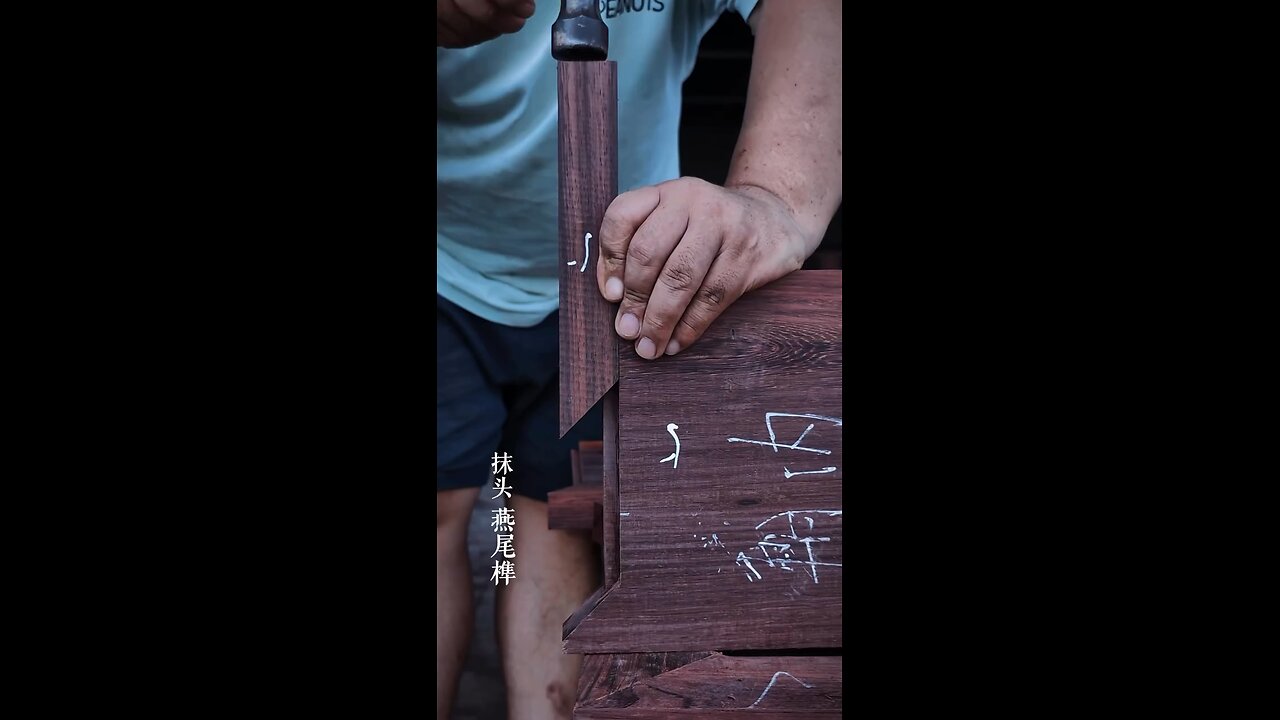
How Japanese Table Joinery Is Done
In traditional Japanese woodworking, furniture is often joined without screws or nails through a technique called joinery, which involves using precise, interlocking wooden joints. These joints rely on the wood's natural strength, the craftsmanship, and the materials to hold the structure together. Here are some key techniques used:
1. Dovetail Joints (Kiwari-iri)
These are interlocking joints where the ends of two pieces of wood are shaped into wedge-like projections (called tails) and corresponding slots (called pins), creating a strong, durable connection.
Common in drawer construction and small furniture pieces, dovetail joints resist pulling apart, making them ideal for tight-fitting connections.
2. Mortise and Tenon Joints (Ho-iro-no-tsugi)
One of the most fundamental joinery methods. In this technique, one piece of wood (the tenon) fits precisely into a cavity (the mortise) in another piece of wood.
These joints are often used in structural furniture, such as in the framework of tables or chairs.
3. Lapped Joints (Kake-iri)
In lapped joints, two pieces of wood are overlaid and then interlocked, often with a slight bevel on the edges. This allows the pieces to fit snugly together.
Sometimes, the ends of the pieces are shaped to form a stronger bond, increasing the joint's stability.
4. Tusk Tenon Joints (Kakebi)
A variation of the mortise and tenon, where a projecting tenon (with a rectangular or square shape) is inserted into the mortise and held in place by a pin or peg.
5. Japanese Wooden Pegs (Sujigake)
In some cases, after creating a joint, small wooden pegs are driven through both pieces of wood to secure them in place.
These pegs are often used in combination with other joinery techniques, like mortise and tenon, and can be a decorative feature.
6. Kanawa or Sliding Dovetail
This joint involves one piece of wood sliding into a matching channel or groove in the other piece. It's often used for drawer assemblies and certain types of paneling.
7. Shaped Joints
Sometimes, Japanese furniture may feature custom-shaped joints where the edges of the wood are intricately carved to create a strong bond without additional fastening materials.
These joinery methods are designed not only to provide strong, durable furniture but also to highlight the natural beauty of the wood grain and the craftsmanship. Japanese joinery is often seen in traditional furniture such as tatami mats, chests (tansu), and futons. Additionally, many of these techniques don't require glue, as the interlocking nature of the joints holds the pieces together through tension and friction.
The skill of traditional Japanese carpenters has been passed down for centuries, and it is a significant part of Japan's cultural heritage.
-
 1:35:27
Inverted World Live
10 hours agoLost Satellites, Wild Horses, and 3i/Atlas
154K6 -
 2:53:42
TimcastIRL
8 hours agoCandace Owens IMPLODES, Audience IN REVOLT, Claim SHES A CLONE Or GOT THE CALL | Timcast IRL
295K219 -
 2:49:53
Barry Cunningham
9 hours agoLIVE BREAKING NEWS: President Trump Celebrates Hanukkah! And More News
74.6K13 -
 1:29:40
Anthony Rogers
16 hours agoEpisode 394 - Isaac Butterfield
34.2K1 -
 8:02
8:02
China Uncensored
14 hours agoChina Just Took The First Step Towards WAR
48.9K25 -
 1:20:04
Flyover Conservatives
1 day agoWhy Did Jesus Really Come? It’s NOT What You Think - Pedro Adao | FOC Show
43.8K4 -
 2:18:25
DLDAfterDark
6 hours ago $3.52 earnedYo Homie! Is That My Briefcase?? EDC & Gun Talk - Blue Waffle Giveaway Pre Stream
34.8K4 -
 1:34:23
Glenn Greenwald
11 hours agoSydney Shooting Exploited for Pro-Israel Censorship and Anti-Muslim Crackdowns; How Media DEI Was the Opposite of Diversity | SYSTEM UPDATE #559
146K134 -
 1:09:01
MattMorseTV
10 hours ago $55.54 earned🔴Trump just handed Congress THE EVIDENCE.🔴
61.9K126 -
 1:01:54
BonginoReport
11 hours agoVanity Fair Goes Nuclear On Trump’s Inner Circle - Nightly Scroll w/ Hayley Caronia (Ep.198)
157K75