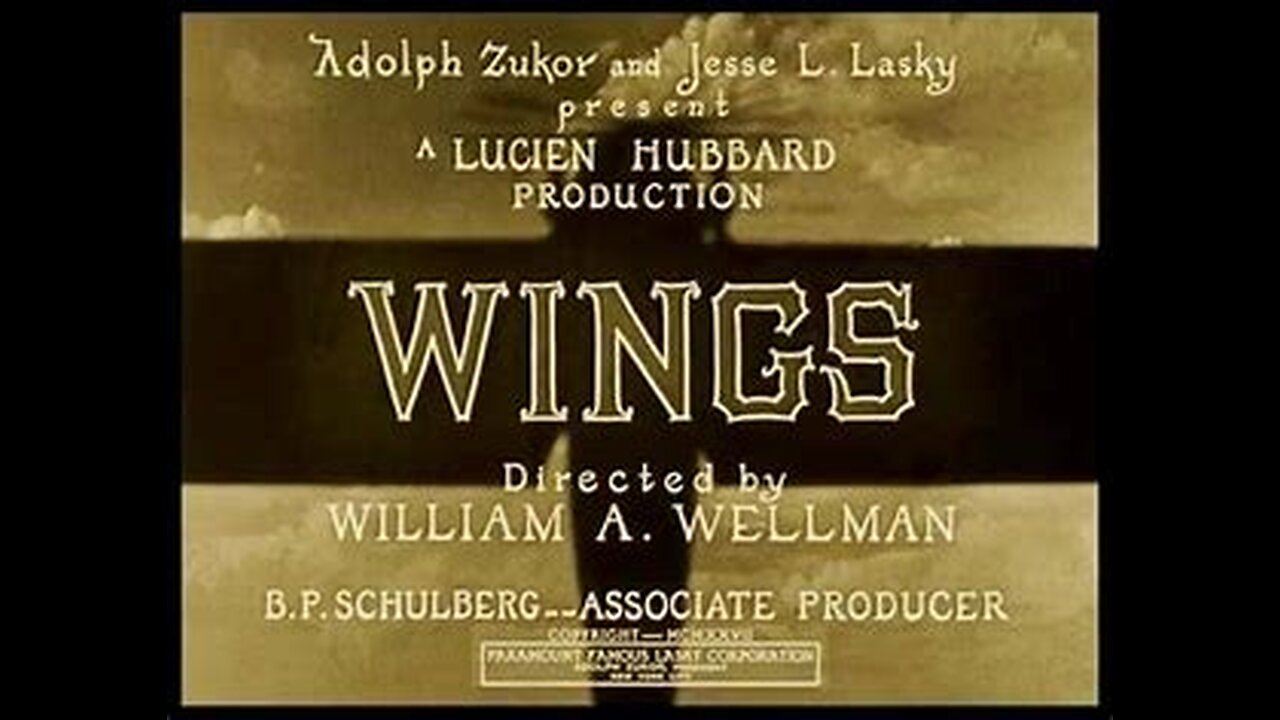
Wings (Silent, War, Drama, Romance, Action, 1927)
Wings (1927), directed by William A. Wellman, is a 144-minute silent film, the first to win the Academy Award for Best Picture. Set during World War I, it follows Jack Powell (Charles “Buddy” Rogers) and David Armstrong (Richard Arlen), two young men from a small American town who enlist as fighter pilots in the Army Air Service. Jack, a working-class dreamer obsessed with cars, and David, a wealthy romantic, are rivals for Sylvia Lewis (Jobyna Ralston), who loves David but is kind to Jack. Meanwhile, Mary Preston (Clara Bow), Jack’s spirited neighbor, secretly loves him. After training, the two men ship out to France, forming a deep friendship through the crucible of war. The film depicts their aerial dogfights, camaraderie, and personal struggles, with Mary joining the Women’s Army Corps as an ambulance driver. A tragic misunderstanding during a battle leads to a devastating incident, testing their bond. The story blends thrilling combat, romance, and heartbreak, culminating in a bittersweet homecoming. Clara Bow’s vivacious charm and the film’s spectacular air battles anchor its emotional core, exploring themes of duty, sacrifice, and unrequited love.Cast:Charles “Buddy” Rogers as Jack Powell: The eager, impulsive pilot.
Richard Arlen as David Armstrong: The introspective, privileged rival.
Clara Bow as Mary Preston: The lively “girl next door” and breakout star.
Jobyna Ralston as Sylvia Lewis: The refined love interest.
El Brendel as Herman Schwimpf: A comedic German-American recruit.
Gary Cooper as Cadet White: A brief but memorable role, launching his career.
Gunboat Smith as Sergeant: A minor role as a tough instructor.
Henry B. Walthall as David’s father.
Julia Swayne Gordon as David’s mother.
Facts:Production: Produced by Paramount Pictures for $2 million, Wings was a massive undertaking, filmed in Texas with extensive aerial sequences at Kelly Field. Wellman, a former WWI pilot, directed with authenticity, using real planes and stunt pilots. Over 300 pilots, 3,500 soldiers, and 65 planes were involved, with cameras mounted on aircraft for groundbreaking combat footage. Lucien Hubbard and Louis D. Lighton produced, with the script by Hope Loring and Louis D. Lighton, based on a story by John Monk Saunders.
Cinematic Style: The film’s aerial sequences, shot with innovative riggings and handheld cameras, remain a technical marvel, capturing dogfights with visceral clarity. Wellman’s direction balances spectacle with intimate character moments, using tinted intertitles (blue for night, sepia for day) and dynamic editing. Clara Bow’s charisma shines in comedic and romantic scenes, while the battle sequences, including a zeppelin attack and the Battle of Saint-Mihiel, are meticulously staged. The score, often performed live in theaters, enhanced the drama.
Reception and Legacy: Released August 12, 1927, Wings was a critical and commercial hit, grossing over $3.6 million. It won the first Best Picture Oscar (then called “Outstanding Picture”) and Best Engineering Effects at the 1929 Academy Awards. Critics praised its realism and emotional depth, though some noted its melodramatic romance. It influenced war films like Hell’s Angels (1930) and Top Gun (1986). Clara Bow’s role cemented her as a major star.
Preservation and Availability: A 2012 restoration by Paramount, with a re-recorded score by J.S. Zamecnik and sound effects, is available on Blu-ray, DVD, and streaming platforms like Paramount+, Amazon Prime, and Kanopy. The restored version recreates the original theatrical experience, including a synchronized organ score. The film is not in the public domain due to Paramount’s copyright.
Cultural Context: Made a decade after WWI, Wings reflects America’s fascination with aviation and war heroism, while subtly critiquing its costs through David and Jack’s losses. Wellman’s firsthand experience lent authenticity, though the film romanticizes the “knights of the air.” Clara Bow’s flapper energy and a brief nude scene pushed pre-Code boundaries, adding populist appeal. The film’s depiction of male friendship and subtle homoerotic undertones have been noted by modern scholars.
Wings is a landmark silent film, celebrated for its pioneering aerial cinematography, heartfelt performances, and epic scope. Its blend of action, romance, and tragedy makes it a timeless classic, still thrilling for its technical audacity and emotional resonance.
-
 1:47:05
Silver Screen Echoes
3 months agoJigsaw (Film noir, crime drama, 1949)
92 -
 LIVE
LIVE
TheSaltyCracker
1 hour agoAOC Goes Full Derp on World Stage ReeEStream 02-16-26
11,093 watching -
 LIVE
LIVE
Dr Disrespect
10 hours agoHEY! YOU GOT A PROBLEM!? | ARC Raiders
743 watching -
 47:33
47:33
The Sam Hyde Show
1 hour agoKen O'Keefe "This is War" | THE SAM HYDE SHOW #17
911 -
 LIVE
LIVE
Badlands Media
19 hours agoCulture of Change Ep. 139
268 watching -
 LIVE
LIVE
The Jimmy Dore Show
3 hours agoCandace Owens Drops Erika Kirk Trafficking Bombshell! Here's How Israel Runs US Elections!
9,664 watching -
 10:17
10:17
Clintonjaws
7 hours ago $0.19 earnedTrump and Tulsi Watch Kamala's Live Speech And Do THIS
2343 -
 LIVE
LIVE
SpartakusLIVE
3 hours ago#1 Presidential Monday MOTIVATION || Spooky Game Later??
163 watching -
 LIVE
LIVE
We Like Shooting
13 hours agoDouble Tap 449 (Gun Podcast)
127 watching -
 8:58
8:58
MattMorseTV
1 hour agoTrump was 10 STEPS AHEAD.
38010