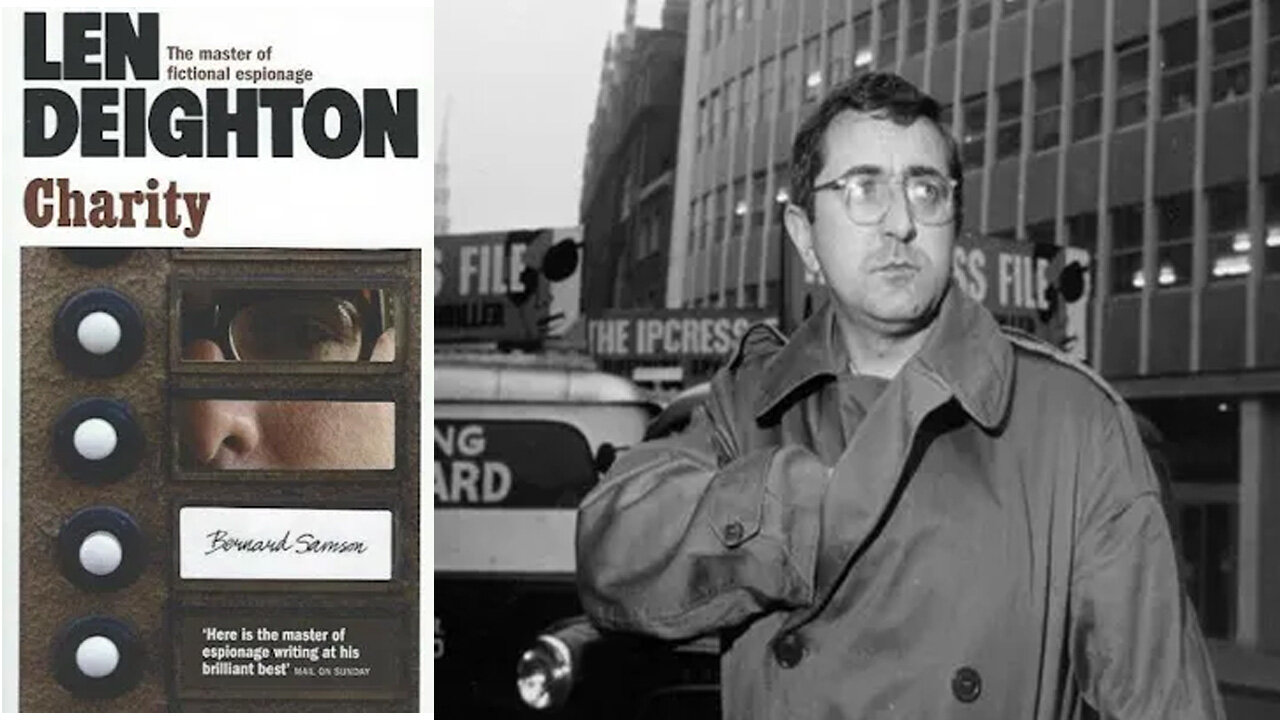
'Charity' (1996) by Len Deighton
'Charity' is the final book in Len Deighton’s Bernard Samson series — a sequence of ten novels that together form one of the most ambitious and psychologically astute espionage cycles in modern literature. As the concluding volume of the 'Faith', 'Hope', and 'Charity' trilogy (and the overarching 'Game', 'Set', and 'Match', 'Hook', 'Line', and 'Sinker', and 'Faith', 'Hope', and 'Charity' trilogies), 'Charity' bears the heavy burden of resolution. It must tie together the frayed threads of betrayal, loyalty, secrecy, and emotional damage that have defined Samson’s journey across Cold War Europe and the corridors of London’s MI6. Deighton, characteristically, does not deliver this resolution in the form of grand revelations or Hollywood-style climaxes. Instead, he offers something more ambiguous, more subtle — and, arguably, more honest.
Bernard Samson, the sardonic, battle-weary intelligence officer who has narrated most of the series, remains a man caught between two worlds: East and West, loyalty and pragmatism, marriage and infidelity, past and present. In 'Charity', he is still trying to make sense of the damage done by his wife Fiona’s defection to the East (and her subsequent return), the machinations of his MI6 superiors, and the legacy of his own father — once a legendary spy, now a shadow over Bernard’s conscience.
The central “plot” of 'Charity' is less important than its emotional and thematic concerns. There is espionage — yes — and a final operation to deal with a Stasi defector. But the novel’s heart lies elsewhere. It is about fallout: personal, professional, ideological. Bernard is looking for answers, but also for meaning — a way to reconcile what has happened to him and around him, and what part he has played in it. There are no clean victories in this world. Spying is not about glamour, but exhaustion. Deighton understands this profoundly.
As always, the strength of Deighton’s work lies not in plot twists but in character and atmosphere. Bernard’s voice is dry, intelligent, and deeply human. His reflections on the bureaucratic games within MI6 — the backstabbing, the petty rivalries, the institutional hypocrisy — are as cutting as ever. So too are his insights into personal relationships: his fraught entanglement with Fiona, his complicated romance with Gloria, and his faltering attempts to protect those he loves while still serving a machine that does not love him back.
What makes 'Charity' particularly effective as a conclusion is its refusal to offer easy closure. Some questions are answered. Others are not. The spy world Deighton has constructed over ten novels is one in which truth is often provisional, and justice rarely served. Bernard does not walk away victorious — but he does walk away with clarity, perhaps even peace. The final chapters have a bittersweet quietude, as the Cold War itself draws to an end and Bernard — like many real-life intelligence officers of the era — finds himself wondering what it was all for.
'Charity' is a novel about endings — not just of careers or relationships, but of an age. The Berlin Wall has fallen, and the certainties that once underpinned the West’s espionage game have crumbled. The finality of the book mirrors the collapse of that entire ideological theatre. Deighton’s choice to end not with a bang but with a sigh feels entirely appropriate. It is, in many ways, a story about the impossibility of definitive conclusions — in love, in politics, in history.
In literary terms, 'Charity' showcases Deighton at his most mature and controlled. His prose is spare but precise. Dialogue is sharp. Exposition is handled deftly. But the real triumph lies in how he manages long-form character development — a rarity in spy fiction, where characters are often sacrificed for pace. Bernard Samson, by the end of 'Charity', feels as real and flawed as any protagonist in serious literary fiction.
In conclusion, 'Charity' is a quiet, contemplative, and fitting end to a monumental espionage saga. It doesn’t try to outdo the earlier books in spectacle, but rather deepens them in resonance. Deighton leaves his readers not with dramatic fireworks, but with something far more enduring: the image of a man who has survived the Cold War, and who now must learn to survive the peace. For fans who have followed Bernard Samson from the beginning, 'Charity' is not just a conclusion — it is a reckoning.
-
 1:51:32
Candace Owens
2 hours agoCandace x Bassem Youssef | Candace Ep 298
33.9K44 -

Kim Iversen
2 hours agoTPUSA INFILTRATED by Mossad: Strange Behavior and Sexpionage?
37.3K64 -
 1:36:15
Redacted News
3 hours agoBREAKING! They are HIDING the Epstein files on purpose, DOJ and Pam Bondi
114K136 -
 LIVE
LIVE
Decoy
2 hours agoHe's panicking now
337 watching -
 1:59:26
The Quartering
4 hours agoRIOT FUNDING EXPOSED! NINTENDO GETS WOKE & VILE PROTESTOR GOES VIRAL FOR THE WRONG REASONS
205K72 -
 1:05:43
DeVory Darkins
6 hours agoTim Walz BLINDSIDED by Minnesota County Sheriff after DISASTROUS interview
171K117 -
 1:01:17
Timcast
7 hours agoDemocrats THREATEN Government SHUTDOWN Over ICE Reform
206K90 -
 58:57
58:57
Cyrus Janssen
2 days agoWhy Greenland? Military, Resources & The Arctic Race With Patrick Lancaster
47.7K14 -
 2:10:48
iCkEdMeL
7 hours ago $1.57 earnedRUMBLE PREMIUM LIVE: Breaking News, Unfiltered Coverage & Open Hangout
39.6K -
 2:59:49
Wendy Bell Radio
11 hours agoTruckloads Of Evidence
100K118