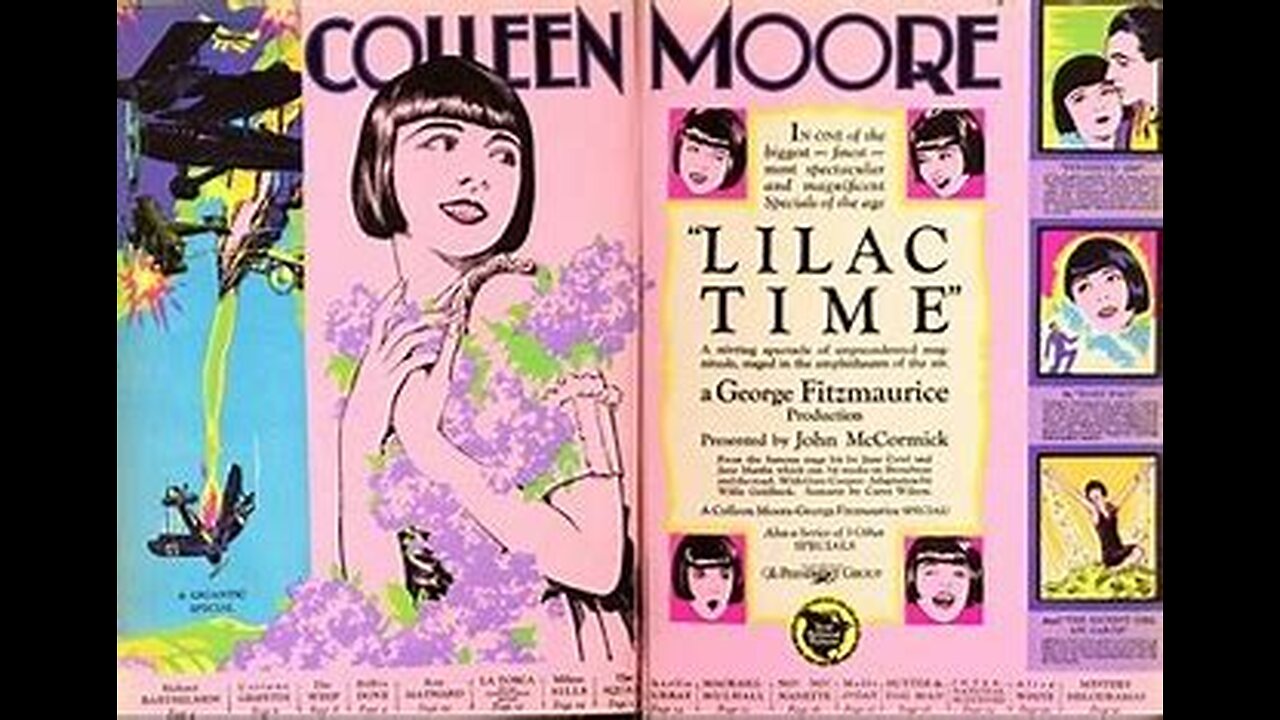
Lilac Time (Silent War Drama, 1928)
Lilac Time (1928) is set during World War I and follows a group of young American aviators fighting for Britain, billeted at a French farmhouse near the front. The story centers on Jeannine Berthelot (Colleen Moore), the farmer’s daughter, who forms a bond with the pilots, particularly Captain Philip Blythe (Gary Cooper), a replacement pilot. Their relationship begins with playful antagonism—Jeannine stands in the middle of Philip’s makeshift runway during his landing—but soon blossoms into romance. As the pilots embark on a dangerous mission, Philip promises to return to Jeannine. He is shot down in a dramatic aerial battle with the German "Red Ace" (Eddie Clayton), and Jeannine helps rescue him from the wreckage, believing him dead. Unable to accompany him, she later tracks him to a military hospital in Paris, where incorrect records indicate he has died. In a poignant climax, Jeannine sends lilacs to his room as a tribute, only for Philip, barely alive, to recognize the flowers and call her back, reuniting them. The film blends slapstick comedy, intense romance, and thrilling aerial sequences, though its sentimentality has been noted by critics.
Cast:Colleen Moore as Jeannine Berthelot: A charming and expressive actress, known for her flapper roles, who brings both comedic and dramatic depth to the role.
Gary Cooper as Captain Philip Blythe: A rising star in his first major role, delivering a charismatic performance as the dashing pilot.
Burr McIntosh as General Blythe
Eugenie Besserer as Madame Berthelot: Previously played a motherly role in Moore’s Little Orphant Annie.
George Cooper as Sergeant Hawkins, the mechanic’s helper (no relation to Gary Cooper)
Cleve Moore as Captain Russell: Colleen Moore’s brother.
Jack Stoney as The Kid: Colleen Moore’s cousin, credited as Jack Stone.
Arthur Lake as The Unlucky One
Kathryn McGuire as Lady Iris
Edward Dillon as Corporal Smithie
Emile Chautard as The Mayor
Edward Clayton as The Enemy Ace
The film’s romantic and melodramatic tone, combined with its aviation focus, reflects the post-WWI nostalgia of the late 1920s, similar to The Big Parade and Wings.
-
 56:26
56:26
Silver Screen Echoes
1 month agoDark Mountain (Film noir, Crime drama, 1944)
29 -
 LIVE
LIVE
Badlands Media
3 hours agoBadGaming
572 watching -
 18:17
18:17
Nikko Ortiz
2 days agoMilitary Clips Gone Wrong #2...
51.7K8 -
 1:58:15
Right Side Broadcasting Network
7 hours agoLIVE: President Trump Holds a Bilateral Meeting with Ukrainian President Zelenskyy - 12/28/25
211K71 -
 LIVE
LIVE
Astral Doge Plays!
7 hours agoZelda: A Link tothe Past ~LIVE!~ A New Legend Begins
128 watching -
 LIVE
LIVE
NeoX5
3 hours agoNaughty Dog Christmas Wrap-up with Uncharted! | Holiday Rush Ep 16 | Rumble Gaming
83 watching -
 30:54
30:54
The Rubin Report
14 hours agoThe Real Story Behind the Film the Gov’t Doesn’t Want You to See | Dan Farah
172K118 -
 LIVE
LIVE
WorldofGaming
2 days agoTHE THRILLING PAPER MARIO RACE! (PT.3)
62 watching -
 18:04
18:04
tactical_rifleman
1 day ago $7.69 earnedThermal Optics for Old Guys | Tactical Rifleman
64K10 -
 LIVE
LIVE
Ouhel
8 hours agoSUNDAY | ARC Raiders | O'HELL LIVE | Continue the journey!
104 watching