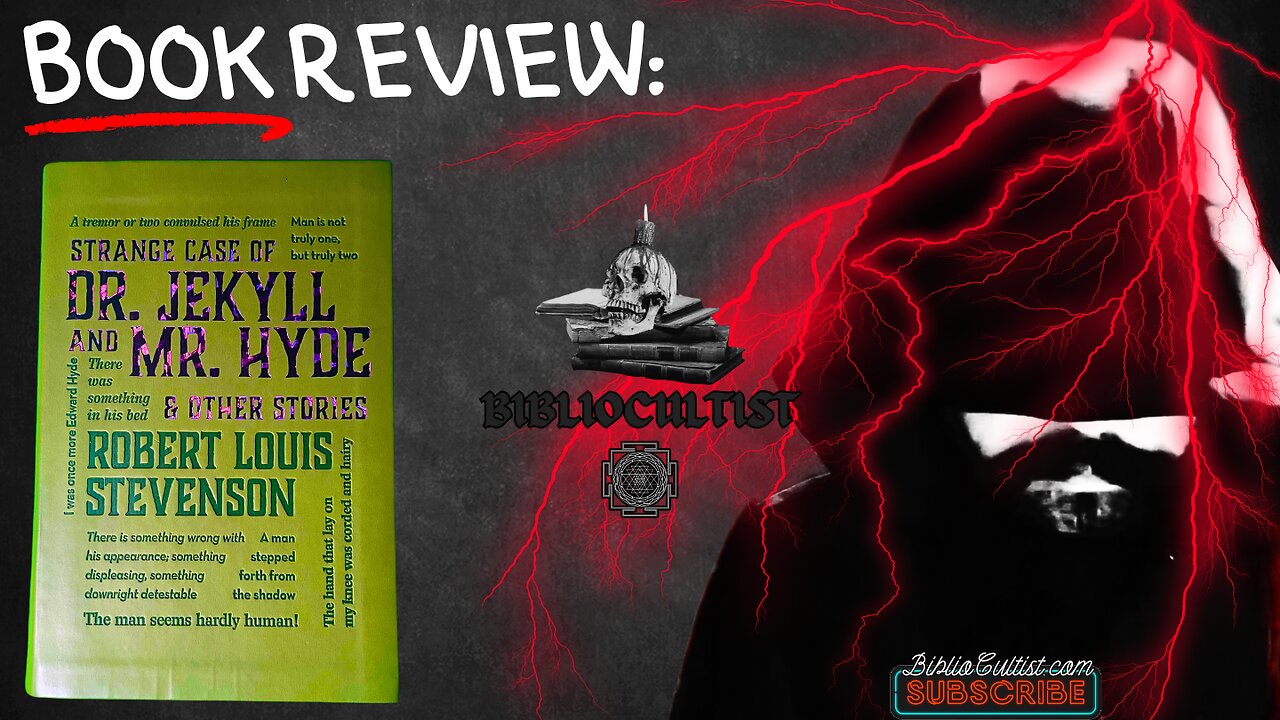
Dr Jekyll, Murder, and Medieval Madness: Reviewing Stevenson’s Dark Tales of Duality & Danger
**DONATE HERE IF YOU WISH TO HELP FUND THIS PROJECT: http://ko-fi.com/bibliocultist**
In this #bookreview, I review a powerful collection featuring Strange Case of Dr Jekyll and Mr Hyde, The Suicide Club, The Rajah’s Diamond, The Pavilion on the Links, and A Lodging for the Night — stories united by danger, moral ambiguity, and the shadowy depths of human nature. Written as part of or inspired by Stevenson’s New Arabian Nights, these tales blend exotic adventure with Gothic horror, secret societies, split identities, and medieval violence, all wrapped in rich, atmospheric prose. I explore how Stevenson uses the frame of storytelling — one night, one tale — to probe deep philosophical questions: What happens when the soul and body separate? Can a man be both good and evil? And how thin is the line between civilization and chaos? From the foggy streets of London to the cold brutality of 15th-century France, this collection reveals Stevenson not just as a master of adventure, but as a pioneer of psychological fiction.
#RLStevenson #DrJekyllAndMrHyde #TheSuicideClub #TheRajahsDiamond #ThePavilionOnTheLinks #ALodgingForTheNight #NewArabianNights #ClassicLiterature #GothicFiction #PsychologicalHorror #VictorianLiterature #LiteraryAnalysis #DarkTales #MoralDuality #ClassicBooks #PhilosophicalFiction #booktok #booktube #biblio #cultist #bibliocultist
**SHOW NOTES**
1. Robert Louis Stevenson (1850–1894) was a Scottish writer whose innovative storytelling profoundly shaped modern literary genres. He is widely credited with inventing the modern adventure novel through Treasure Island (1883), a work that established enduring tropes of pirate lore—such as treasure maps, tropical islands, and the complex antihero—becoming a blueprint for generations of adventure fiction. His novella Strange Case of Dr Jekyll and Mr Hyde revolutionized Gothic and psychological fiction, introducing a powerful narrative of dual identity that influenced horror, science fiction, and existential literature, while embedding the concept of the "split self" into popular culture. A master of atmosphere, suspense, and moral ambiguity, Stevenson bridged Romanticism and modernism, leaving a lasting legacy on fantasy, horror, and adventure writing.
2. Robert Louis Stevenson didn’t just draw inspiration from One Thousand and One Arabian Nights — he deliberately set out to create a 19th-century Western version of it. In 1878, he published New Arabian Nights, a collection in which he openly declared his ambition: to craft a series of thrilling, interconnected tales framed within a narrative structure reminiscent of Scheherazade’s legendary storytelling. Like the original Arabian Nights, Stevenson’s work uses a layered format — stories told within stories, often over successive nights — uniting adventure, mystery, and moral ambiguity under a single literary spell. "The Suicide Club," "The Rajah’s Diamond," and "A Lodging for the Night" are all part of this deliberate project: not merely standalone tales, but chapters in Stevenson’s self-proclaimed New Arabian Nights.
3. During Robert Louis Stevenson’s time, a profound philosophical and scientific shift was underway regarding the human body: the growing view of it as a biological machine, governed by physical laws rather than sacred mystery. Influenced by advances in anatomy, physiology, and Darwinian evolution, many 19th-century thinkers began to see the body not as a temple of the soul, but as a complex mechanism that, once it ceased functioning, lost all intrinsic meaning or sanctity. This mechanistic worldview opened the door to widespread dissection, medical experimentation, and the clinical study of corpses—practices that had long been restricted by religious and cultural taboos.
4. In Christian theology, the body is not a mere vessel for the soul but an essential part of human identity. Unlike philosophies that view the body as a prison for the soul, orthodox Christianity teaches that the body is good, created by God, and destined for resurrection. After death, the soul may continue in an intermediate state, but this separation is incomplete and unnatural — the soul without the body is in a state of longing, not fulfillment. Full restoration comes only at the resurrection of the dead, when body and soul are reunited in glorified form, as affirmed in creeds like the Apostles’ and Nicene.
5. "A Lodging for the Night" by Robert Louis Stevenson is a work of historical fiction set in 15th-century France during a turbulent period marked by the aftermath of the Hundred Years' War and the reign of King Louis XI (r. 1461–1483), a central figure in the story. The tale captures the lawlessness and political intrigue of the late Middle Ages, a time when France was fragmented by feuding nobles, mercenary bands (routiers), and a weakened central authority struggling to consolidate power.
-
 20:43
20:43
Stephen Gardner
18 hours agoTrump CRUSHES Tim Walz: Ilhan Omar Fraud Ties Surface
8.96K53 -
 1:01:00
HotZone
13 days ago"Teen Trend" Takeovers: Chaos Exploding Across America’s Cities
1781 -
 LIVE
LIVE
Side Scrollers Podcast
2 hours agoNetflix/WB Will RUIN Entertainment + Anita Sarkessian “doesn’t deserve hate” + More | Side Scrollers
530 watching -
 UPCOMING
Badlands Media
9 hours agoGeopolitics with Ghost Ep. 63 - December 9, 2025
4.95K1 -
 58:19
58:19
Timcast
2 hours agoCandace Owens Is A Spiritual Leftist
124K165 -
 2:08:18
Steven Crowder
4 hours agoBe Careful - Woke Isn't Dead Yet & Netflix Proves It
342K181 -
 LIVE
LIVE
Barry Cunningham
1 hour agoBREAKING LIVE: President Trump Hits The Road! What To Expect | Time For The Rise Of REAL MAGA!
1,267 watching -
 LIVE
LIVE
Sean Unpaved
2 hours agoKevin Stefanski Names Shedeur Sanders STARTING QB For Rest Of Season! | UNPAVED
90 watching -
 58:55
58:55
The Rubin Report
3 hours agoBill Maher Makes Ana Kasparian Squirm by Refusing to Let Her Avoid This Question
32.6K33 -
 6:13
6:13
Buddy Brown
2 hours ago $0.69 earnedThis is Why Everyone's GOOGLING December 19th! | Buddy Brown
5.97K5