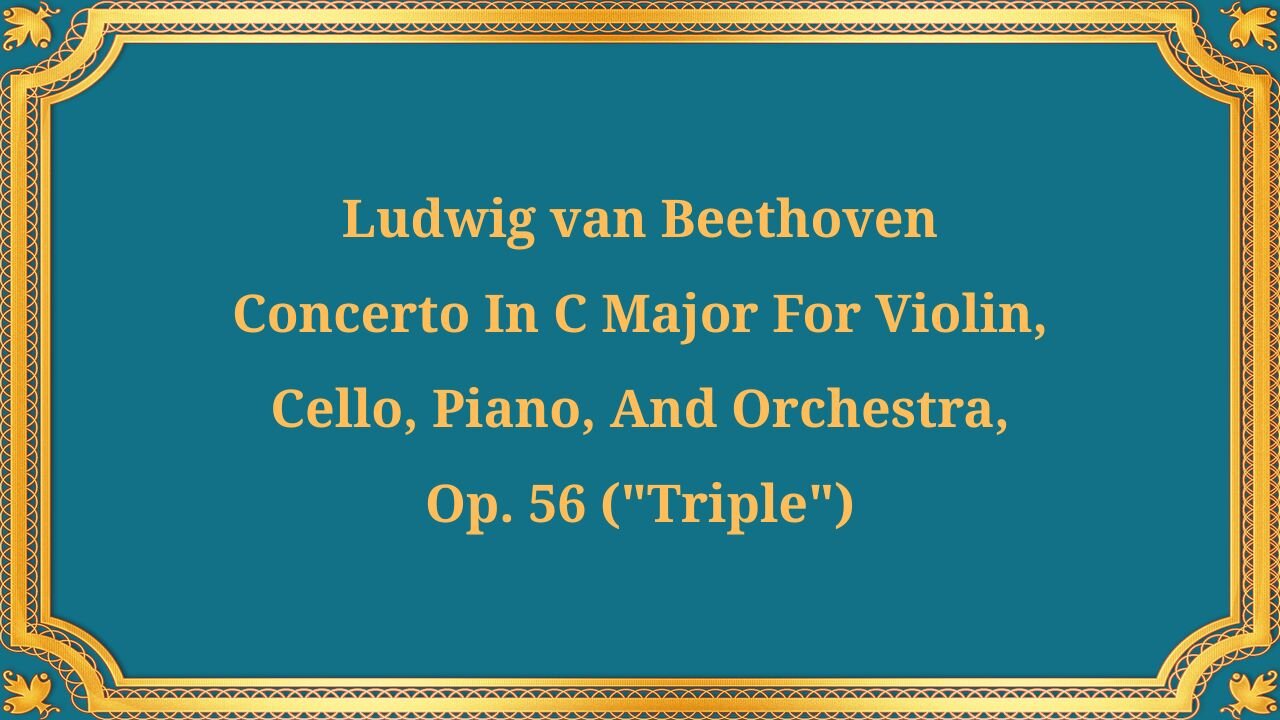
Ludwig van Beethoven's Concerto in C major for Violin, Cello, Piano, and Orchestra, Op. 56
#Beethoven #TripleConcerto #ClassicalMusic #Concerto #Ensemble #RareRepertoire #RareEdition
Publication date 1949
John Corigliano; Leonard Rose; Walter Handl; Bruno Walter; New York Philharmonic
Among Ludwig van Beethoven's large-scale symphonies and solo concertos, his Concerto for Violin, Cello, Piano, and Orchestra in C major, Op. 56, known as the "Triple Concerto," occupies a special place. This work, composed around 1803-1804, stands at the crossroads of genres, combining the chamber intimacy of an ensemble with the monumentality of an orchestral concerto.
The Triple Concerto was written during the fruitful period when Beethoven was working on his Eroica Symphony. Despite this, the concerto's music is devoid of heroic pathos and drama, exuding rather a noble, classical calm and melodic generosity. The composer found an elegant solution to the complex task of balancing three powerful solo instruments, each with a unique timbre and range.
The concerto's structure is traditional and consists of three movements:
Allegro—a large-scale first movement, in which the orchestra and soloists engage in a rich dialogue. The main theme, presented by the orchestra, is full of dignity and energy, while the three soloists alternately take up and develop the musical material, sometimes competing with, sometimes complementing, one another.
Largo—the lyrical center of the work. This movement is a heartfelt song-and-ariosa statement, in which the cello is particularly expressive, setting a melancholic, pensive tone. Rondo alla Polacca is a finale in the rhythm of a polonaise. A joyful, graceful, and virtuosic movement that brings the concerto to a brilliant and uplifting conclusion. Here, the soloists demonstrate their technical prowess, and the music is filled with light and grace.
Historically, the Triple Concerto is associated with Beethoven's patron, Archduke Rudolf, who was his student and likely played the piano part. This explains the somewhat restrained pianistic complexity compared to the composer's other concertos.
As a result, the Triple Concerto remains a unique phenomenon in world music. It is not simply a concerto for three instruments, but a brilliantly constructed dialogue between equal partners, the embodiment of the idea of unity and harmony. It offers the listener not a struggle between soloist and orchestra, but their collaboration, revealing the multifaceted genius of Beethoven in creating complex yet incredibly balanced musical forms.
-
 21:40
21:40
Classical music_Music Inspiration
18 days agoEugène d'Albert Cello Concerto in C major, Op. 20
571 -
 1:56:44
Benny Johnson
2 hours agoBOMBSHELL: Confirmed Proof Biden FBI Identified Pipe Bomber in 2021, Cover Up EXPOSED In New Docs
47.7K35 -
 LIVE
LIVE
Trumpet Daily
56 minutes agoTrumpet Daily LIVE | Dec. 9, 2025
403 watching -
 LIVE
LIVE
Daniel Davis Deep Dive
5 hours agoCol Doug Macgregor: Ukraine Won't Give Up Land
104 watching -

Grant Stinchfield
1 hour agoAirport Wellness or Taxpayer Wallet Waste? Airports Need Health... Not Handouts!
1.52K -
 1:38:10
Graham Allen
4 hours agoTim Pool Is Going Underground Due To Safety! We ALL Will Soon! The Breaking Point Is Here!
141K656 -

Chad Prather
2 hours agoWhat The Bible Says About Grief & Is Erika Kirk A Good Example? + Bible Q&A & Top Stories!
12K15 -
 2:32:32
Matt Kohrs
15 hours agoLive Trading Market Open (Futures & Options) || The Matt Kohrs Show
24.9K1 -
 1:14:43
The Illusion of Consensus
1 day agoModern Dating is a DISASTER — Evolutionary Psychologist Explains Why
20.5K -
 1:18:50
The Big Mig™
3 hours agoIlhan & Tampon Tim Turned Minnesota Into Mogadishu”s ATM
11.8K9