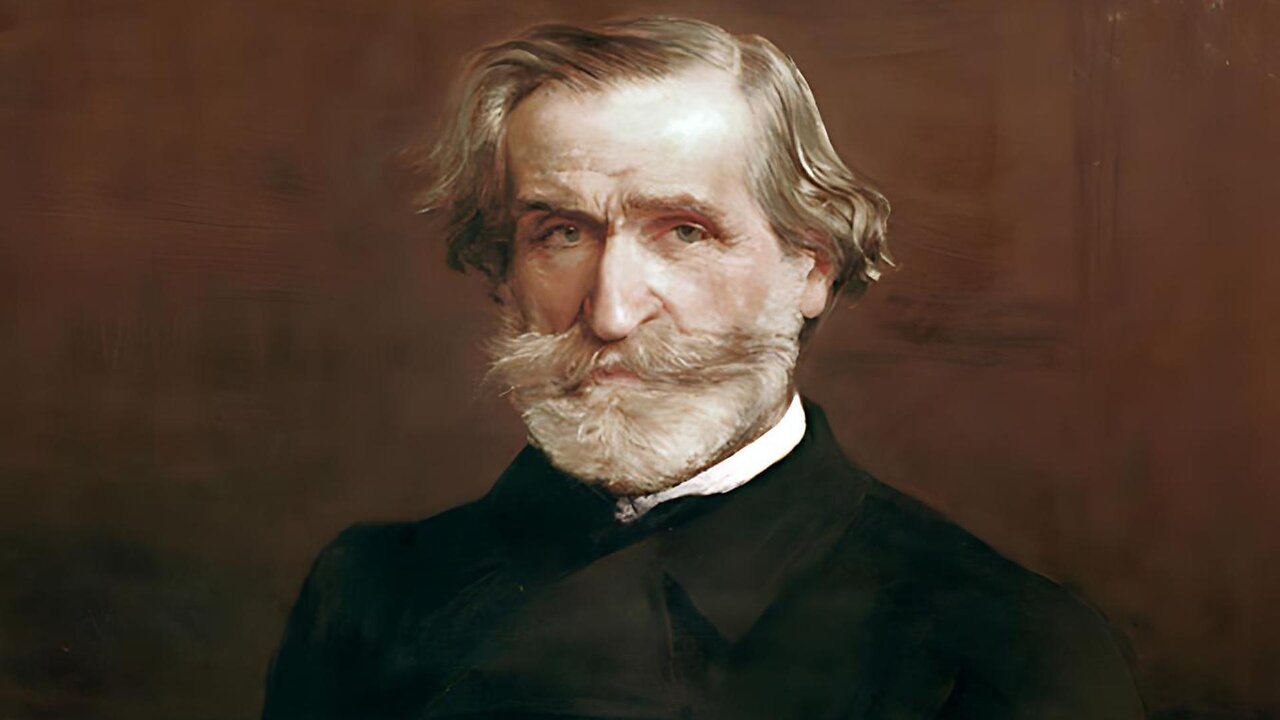
La Storia siamo Noi: Giuseppe Verdi (ENG SUB)
Giuseppe Fortunino Francesco Verdi, known as Giuseppe (le Roncole di Busseto, 10 October 1813 – Milan, 27 January 1901), was an Italian composer and politician. He is globally recognized as one of the greatest opera composers and opera composers of all time, along with other protagonists of 19th-century Italian musical theatre: Gioachino Rossini, Vincenzo Bellini, Giacomo Puccini, and Gaetano Donizetti.
He sympathized with the Risorgimento movement that pursued Italian unification and even briefly participated actively in political life. Over the course of his long life, he established a unique position among his compatriots, becoming a profound artistic symbol of the country's unity. For this reason, a month after his death, a solemn and immense procession passed through Milan, accompanying his remains with the strains of "Va pensiero," the chorus of Jewish slaves from Nabucco, which he had written 60 years earlier, effectively expressing the feelings of Italians toward their lost hero. This demonstrated the extent to which Verdi's music had been assimilated into the national consciousness.
A meticulous composer, gifted with an exceptional dramatic sensibility that he further refined over the years, Verdi was an experimenter throughout his life, striving for ever higher goals and endowed with an uncommon critical sense, which allowed him to satisfy the tastes of an increasingly demanding audience without ever renouncing his own convictions as a man and an artist.
Early in his career, Verdi wrote music for the Busseto Philharmonic Society (vocal music, band music and chamber music, including an alternative overture to Rossini's The Barber of Seville), although much of it has not survived. The first study of Verdi's music, published in 1859 by the Italian critic Abramo Basevi, already divided his musical production into four periods. The first period, "grandiose" according to Basevi, ends with La battaglia di Legnano (1849), while a style defined as "personal" begins with the next opera, Luisa Miller. These two operas are generally accepted by critics as the dividing point between Verdi's early and middle periods. The "middle" period ends with La traviata (1853) and Les Vêpres siciliennes (1855), while the "late" period tends to coincide with Simon Boccanegra (1857) through Aida (1871). The last two operas, Otello and Falstaff, together with the Requiem and the four sacred pieces, constitute the works of the "final" period.
His works remain among the best known and most performed in theatres around the world, in particular Aida (1871), the aforementioned Nabucco (1842) and the so-called "Popular Trilogy": Rigoletto (1851), Il trovatore (1853) and La traviata (1853).
-
 2:02:39
Adaneth - Arts & Literature
2 days agoLa Bohème | Scotto, Pavarotti, Wixell - Levine, Pizzi (MET 1977 - MULTISUB)
162 -
 1:32:46
Glenn Greenwald
5 hours agoHillary Blames TikTok for Anti-Israel Sentiment; MAGA Sycophants Gain Pentagon Press Access; Who Should Win Anti-Semite of the Year? See the Top 10 Finalists | SYSTEM UPDATE #552
109K86 -
 56:12
56:12
Flyover Conservatives
22 hours ago100% Chance the Grid Fails: Why No One Is Fixing It (and How Easy It Is) - Tommy Waller | FOC Show
11.9K4 -
 LIVE
LIVE
JDubGameN
3 hours agoStarlink Network Test Stream! | Road to 100 Followers
227 watching -
 2:17:31
The Daily Signal
6 hours ago $0.21 earned🚨BREAKING: Tennessee Congressional Election Results, Minneapolis Police to "Intervene" Against ICE,
16.8K6 -
 1:52:47
megimu32
2 hours agoON THE SUBJECT: Christmas Vacation Is UNTOUCHABLE!
9.99K4 -
 59:56
59:56
Sarah Westall
4 hours agoNeurostrike, Cognitive Targeting & the New Tech Arms Race w/ Professor Armin Krishnan
9.77K2 -
 2:52:28
Nikko Ortiz
5 hours agoNo More Gear Fear... | Rumble LIVE
18.6K1 -
 LIVE
LIVE
Razeo
3 hours agoTopside carnage with some fries.,
20 watching -
 1:03:17
BonginoReport
6 hours agoViolent Criminals Run Free in NY & CA - Nightly Scroll w/ Hayley Caronia (Ep.188) - 12/02/2025
121K39