Infinite Sequence, Definition, Convergence, Practice Problems - Calculus
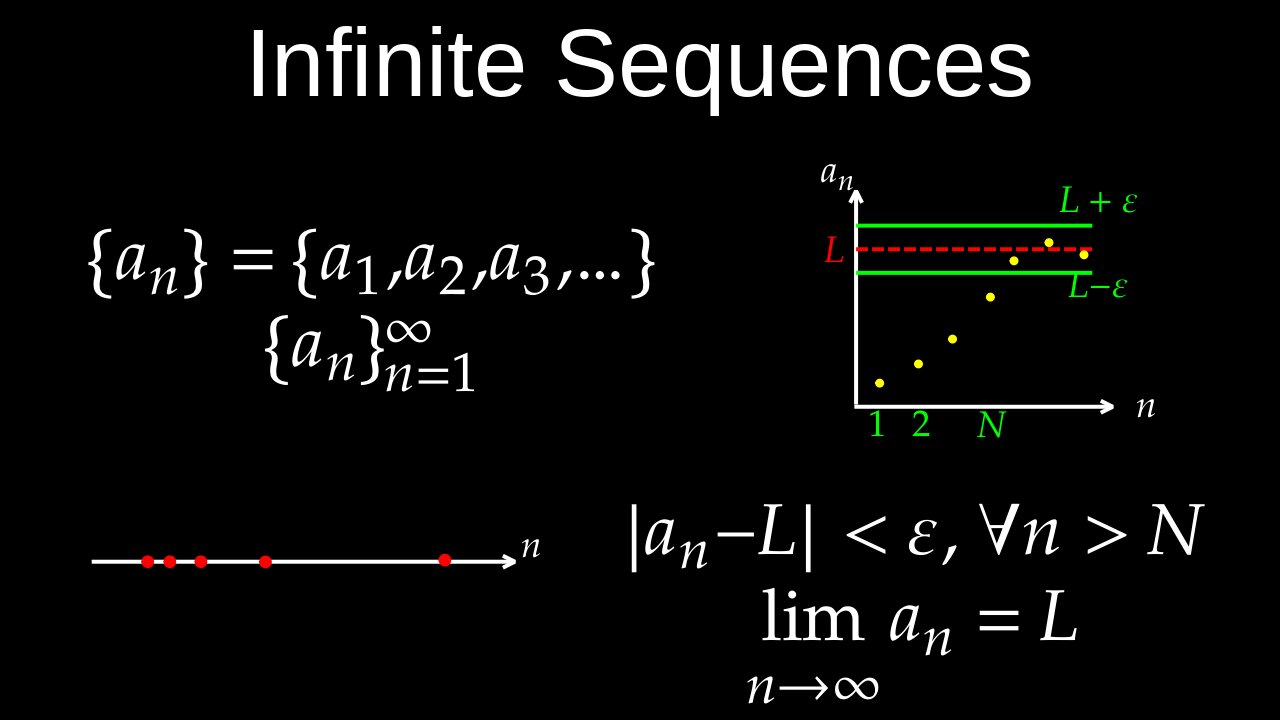
An infinite sequence converges if its terms approach a specific, finite number (its limit) as the index \(n\) approaches infinity. An infinite sequence diverges if the limit does not exist, or if it increases or decreases without bound. To determine convergence, you find the limit of the sequence's general term as \(n\) approaches infinity; if this limit is a finite number, the sequence converges to that number.
💡Convergent sequences
• Definition: A sequence \(a_{n}\) converges to a limit \(L\) if \(\lim _{n\rightarrow \infty }a_{n}=L\), where \(L\) is a finite number.
• Meaning: As \(n\) gets larger and larger, the terms of the sequence get closer and closer to \(L\).
• Example: The sequence \(a_{n}=1/n\) converges because as \(n\) approaches infinity, \(1/n\) approaches \(0\).
💡Divergent sequences
• Definition: A sequence diverges if it does not have a finite limit.
• Meaning: The terms of the sequence either:
⚬Do not approach a single, finite value.
⚬Increase or decrease without any upper or lower bound (i.e., go to infinity).
• Example: The sequence \(a_{n}=n^{2}\) diverges because as \(n\) approaches infinity, the terms grow infinitely large.
💡Worksheets are provided in PDF format to further improve your understanding:
• Questions Worksheet: https://drive.google.com/file/d/1DlYi7xcmyEAhWTnwUN8zRgisBdHIdmtr/view?usp=drive_link
• Answers: https://drive.google.com/file/d/1VEHFVDs67vvvQVVsozjmOCO5RbEgzbkA/view?usp=drive_link
💡Chapters:
00:00 Infinite sequences
00:57 Convergence
02:15 Worked examples
🔔Don’t forget to Like, Share & Subscribe for more easy-to-follow Calculus tutorials.
🔔Subscribe: https://rumble.com/user/drofeng
_______________________
⏩Playlist Link: https://rumble.com/playlists/Ptm8YeEDb_g
_______________________
💥 Follow us on Social Media 💥
🎵TikTok: https://www.tiktok.com/@drofeng?lang=en
𝕏: https://x.com/DrOfEng
🥊: https://youtube.com/@drofeng
-
 LIVE
LIVE
BenderOdoyle
3 hours agoBO7 - with Friends, The Return
32 watching -
 17:17
17:17
Fit'n Fire
3 hours ago $0.31 earnedDraco Owners Won't Like This...Zastava M85 & M92 Are Better
4.33K2 -
 LIVE
LIVE
NSSKEnt
6 hours ago5 Mil Easy | Max Level EASY | ARC Raiders
45 watching -
 LIVE
LIVE
Sami Mikata
2 hours agoZombie Army 4 Dead War Live Stream
61 watching -
 52:02
52:02
MattMorseTV
4 hours ago $65.41 earned🔴It’s happened 4 TIMES in 48 HOURS.🔴
120K356 -
 29:51
29:51
Stephen Gardner
20 hours agoYou'll NEVER Believe What Gavin Newsom Just Did to Elon Musk!
112K110 -
 32:45
32:45
Degenerate Plays
6 hours ago $0.43 earnedJanuary 6th The Level? The Chinoman Needs Cortussy - Call of Duty: Modern Warfare 2 (2009) : Part 12
5.42K -
 2:48:52
Game On!
1 day ago $12.28 earnedNFL Week 15 Wiseguy Roundtable BEST BETS!
209K15 -
 56:09
56:09
Athlete & Artist Show
2 days ago $1.57 earnedLIVE GAMES: WATCH US GET TO $10K!
19.6K -
 4:53:49
Joe Donuts Live
10 hours agoThe Mystery Deepens in Alan Wake | Episode 3 |Uncovering the Truth Behind the Darkness
37.9K1