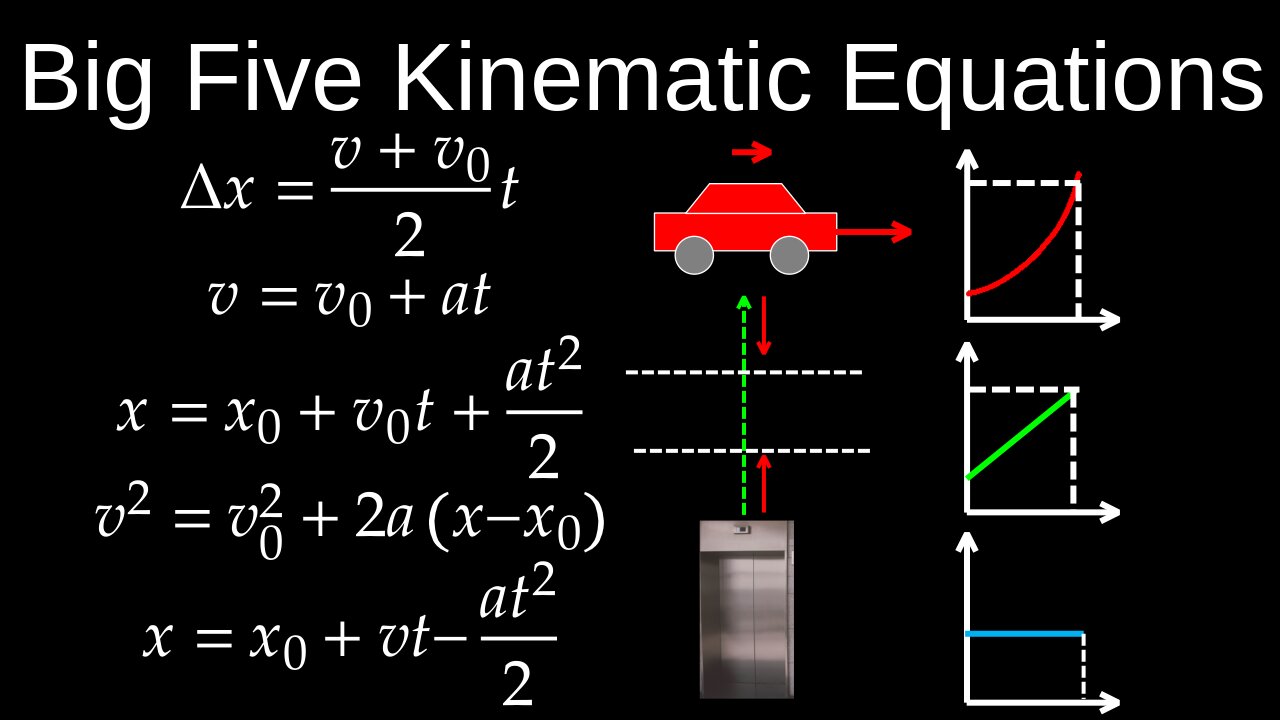
Big Five Kinematics, Uniform Acceleration, How to Select, Intervals, Objects - Physics (Mechanics)
The "big five" in kinematics refers to the five key quantities used to describe motion with constant acceleration: displacement (\(\Delta x\)), initial velocity (\(v_{i}\)), final velocity (\(v_{f}\)), acceleration (\(a\)), and time (\(t\)). These five quantities are interconnected by five fundamental kinematic equations, allowing you to solve for an unknown variable if you know the other four.
💡The five kinematic quantities
• Displacement (\(\Delta x\) or \(s\)): The change in an object's position, measured in meters (m).
• Initial velocity (\(v_{i}\) or \(u\)): The velocity of an object at the beginning of a time interval, measured in meters per second (m/s).
• Final velocity (\(v_{f}\) or \(v\)): The velocity of an object at the end of a time interval, measured in meters per second (m/s).
• Acceleration (\(a\)): The rate at which velocity changes, measured in meters per second squared (\(m/s^{2}\)).
• Time (\(t\)): The duration of the motion, measured in seconds (s).
💡The five kinematic equations
These equations apply when acceleration is constant.
• \(v_{f}=v_{i}+at\)
• \(\Delta x=v_{i}t+\frac{1}{2}at^{2}\)
• \(v_{f}^{2}=v_{i}^{2}+2a\Delta x\)
• \(\Delta x=\frac{1}{2}(v_{i}+v_{f})t\)
• \(v_{avg}=\frac{v_{i}+v_{f}}{2}\) and \(\Delta x=v_{avg}t\) (when acceleration is constant, average velocity is the arithmetic mean of the initial and final velocities)
💡How to use the big five
• Identify the known and unknown variables in a given problem.
• Select the equation that contains the known variables and the one you want to find.
• Solve the equation for the unknown variable.
💡Worksheets are provided in PDF format to further improve your understanding:
• Questions Worksheet: https://drive.google.com/file/d/1FZHK2lvewIfauVNmVxQprxLvhBZfVv02/view?usp=drive_link
• Answers: https://drive.google.com/file/d/1h8pFAHvhQo5qqSPsfYA9GETrdjMQg8z8/view?usp=drive_link
💡Chapters:
00:00 Big five kinematic equations
02:26 Selecting kinematic equations, multiple intervals
04:34 Selecting kinematic equations, multiple objects
06:02 Worked examples
🔔Don’t forget to Like, Share & Subscribe for more easy-to-follow Calculus tutorials.
🔔Subscribe: https://rumble.com/user/drofeng
_______________________
⏩Playlist Link: https://rumble.com/playlists/d3cTgspk0Ro
_______________________
💥 Follow us on Social Media 💥
🎵TikTok: https://www.tiktok.com/@drofeng?lang=en
𝕏: https://x.com/DrOfEng
🥊: https://youtube.com/@drofeng
-
 1:07:27
Inverted World Live
7 hours agoAI Person of the Year & Robot Wolves in Japan | Ep. 153
78.7K8 -
 3:03:11
TimcastIRL
9 hours agoRob Reiner MURDERED, Son Arrested, Trump Faces Backlash Over Comments | Timcast IRL
290K150 -
![ON THE SUBJECT: Top Christmas Movies That Raised Millennials [Part 1]](https://1a-1791.com/video/fww1/d4/s8/1/M/E/t/I/MEtIz.0kob-small-ON-THE-SUBJECT-Top-Christma.jpg) 1:46:20
1:46:20
megimu32
8 hours agoON THE SUBJECT: Top Christmas Movies That Raised Millennials [Part 1]
55K8 -
 57:22
57:22
Flyover Conservatives
1 day agoChina and India are Draining Silver — Prices Are Responding Fast - Dr. Kirk Elliott; Natural Remedy You Don't Know About - Dr. Troy Spurrill | FOC Show
60.1K6 -
 7:08:29
MissesMaam
8 hours agoARC NOOBS 💚✨
45.9K1 -
 2:30:28
Anthony Rogers
14 hours agoEpisode 393 - Psychic Readings
29.4K3 -
 44:52
44:52
Donald Trump Jr.
12 hours agoShip Outta Luck, Plus FBI Foils LA Terror Plot and Much More | Triggered Ep.300
251K121 -
 12:50
12:50
Dr. Nick Zyrowski
4 days agoThe AMAZING Health Benefits of NAC ( N-Acetyl Cysteine) - Must See!
50.1K21 -
 1:15:43
We Like Shooting
21 hours ago $6.04 earnedDouble Tap 440 (Gun Podcast)
27.8K -
 59:03
59:03
BonginoReport
12 hours agoEvil Terrorists Target Jewish Celebration - Nightly Scroll w/ Hayley Caronia (Ep.197)
71.1K84