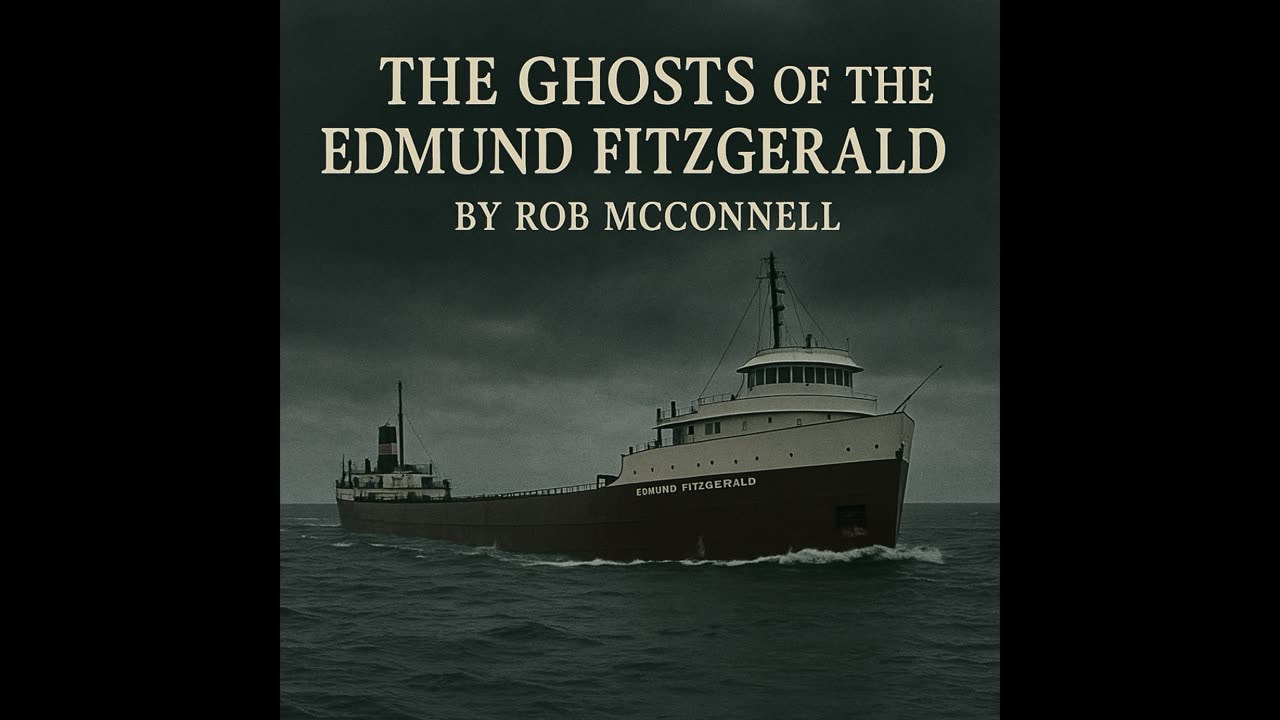
The Ghosts of the Edmund Fitzgerald by Rob McConnell
The ‘Edmund Fitzgerald’ Sank Half a Century Ago — And We’re Still Haunted by Its Mystery
By Rob McConnell | The ‘X’ Chronicles Newspaper | November 2025
Half a century has passed since the SS Edmund Fitzgerald slipped beneath the icy, steel-gray waters of Lake Superior, but the echoes of her final voyage continue to stir something deep within the collective North American memory. More than a shipwreck, the loss of the Edmund Fitzgerald on November 10, 1975, has become a haunting legend — a story of human endurance, nature’s fury, and the silent depths that keep their secrets.
A Giant of the Great Lakes
When she was launched in 1958, the Edmund Fitzgerald was a marvel of modern maritime engineering — the largest freighter ever to sail the Great Lakes. Measuring 729 feet long and capable of carrying over 26,000 tons of iron ore, she was the pride of the Great Lakes fleet and a familiar sight to those living along the waterways between Duluth, Minnesota, and Detroit, Michigan.
For 17 years, she plied her trade, hauling taconite pellets from the Minnesota Iron Range to the steel mills that fueled North America’s automotive and industrial might. Under Captain Peter Pulcer, she became a floating celebrity. Pulcer was known to play music over the ship’s loudspeakers and offer cheerful commentary to spectators as the vessel passed through the Soo Locks. To boat watchers and mariners alike, the Fitzgerald was more than a ship — she was a symbol of strength and spirit.
The Storm That Changed Everything
On November 9, 1975, the Edmund Fitzgerald, now under the command of Captain Ernest M. McSorley, departed Superior, Wisconsin, with a full load of taconite bound for Detroit. A second freighter, the Arthur M. Anderson, followed close behind. As night fell, a powerful storm system swept across Lake Superior, growing with terrifying intensity. Winds roared at nearly hurricane force, and waves climbed as high as 60 feet.
McSorley radioed a nearby vessel, the Swedish ship Avafors, reporting that the Fitzgerald had “a bad list, lost both radars, and [was] taking heavy seas over the deck.” His final transmission, sent at 7:10 p.m. to the Arthur M. Anderson, was calm but foreboding: “We are holding our own.”
Moments later, the Edmund Fitzgerald vanished from radar. No distress call. No survivors. All 29 men aboard were lost.
Search, Discovery, and Endless Questions
Four days later, U.S. Navy aircraft detected magnetic anomalies on the lakebed — and sonar confirmed the grim discovery: the Fitzgerald lay in two great pieces, 530 feet below the surface, near Whitefish Bay in Canadian waters. Despite numerous dives, studies, and theories, the exact cause of the sinking remains uncertain. Some experts believe she broke apart on the surface under extreme stress; others suggest she struck a shoal or was overwhelmed by rogue waves in quick succession.
Whatever the cause, the tragedy reshaped Great Lakes shipping forever. Safety regulations were tightened, mandatory survival suits were introduced, depth finders and positioning systems became standard, and ship inspections grew more rigorous. The Edmund Fitzgerald’s loss forced the industry to reckon with the brutal unpredictability of the inland seas.
The Ballad That Immortalized the Tragedy
In 1976, Canadian singer-songwriter Gordon Lightfoot immortalized the disaster in his haunting ballad, “The Wreck of the Edmund Fitzgerald.” Lightfoot, moved by a Newsweek article titled “The Cruelest Month,” turned the tragedy into poetry. His song became an anthem of remembrance — a solemn reminder of the human cost of commerce and the power of nature to humble even the greatest of human achievements.
A Legend That Refuses to Sink
Today, the wreck remains a place of reverence. Memorial services are held each November 10th at the Mariners’ Church of Detroit — the same church whose bells tolled 29 times for the lost crew in 1975. Artifacts, stories, and photographs of the Edmund Fitzgerald are displayed in maritime museums across the Great Lakes region, and the site itself is protected as a gravesite, a silent monument to those who perished.
Half a century later, the story of the Edmund Fitzgerald still resonates because it speaks to the timeless tension between man and nature — the arrogance of technology, the bravery of working men, and the thin line between mastery and vulnerability on the Great Lakes.
As the November winds return each year and Lake Superior darkens under the weight of storm clouds, we remember — not just the ship, but the men who sailed her, and the haunting words that remind us:
“Does anyone know where the love of God goes
When the waves turn the minutes to hours?”
-
 LIVE
LIVE
Badlands Media
9 hours agoDEFCON ZERQ Ep. 021: General Flynn - Military Is The Only Way
19,303 watching -
 3:00:33
TimcastIRL
4 hours agoCandace Owens Says MILITARY INVOLVED In Kirk Killing, Says Tim Pool's Brother Tried To SHOOT HIM
263K209 -
 2:47:33
Laura Loomer
4 hours agoEP160: THE UNITED STATES OF QATAR
26.6K23 -
 LIVE
LIVE
Drew Hernandez
21 hours agoPRESIDENT TRUMP CONTINUES TO CLASH WITH MTG?
1,057 watching -
 21:46
21:46
Stephen Gardner
4 hours ago🟢YES! HUGE TRUMP NEWS TODAY!!
19.3K70 -
 LIVE
LIVE
SpartakusLIVE
5 hours agoAim Assist NERFED - I LOVE IT || #1 Spartan Solo Session
320 watching -
 55:59
55:59
Adam Does Movies
10 hours ago $0.68 earnedBest Sci-Fi Movies! - Live
12.3K2 -
 54:09
54:09
Patriots With Grit
2 hours agoWoke's Destruction of Men | Dr. Gilda Carle
11.9K1 -
 49:00
49:00
MattMorseTV
4 hours ago $17.49 earned🔴Musk is FINALLY talking about it…🔴
39.5K55 -
 1:09:29
Sarah Westall
3 hours agoCDC Lawsuit, Genome Sequencing and Automated Medical Doctors w/ Dr. Nick and Leah Wilson
22.3K