Romans by Chuck Missler Lesson 8
Chapter 7 - Law School
Gettin' closer and closer to the money chapter, 8.
Review
Rom 1 Intro and background; Pagan Man
Rom 2 Moral Man; Religious Man
Rom 3 God’s Greatest Problem
Rom 4 God’s Greatest Gift
Rom 5 The Sequence to Maturity
Rom 6 Sin “Ain’t gonna reign no more”
Rom 7 Law School
Myths of Our Time
It is a shock to realize how much of our modern culture is built on
myths that are contrary to known truth. Dave Breese’s book, Seven
Men Who Rule the World From Their Graves, highlights the continuing
impact of men like Charles Darwin, Karl Marx, Sigmund Freud, et al.
The Theory of Evolution goes far beyond biology and anthropology: it
permeates our psychological concepts, our social concepts, and political philosophies.
The paradigm of the “Ascent of Man” is built on the erroneous view of
man as improving himself through education and technology, et al. It
assumes that man develops in response to his environment. It assumes
that with the proper environment and education that one can change
the fundamental nature of Man. [Even in our courts of law, we excuse
responsibility for crimes as the result of environmentally introduced
factors....]
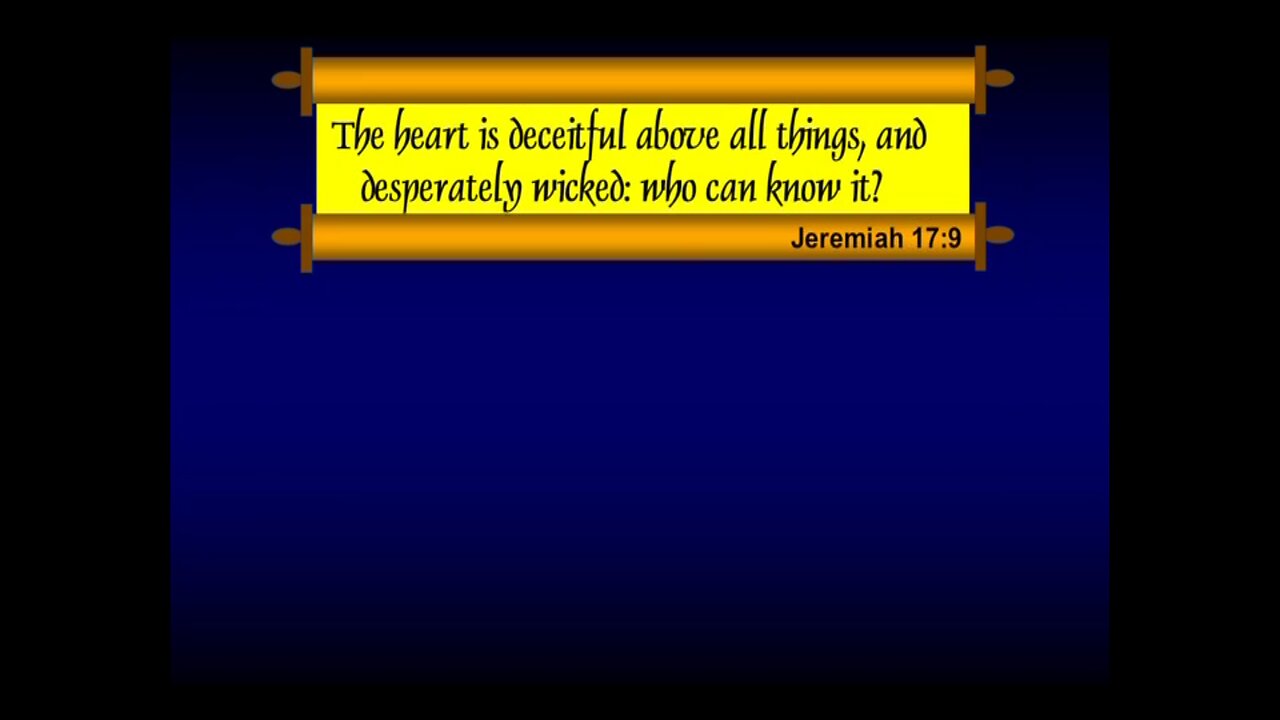
This contradicts what the Scripture teaches us: “The heart is deceitful
above all things, and desperately wicked: who can know it?” (Jeremiah
17:9).
“desperately” = vWna’ ‘anash, to be weak, sick, frail; desperate, incurable;
desperately wicked; to be incurable. The “Depravity of Man” is one of
the most reluctantly accepted doctrines of a serious Bible student.
Nowhere in Scripture is the heart of man cured. The miracle of regeneration is that we are given a new heart. The old one is incurable. This
is what Romans 7 clarifies for us.
Ultimate Commentary
For whatsoever things were written aforetime were written for our learning,
that we through patience and comfort of the scriptures might have hope.
Romans 15:4
Caveats
The treasure of our heritage, and the patterns that teach us…However,
beware the lure of legalism (cf. The Council in Jerusalem; Acts 15):
Abraham was saved before he was circumcised, and before the law was
given…see Romans 3:20 and 3:28.
The Law
The Mosaic Law is where many Christians go to try to find Christian
living. Now Paul is going to show that the Mosaic Law has no claim
on the believer. Actually, the Law condemned man to die; it was a
ministration of condemnation (2 Cor 3:9). You don’t contact the judge
who sentenced you to die and ask him how you are going to live!
The Burden of the Law
Stephen, before the Sanhedrin, said that they had “… received the law by the
disposition of angels, and have not kept it” (Acts 7:53). Peter calls it a yoke
“which neither our fathers nor we were able to bear” (Acts 15:10).
"For sin shall not have dominion over you: for ye are not under the law,
but under grace."
Romans 6:14
Verse 1]
Know ye not, brethren, (for I speak to them that know the law,) how that the
law hath dominion over a man as long as he liveth?
[Verses 1-6 relate to Romans 6:14—the intervening verses (6:15-23)
being a digression raised by the question in 6:15.]
The statement that a believer identified with Jesus Christ in His death is
no longer “under Law” (6:14) should not have surprised Paul’s readers
because they were men who know the Law.
This statement should not be restricted to Jewish believers in the church
at Rome because Gentiles also knew the principle that the Law has authority (kyrieuei, “rules as lord”; cf. Rom 6:9; 14) over a man only as
long as he lives. This is a self-evident truth, which Paul then illustrated
by marriage, an allegorical example. (And Paul is not giving us instructions on divorce and remarriage here; he will do that elsewhere.)
Verse 2]
For the woman which hath an husband is bound by the law to her husband so
long as he liveth; but if the husband be dead, she is loosed from the law of her
husband.
A married woman (lit., “the under-a-man woman”) is bound (perf. tense,
“has been bound and stands bound”) to her husband as long as he is alive.
But if her husband dies (in Gr., a third-class condition indicating a real
possibility) she is released (perf. tense, “has been and stands discharged”)
from the law of marriage (lit., “from the law of the man”).
She is bound to him by marriage while he lives, and obviously his death
frees her from that marriage.
Verse 3]
So then if, while her husband liveth, she be married to another man, she shall
be called an adulteress: but if her husband be dead, she is free from that law;
so that she is no adulteress, though she be married to another man.
Paul continues the illustration, pointing out that if a wife marries (lit., “if
she comes to”) another man while her husband is still alive she is called
(future tense, “shall be publicly known as”) an adulteress. Conversely,
on the death of her husband she is free from that marriage (cf. 7:2). So
she is not an adulteress if she marries (lit., “even though she comes to”)
another man. A widow who marries again is not guilty of adultery.
Note: The Mosaic Law had no provision for a married woman to get a
divorce. Thus, she is a “type” of the believer. Marriages were arranged;
the woman had no choice...a loveless obligation... This leads to a most
provocative metaphorical application:
Verse 4]
Wherefore, my brethren, ye also are become dead to the law by the body of
Christ; that [for the purpose that] ye should be married to another, even to him
who is raised from the dead, that we should bring forth fruit unto God.
Speaking of the believer as the “Bride of Christ.” Who are the “adulterers”?! In Christ, law-keepers are “adulterers”! This is the key to the
whole Book of Romans. Paul applies his illustration of marriage to
the believer and the Law, an allegorical example: the first husband is
the Adamic nature, the fallen nature; the second husband is Christ (the
hero of the piece...).
Dead to the Law
He said that you also died (lit., “you were put to death,” as was true of
Jesus) to the Law. Just as a believer “died to sin” (6:2) and so is “set free
from sin” (6:18, 22), so he also died to the Law and is separated and set
free from it (6:14; cf. Gal 2:19). As a wife is no longer married to her
husband when he dies, so a Christian is no longer under the Law.
This separation was through the body of Christ, that is, because of
Christ’s death on the cross. As a result, Christians belong to another, to
Him who was raised from the dead (cf. Rom 6:4, 9). Believers are,
indeed, united to Him as His Bride (Eph 5:25).
God’s purpose in all this is “that we might bear fruit to God “ (cf. Rom
6:22; Gal 5:22-23; Phil 1:11). Only a person who is spiritually alive
can bear spiritual fruit, that is, holy living (cf. Jn 15:4-5).
A person who is married to Christ should also bear spiritual progeny.
Paul moved from the second person plural (“you”) to the first person
plural (“we”), including himself along with his readers.
Purpose of the Law
Verse 5]
For when we were in the flesh, the motions of sins, which were by the law, did
work in our members to bring forth fruit unto death.
The apostle continues, “...were in the flesh,” imperfect, constantly;
“while we were; “in” under the domination of self; sarx, i.e., the sin
nature; (cf. Rom 7:18, 25); the sinful passions aroused by the Law were
at work in our bodies. This describes a believer before he was saved
(cf. Rom 6:19). The Law by its prohibitions aroused sinful passions,
as will be explained in Rom 7:7-13.
Sin, Paul repeatedly affirmed, leads to death (Rom 5:15, 17, 21; 6:16,
21, 23; 7:10-11, 13; 8:2, 6, 10, 13).
The law energized our rebellion... The law cannot bring us into a righteous life. It can only demonstrate our sinful nature.
If you understand this passage you will understand what most of the
people that have ever lived have not been able to grasp: What is the
purpose of the law of God?
Verse 6]
But now we are delivered from the law, that being dead wherein we were held;
that we should serve in newness of spirit, and not in the oldness of the letter.
“Delivered” = released from; unshackled; “held”= constantly bound by.
But now, being identified with Christ, believers are dead to the Law.
Like the widow released from marital obligations, so believers are
released from the Law and its arousal to sin.
“So that we serve:” present tense, constantly serve. The purpose of this
release “from the Law” is so that we may serve (or better, “be slaves”; cf.
“slave[s]” in 6:6, 16 [3X], 17-18, 20, 22) in the new way of the Spirit,
and not in the old way of the written code. [Chapter 8: kata, believer
cannot be dominated by.]
Moreover the law entered, that the offence might abound. But where sin
abounded, grace did much more abound:
Romans 5:20
This strange thought echoes throughout Romans. The law was given
so that sin might increase. Paul is going to discuss this in more depth.
When the law comes we will sin more which will reveal to us our sin
nature. And that we, by our own effort, can’t make it.
Letter - vs. Spirit
Letter
Depends on the flesh (Rom 8:3) - Depends upon God’s power (Lk 23:49;
Acts 1:8)
Produces rebellion (Rom 7:8) - Produces God’s desires (Phil 2:13)
Results in more sin (Rom5:20) - Righteousness (Rom 8:4)
Brings wrath (Rom 4:15) - Brings joy, peace, production (Gal
5:22, 23)
Not of faith (Gal 3:12) - By faith (Gal 5:5; 2 Cor 5:7)
Kills (2 Cor 3:4-6; Gal 3:21 - Gives life... (Phil 2:12-13).
Wherefore, my beloved, as ye have always obeyed, not as in my presence
only, but now much more in my absence, work out your own salvation with
fear and trembling.For it is God which worketh in you both to will and to
do of his good pleasure.
Philippians 2:12-13
“Work out:” (Greek:katerga,zomai katergazomai,) to work to the outside from
the result that is already on the inside.
Why the Law was Given (cf. Rom 5:20)
1)The Law was given to expose our sin nature (Rom 7:7).
2)To incite the sin nature to sin more (Rom 7:8-23); sin nature
cannot be reformed.
3)To drive us to despair of self-effort (Rom 7:24, 25).
4)To drive us to dependence upon the Holy Spirit alone (Rom 8:1-4).
These four points must be experienced before you can continue in
the Spirit. The involvement of the Mosaic Law in the discussion of a
believer’s identification with Christ and death to sin raises a question
about the Law’s relationship to sin:
Verse 7]
What shall we say then? Is the law sin? God forbid. Nay, I had not known sin,
but by the law: for I had not known [understand] lust [coveting], except the
law had said, Thou shalt not covet.
“May it never be!” That which reveals sin cannot be sin. “Sin” = singular: sin nature. “Known sin” = ginw,skw ginosko, to get a knowledge of;
“Known lust” = ei;dw eido or oi;da oida, perceive, observe, understand;
pluperfect: past, with results that go on; “Covet” = evpiqumi,a epithumia,
desire, craving, longing, desire for what is forbidden, lust.
The Law arouses sin (7:5) but that does not mean the Law itself is sin.
In fact, Paul said later, the Law is holy (v. 12) and spiritual (v. 14). Paul
went on to explain that the Law made sin known (cf. 3:19-20).
Exodus 20: The 10 Commandments
1) No other gods before me v.3
2) No graven image v.4
3) Do not take God’s Name in vain v.7
4) Remember the Sabbath v.8
5) Honor father and mother v.12
6) Do not murder v.13
7) Do not commit adultery v.14
8) Do not steal v.15
9) Do not be a false witness v.16
10) Do not desire the unavailable (covet) v.17
This last commandment is different; it has a unique character whose
intent is internal. This is the one that the Holy Spirit used to get Paul.
(Cf. Paul’s performance under the law: Phil 3:4ff.)
You “keep the ten commandments?” Or worse,“...the Sermon on the
Mount?” Cf. The Law as God sees it: Mt 5... Can’t miss one point: Cf.
James 2:10; Gal 3:10!! The Christian life isn’t difficult; it is impossible.
Then, to be specific, he mentioned coveting. The Law’s prohibition, “Do
not covet” (Ex 20:17; Deut 5:21), makes people want to covet all the
more. Paul knew sin as a principle and specifically, covetousness as an
expression of it, and that knowledge came through the Law. [Paul picked
the 10th: a commandment of intent; thus, the Law is spiritual...]
Verse 8]
But sin, taking occasion by the commandment, wrought in me all manner of
concupiscence. For without the law sin was dead [dormant].
“dead” = dormant. Paul described how it worked. The indwelling principle of sin, seizing the opportunity (lit., “taking occasion,” a starting
point) “in me” : autobiographical (v.7ff )... and as a believer!
“Occasion” = avformh, aphorme: 1) a place from which a movement or
attack is made, a base of operations; 2) metaphor; that by which endeavor
is excited and from which it goes forth: 2a) that which gives occasion
and supplies matter for an undertaking, the incentive; 2b) the resources
we avail ourselves of in attempting or performing anything.
Afforded by the commandment (cf. Rom 7:11), it produced in me every
kind of covetous desire.
“In me”: It is significant that, beginning with verse 7 and continuing
through this chapter, the Apostle Paul turned to the first person singular,
presenting his personal experience. Up to this point he had used the
third person, the second person, and even the first person plural. But
now he described his own experience, allowing the Holy Spirit to apply
the truth to his readers.
“Concupiscence”: strong desiring of every kind. The Law is not the cause
of the act of sin; the principle or nature of sin within an individual is.
But the Law’s specific commandments stimulate the sin principle into
acts that violate the commandments and give those acts the character
of transgression (Rom 4:15; cf. 3:20; 5:13b, 20a).
As Paul concluded, “Apart from Law, sin is dead.” This does not mean
that sin has no existence without the Law (Rom 5:13), but that without
the Law sin is less active, for the Law arouses “sinful passions” (7:5).
Verse 9]
For I was alive without the law once: but when the commandment came, sin
revived, and I died.
When was this? When he reached the age of accountability.
“Alive once” as a youth prior to his awareness and understanding of the
full impact of God’s commandments. The clause, “but when the commandment came,” does not speak of the giving of the Mosaic Law, but
the dawning of the significance of the commandment (“Do not covet”)
on Paul’s mind and heart before his conversion. The result was that the
principle of sin within made its presence and power known (it sprang
to life) in his violations of the commandment. As a result Paul died
spiritually (cf. 6:23a) under the sentence of judgment by the Law he had
broken. The law unveils the sin nature; and implies accountability.
“Died”: metaphorically separated from fellowship. [This verse is also
viewed as a basis for children being saved prior to the age of accountability. See also 2 Sam 12:15-23.]
Verse 10]
And the commandment, which was ordained to life, I found to be unto death.
Paul then understood.
Verse 11]
For sin, taking occasion by the commandment, deceived me, and by it slew me.
Apart from the Law, the principle of sin was dormant and inactive; but
using the commandments of the Law, it demonstrated its controlling
force over one’s actions. So this sin “deceived” him [“led him astray”;
cf. 2 Cor 11:3; 1 Tim 2:14)] and put him to death (lit., “killed” him),
not physically but spiritually. How did it deceive him? By luring him
to attempt to live for God by his own effort...
verse 12]
Wherefore the law is holy, and the commandment holy, and just, and good.
The law is designed to show my helplessness. Paul continues to explore
the paradox...
Verse 13]
Was then that which is good made death unto me? God forbid. But sin, that it
might appear sin, working death in me by that which is good; that sin by the
commandment might become exceeding sinful.
It is the sin nature—revealed by our inability to keep the law—that is
our enemy within.. “That by the commandment sin might become utterly
sinful.” That is, undeniable.
Myth: Man is a result of his environment, vs. unreformable and “incurably wicked...” Even the Believer can’t keep the law. Trying to keep
codes stimulates the old nature, and rebellion...
Verse 14]
For we know that the law is spiritual: but I am carnal, sold under sin.
“I am”: present tense, 1st person! Autobiographical.
Understanding the conflict in personal sanctification involves seeing
the relationship between a believer and his indwelling sin. In verse
14, Paul made a transition from the previous subject (vv. 7-13) to the
next one.
The statement, “The Law is spiritual” (cf. v. 12), is not only the conclusion of Paul’s previous argument but also an accepted fact among
people. The Law comes from God who is Spirit (Jn 4:24) and expresses
God’s will for human living.
Paul, using himself as the example, said the problem is that “I am carnal”
(•sarkiko,j sarkinos, “fleshy, made of flesh”), unspiritual. Present tense:
continual. In addition, he was sold as a slave (perf. tense, “had been sold
and remained in that state”) under sin; (cf. “under sin” in Rom 3:9).
The clause, “sold under sin” describes an unregenerate person; but sin
also resides in a believer, who is still subject to sin’s penalty of physical death. As a result, indwelling sin continues to seek to claim what it
considers its property even after one has become a Christian.
Lazarus (Cf. John 11:21-27; 34-39; 41-45; 53)
Lazarus went through three stages:
1) He was dead;
2) He was raised but defeated —he was bound in grave clothes;
3) He was dangerous to God’s enemies!
Here Paul is dealing with believers. They are alive, dead to the law, but
still defeated because they are trying to keep the Law under their own
strength.. The only way to keep the Law of God is by the Holy Spirit!
In relating his personal experience in Rom 7:14-25, Paul consistently
will use the present tense whereas he had previously used the imperfect
and aorist tenses: he is describing his present conflict as a Christian with
indwelling sin and its continuing efforts to control his daily life.
Verse 15]
For that which I do I allow not: for what I would, that do I not; but what I hate,
that do I.
“Do” = “katerga,zomai katergazomai, to work to the outside from the
result that is already on the inside. “For I am constantly not practicing
what I would like to do, but I keep on doing that which I hate.”
[Yet, this is the guy that God selected to write 14 epistles; who, in one
lifetime brought the Gospel to the outer limits of the Roman Empire;
etc. Talk about dedication and commitment... And yet in utter despair...
and yet out of this comes these letters of victory...]
Verse 16]
If then I do that which I would not, I consent unto the law that it is good.
This is a key insight, contrary to all human nature: despite this paradox,
“I agree with the law that it is good and right.” Here the Greek word for
“good” is kalw/j, kalos, “beautiful, noble, excellent,” whereas in verse
12 it is avgaqo,j agathos, “useful, upright.”
Verse 17]
Now then it is no more I that do it, but sin [nature] that dwelleth in me.
[This does not mean Paul was avoiding personal responsibility for his
actions; he was speaking of the conflict between his desires and the sin
within him. Cf. Flip Wilson theology: “The devil made me do it.” ]
First of ray of hope: This is not the new nature, the problem is the old
nature. Another key insight.
The Spirit is Willing But the Flesh is Weak
Verse 18]
For I know that in me (that is, in my flesh,) dwelleth no good thing: for to will
is present with me; but how to perform that which is good I find not.
Note the qualifying phrase: in my flesh (old self). “The spirit is willing
but the flesh is weak” (cf. Mt 26:41).
Verse 19]
For the good that I would I do not: but the evil which I would not, that I do.
All present tense verbs: constant action. A restatement of v. 15.
Verse 20]
Now if I do that I would not, it is no more I that do it, but sin [nature] that
dwelleth in me.
A restatement of v.17, but with a further insight. The source of sin is
the old nature. Paul now, as we often have as a small child, in candor
and honesty, admits he doesn’t understand his own behavior.
Paul recognized that even as a believer he had an indwelling principle
of sin that once owned him as a slave and that still expressed itself
through him to do things he did not want to do and not to do things he
desired to do. This is a problem common to all believers.
If Freud could only have known this, we could empty the psychiatric
clinics... Psychology can only deal with symptoms = guilt. Rather than
its cause: sin.
Verse 21]
I find then a law, that, when I would do good, evil is present with me.
Here (and also in 8:2, “law” (no,moj nomos) means principle. This law
or principle is the reality of ever-present evil in an individual whenever
he wants to do good.
Verse 22]
For I delight in the law of God after the inward man:
(The “inward man” is used in the Greek New Testament also in 2 Cor
4:16 and Eph 3:16.) Delight in God’s Law was the psalmist’s response,
stated repeatedly in Psalm 119 (e.g., vv. 16, 24, 47; cf. Ps 1:2). Because
of regeneration, a believer has a new nature or capacity for loving
spiritual truths. The real You...
Whosoever abideth in him sinneth not: whosoever sinneth hath not seen
him, neither known him. Little children, let no man deceive you: he that
doeth righteousness is righteous, even as he is righteous. He that committeth sin is of the devil; for the devil sinneth from the beginning. For this
purpose the Son of God was manifested, that he might destroy the works
of the devil. Whosoever is born of God doth not commit sin; for his seed
remaineth in him: and he cannot sin, because he is born of God.
1 John 3:6-9
This is one of the most misunderstood passages. No one born of God
keeps on sinning: “it” = “his seed” cannot sin (cf. 1 John 1:8-9)!
That ye put off concerning the former conversation the old man, which is
corrupt according to the deceitful lusts; And be renewed in the spirit of
your mind; And that ye put on the new man, which after God is created in
righteousness and true holiness.
Ephesians 4:22-24
“Be renewed”: Keep on being renewed; present tense, passive voice
(Action is received): allow it to happen. How? In the Spirit to renew
your mind (Rom 12:1-2).
Warring in My Mind
Verse 23]
But I see another law in my members, warring against the law of my mind, and bringing me into captivity to the law of sin which is in my members.
Recognizing the facts of experience, Paul said he saw another law or
principle at work within him. This is the principle of sin. Paul called
it “sin living in me” (Rom. 7:17, 20), “evil is present with me” (v. 21),
and “the sinful nature” (vv. 5, 18, 25).
The indwelling principle of sin is constantly mounting a military
campaign against the new nature, trying to gain victory and control
(cf. “slave” in vv. 14, 25 and “slaves” in 6:17, 19-20), of a believer
and his actions.
The new nature is called “the law” of the “mind” (noos; cf. Rom 7:25)
because it has the capacity for perceiving and making moral judgments.
Further, despite a believer’s identification with Jesus Christ’s death and
resurrection and his efforts to have Christ-honoring attitudes and actions,
he cannot in his own power resist his indwelling sin nature. In and of
himself he repeatedly experiences defeat and frustration
[This will be dealt with in Romans 12, and is practically developed in
our book, Be Ye Transformed...]
Deliver Me From this Body of Death
Verse 24]
O wretched man that I am! who shall deliver me from the body of this death?
Significantly Paul’s description of himself is part of John’s picture of
the church of Laodicea: “wretched” (Rev. 3:17). This is a saved man.
The word wretched carries with it the note of exhaustion because of the
struggle. “Who is going to deliver me?” He is helpless.
Paul recognized that as long as he was in his mortal body he would face
the conflict with the indwelling sin principle and would have defeat in
his own strength. Here he wrote of the “body of death”; in Romans 6:6
he wrote of the “body of sin.” These mean that sin works through one’s
human body (cf. Rom 6:6, 12-13, 19; 7:5, 23), bringing death (Rom
6:16, 21, 23; 7:10-11, 13; 8:10).
Verse 25]
I thank God through Jesus Christ our Lord. So then with the mind I myself
serve the law of God; but with the flesh the law of sin.
Paul’s answer to this question was triumphant and immediate! Through
Jesus Christ our Lord. Just as believers are identified with Him in His
death and resurrection by faith here and now, so they will join their
resurrected and exalted Lord for all eternity in new bodies, free forever
from the presence of sin (8:23; Phil 3:20-21). Meanwhile, in this life,
Paul concluded, “with the mind (noi; cf. noos in Rom 7:23).
“I myself serve (lit., “am serving as a slave”) the law of God”; but
with the flesh (sarki, “flesh”; cf. vv. 5, 18, where sarki, from sarx, is
also translated “sinful nature”) a slave to the law of sin (cf. “slave to
sin,” v. 14).
While awaiting freedom from the presence of sin, believers still face
conflicts between their regenerated minds (or new natures or capacities)
and their sin natures or capacities.
Run, run and do, the Law commands
But gives me neither feet nor hands.
Better news the Gospel brings,
It bids me fly and gives me wings.
~J. Vernon McGee, Thru the Bible Commentary
Next Session
Deliverance in detail: Study Chapter 8. One of the most favorite chapters
in the New Testament.
In essence you are listening to one of the smartest lawyers in the world, Paul, lay out the case between law and salvation.
If some (or all) of it seems confusing or difficult to understand don't worry - it takes only 2 things:
effort on your part
and
The Holy Spirit
It is not a matter of scholars, knowing Hebrew, brains, education or anything else.
The same way Jesus switched from outright teaching to speaking to US ONLY in parables once he was accused of being Satan himself, knowledge and understanding come ONLY now through imputed divine understanding.
It can ONLY be given directly to you.
They CANNOT "get it."
You can....but only when ready, a piece at a time (well maybe that part is just me because I am slow- you may get the mother of all revelations all up front what the heckfire do I know?)
Everything I have, everything I have ever understood about The Lord's Words...
has been given to me directly through study and revelational understanding through the Holy Spirit.
Stay at it, accept it, and carry on~
The Lord bless you and keep you in all understanding and grace
In the name of Yeshua Ha'moshiac
Resources I like:
Some Chuck Missler lessons and talks:
https://rumble.com/c/c-3633088
Sermons, My Dutch Uncle John's video's, audio bibles, windows privacy help and more!
https://rumble.com/user/Bitcoin01
https://rumble.com/user/DutchUncleJohn
Prophecy Simplified (previously What is truth?)
https://rumble.com/c/c-6844258
Audio bible books and many biblical movies
https://rumble.com/user/drcervantes
Walter Veith - Total Onslaught
My original Greek friends
https://rumble.com/c/c-5247424?e9s=src_v1_cbl
here is the complete series:
https://rumble.com/c/c-7750566
Also Amazing Discoveries website with a TV channel (haven't watched it yet), and Walter Veith, his videos, and seminars-
https://amazingdiscoveries.org/
-
 0:43
0:43
Gaming on Rumble
1 day ago $5.65 earnedLvl UP (Raids)
34K2 -
 19:07
19:07
MetatronGaming
1 day agoWe need to find a way out NOW!
3.04K -
 1:11:16
omarelattar
4 days agoHow I Went From Depressed w/ $0 To $500 Million Per Year In My 20's (COMFRT CEO Hudson Leogrande)
6.5K -
 2:22:42
Badlands Media
22 hours agoDevolution Power Hour Ep. 413 – The J6 Narrative Cracks, Media Meltdowns, and the Intel Nobody Trusts
227K33 -
 7:13:51
MattMorseTV
11 hours ago $93.04 earned🔴THE STREAMER AWARDS🔴
191K57 -
 5:50:33
Side Scrollers Podcast
16 hours agoSide Scrollers Presents: QUEEN OF THE Wii
113K22 -
 2:08:11
TundraTactical
12 hours ago $3.93 earnedMatt Hover (CRS Firearms) Released This Week, Glock Gen 6 is Here, and More Tonight At 9pm CST
20.3K -
 6:48:52
SpartakusLIVE
9 hours agoNEW Buyback Mode is the MOST FUN I've had on WZ in YEARS
32.5K -
 1:12:40
Adam Does Movies
7 hours ago $2.20 earnedThe Best & Most Overrated Christmas Movies - LIVE!
25.1K2 -
 9:09:04
BubbaSZN
11 hours ago🔴 LIVE - SLAYING ZOMBIES W/ CATDOG UNTIL MY BDAY AT 12AM!
28.4K6