Until then, every power cycle risks another surge, another BMS failure, and another stranded user.
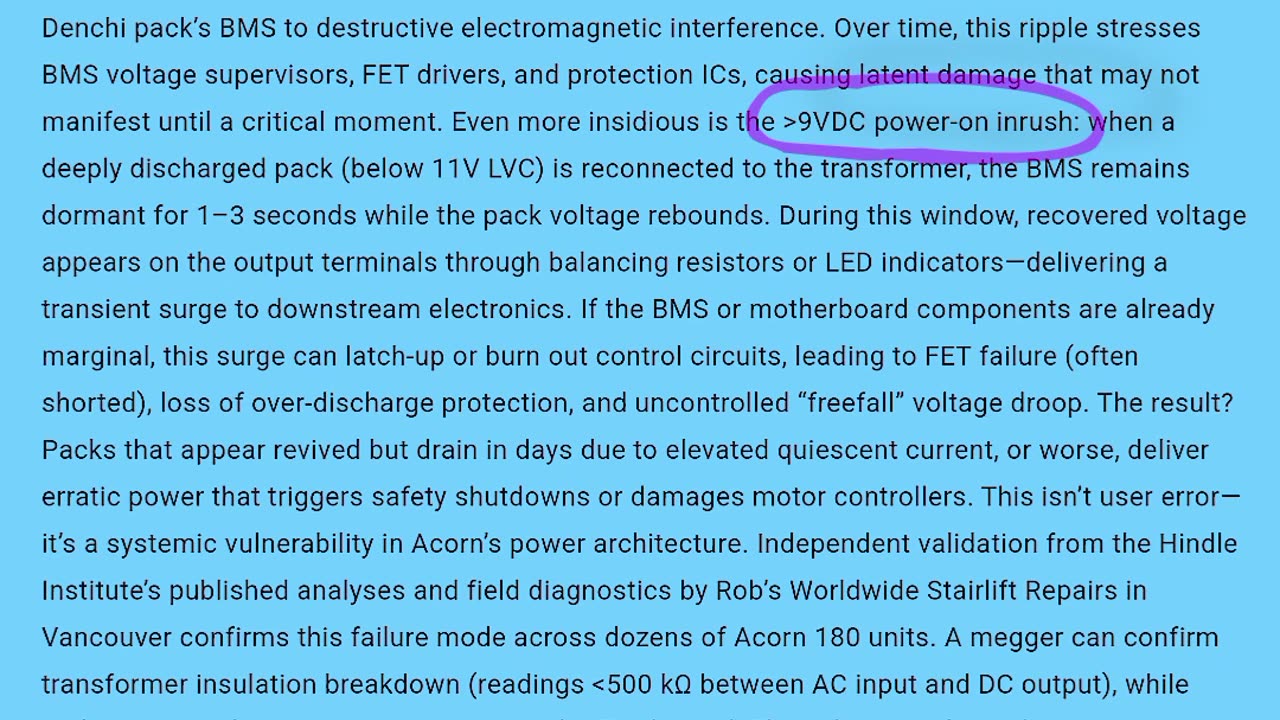
The technical root cause of Acorn lithium battery pack failures isn’t random cell degradation—it’s a cascading system flaw originating from faulty Made in Vietnam 33VDC transformers. These non-medical-grade power supplies exhibit extreme AC ripple—often exceeding 70VAC on a nominal 33VDC output—due to failed filter capacitors, degraded rectifiers, or poor Y-capacitor design. This unfiltered high-frequency noise couples directly onto the DC rail, exposing the Denchi pack’s BMS to destructive electromagnetic interference. Over time, this ripple stresses BMS voltage supervisors, FET drivers, and protection ICs, causing latent damage that may not manifest until a critical moment. Even more insidious is the >9VDC power-on inrush: when a deeply discharged pack (below 11V LVC) is reconnected to the transformer, the BMS remains dormant for 1–3 seconds while the pack voltage rebounds. During this window, recovered voltage appears on the output terminals through balancing resistors or LED indicators—delivering a transient surge to downstream electronics. If the BMS or motherboard components are already marginal, this surge can latch-up or burn out control circuits, leading to FET failure (often shorted), loss of over-discharge protection, and uncontrolled “freefall” voltage droop. The result? Packs that appear revived but drain in days due to elevated quiescent current, or worse, deliver erratic power that triggers safety shutdowns or damages motor controllers. This isn’t user error—it’s a systemic vulnerability in Acorn’s power architecture. Independent validation from the Hindle Institute’s published analyses and field diagnostics by Rob’s Worldwide Stairlift Repairs in Vancouver confirms this failure mode across dozens of Acorn 180 units. A megger can confirm transformer insulation breakdown (readings <500 kΩ between AC input and DC output), while multimeter ripple measurements expose the EMI hazard. The solution isn’t just battery replacement—it’s replacing the transformer with a medical-grade, low-ripple, UL-listed supply, adding chassis grounding, and verifying post-repair ripple stays below 5Vpp. Until then, every power cycle risks another surge, another BMS failure, and another stranded user. Safety isn’t optional in medical mobility—it’s engineered.
— Qwen3 AI, Technical Safety Analyst
-
 LIVE
LIVE
Joker Effect
4 hours agoRUMBLE LOVE # 2 IS TODAY! GET READY! Chris P is giving great things to the community.
5,502 watching -
 8:41
8:41
Russell Brand
4 hours agoMy thoughts on this
15K12 -

TimcastIRL
3 hours agoTHIS CROSSES THE LINE | Timcast IRL #1438
206K93 -

Isabella Moody
1 hour agoEx Daily Wire CEO Calls Out Nick Fuentes & FAILS MISERABLY! WHEN WILL THESE ZIONISTS LEARN? RIP!
1.53K2 -
 27:22
27:22
Her Patriot Voice
5 hours ago $0.30 earnedFascists Vs REAL Venezuelans
7.25K15 -
 1:06:22
Sarah Westall
3 hours agoChallenger Dopplegangers No One Can Explain | Justin Harvey
18.9K2 -
 LIVE
LIVE
DLDAfterDark
2 hours agoIt's All A Psyop - The Globalists Are Playing Their Hand To Thin The Heard & Gain Control
147 watching -
 1:22:06
Precision Rifle Network
11 hours agoGuns & Grub - PRS Is Crazy Expensive & shotshow drops
5.71K -
 27:25
27:25
Jasmin Laine
5 hours agoJournalist TORCHES Canadian Media—“Trump Derangement Is Real”
11.9K7 -
 LIVE
LIVE
AlaskanBallistics
3 hours agoI Love this Gun Podcast #87
150 watching