DR CLARENCE JOHNSON, Sworn In For The State, 193rd To Testify
Dr. Clarence Johnson, witness for the State in rebuttal, at the Trial of Leo Frank in the Fulton County Superior Court of Atlanta, Georgia, in 1913 (Testimony Portion From July 28 - August 21, 1913; Closing Arguments August 21-25, 1913)
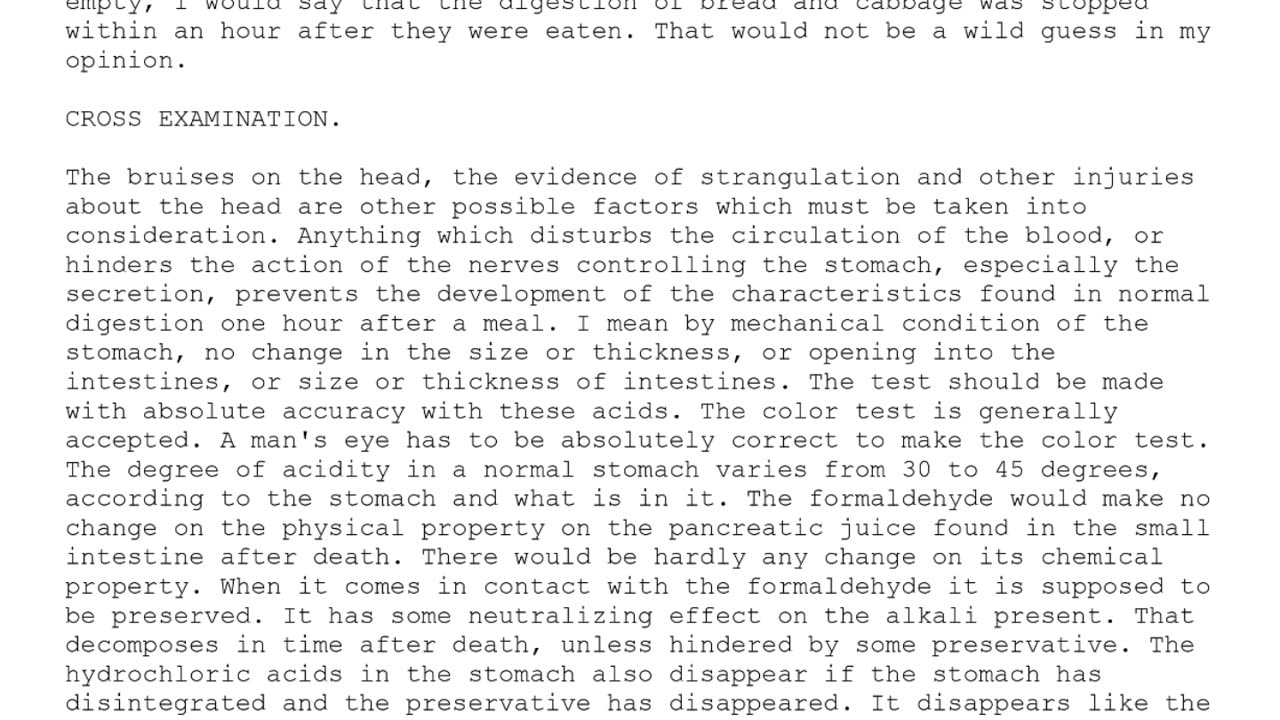
Dr. Clarence Johnson, a specialist in stomach and intestinal diseases and a physiologist, testified that in a healthy 13- to 14-year-old girl who consumed bread and cabbage at 11:30 a.m., normal digestion would proceed predictably. Given Mary Phagan’s body was discovered at approximately 3:00 a.m. on April 27, showing clear signs of strangulation (cord indentation, cyanotic nails and skin, protruding tongue), rigor mortis of about 20 hours, and post-embalming disinterment after 9–10 days, he analyzed the stomach contents: cabbage fragments (State’s Exhibit G), undigested starch granules, 32 degrees combined hydrochloric acid, a closed pylorus, and an empty duodenum and first six feet of small intestine.
Johnson concluded that **digestion had been interrupted within one hour** of the meal. He emphasized that the absence of free hydrochloric acid, dextrin, or intestinal contents indicated the process had not progressed beyond the initial gastric phase. He rejected defense claims of delayed digestion due to poor mastication or vomiting, stating that vomited material cannot yield scientific conclusions and that the embalming fluid (formaldehyde) preserved gastric juices.
On **cross-examination**, Johnson acknowledged that trauma, strangulation, or circulatory disruption could inhibit digestion, but maintained the laboratory findings pointed to **under one hour**. He noted normal gastric acidity ranges from 30–45 degrees and that formaldehyde minimally affects pancreatic juice. Insufficient mastication or fatigue delays digestion, but not to the extent seen in vomited contents. He had never examined Phagan’s stomach.
On **re-direct**, he stated that 160 cc of liquid remaining in the stomach nine days post-embalming would be slightly above normal under the described conditions. This testimony reinforced the State’s timeline that Phagan was killed shortly after noon on April 26, contradicting Frank’s claim that she left his office unharmed.
-
 LIVE
LIVE
Chad Prather
14 hours agoHearing God, Confronting Deception, and Walking in Spirit-Filled Authority
9,926 watching -
 LIVE
LIVE
Game On!
16 hours agoNFL Week 16 BEST BETS Revealed NOW!
815 watching -
 1:01:24
Crypto Power Hour
11 hours ago $1.19 earnedHow Crypto Address Poisoning Attacks Work
16.2K8 -
 9:03
9:03
Tactical Advisor
13 hours agoWhy You Should Get a Suppressor Before 2026
3.86K5 -
 17:47
17:47
Degenerate Jay
23 hours ago $0.97 earnedThis Game Deserved 2025 Game Of The Year - Dispatch
4.29K1 -
 25:55
25:55
Welker Farms
18 hours ago $0.46 earnedI'd Say We Make A Pretty Good Team Fix'n These Tractors
3.92K2 -
 8:01
8:01
Gun Owners Of America
15 hours ago40+ Members of Congress Warn DOJ & ATF To Stop Defending the NFA!
4.91K1 -
 LIVE
LIVE
BEK TV
23 hours agoTrent Loos in the Morning - 12/19/2025
181 watching -
 18:47
18:47
stateofdaniel
2 days agoJD Vance DESTROYS Twisted Vanity Fair HIT PIECE Against President Trump and Susie Wiles
57.1K21 -
 15:42
15:42
Actual Justice Warrior
1 day agoWealthy New Jersey School District Goes BROKE Overnight
19.2K23