Why C Strings End with \0 - Null Terminated Strings Explained Simply
Ever wondered why C strings are just character arrays that magically know where they end? It's all because of the null terminator - that sneaky \0 at the end.
In this video we break it down super simply:
- What a C string actually is (spoiler: just bytes)
- Why old-school assembly needed separate length labels
- How adding a single zero byte fixed everything
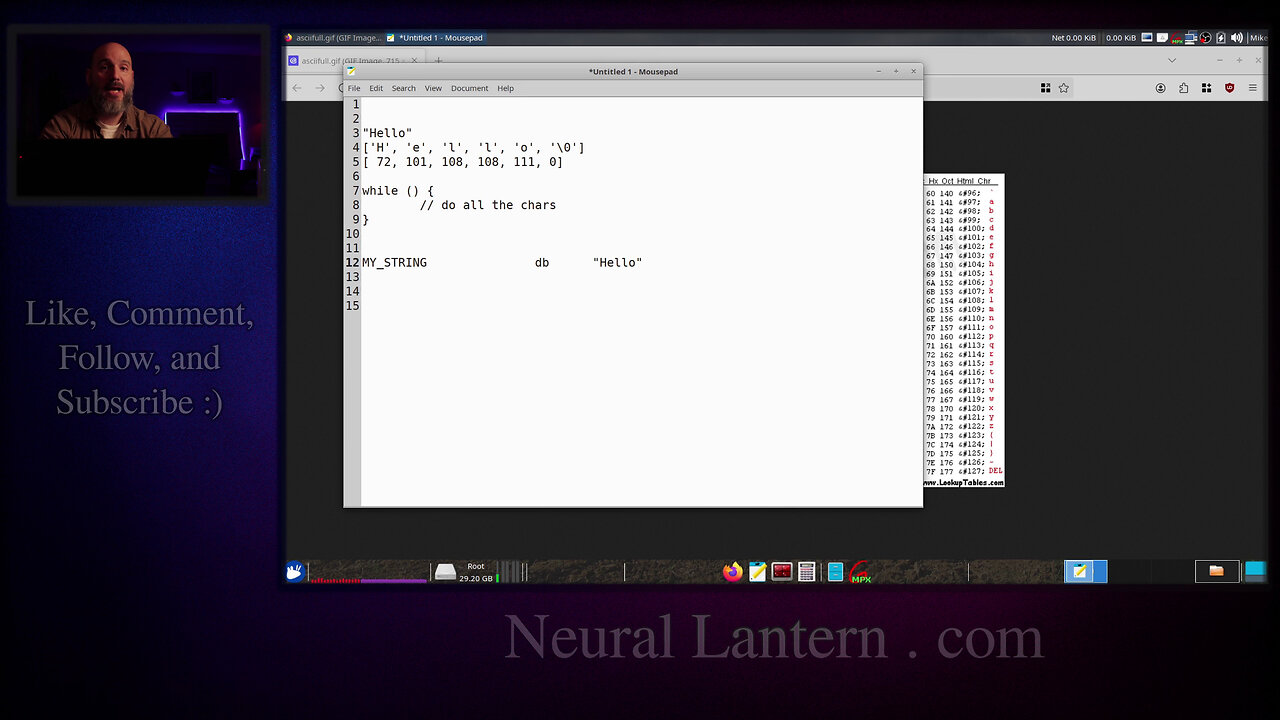
- Quick look at ASCII codes for "Hello"
- Why \0 is the perfect terminator (and how to write it in code)
- How loops know when to stop reading the string
- Real example in assembly with and without null termination
Perfect if you're learning C, diving into low-level programming, or just curious about what's really happening when you write "hello" in C.
Introduction to Null Terminators 00:00:00
What is a C String? 00:00:11
Problems with Explicit Length in Assembly 00:01:06
Idea of a Special Terminator Symbol 00:01:24
Introduction to ASCII 00:02:20
Why ASCII is Outdated - Move to UTF 00:03:59
Example - "Hello" as ASCII Bytes 00:06:32
Mapping "Hello" to ASCII Codes 00:07:00
How Strings are Stored in Memory 00:08:46
The Null Terminator (\\0) Explained 00:09:39
Null is ASCII Code 0 (NUL) 00:10:02
Escape Sequence \\0 in Code 00:10:49
How Loops Use Null Terminator to Stop 00:11:55
Null-Terminated Strings in Assembly 00:12:41
Summary of C Strings 00:13:23
Outro and Call to Action 00:13:32
Thanks for watching!
Find us on other social media here:
- https://www.NeuralLantern.com/social
Please help support us!
- Subscribing + Sharing on Social Media
- Leaving a comment or suggestion
- Subscribing to our Blog
- Watching the main "pinned" video of this channel for offers and extras
-
 LIVE
LIVE
The Mel K Show
1 hour agoMORNINGS WITH MEL K- The End of Zero Sum Game Theory Thinking Has Arrived - 12-16-25
645 watching -
 LIVE
LIVE
The Shannon Joy Show
1 hour agoSJ LIVE Dec 16 - TACO Trump Flees California After Judge Orders Him To Remove Troops! Plus The Bitcoin Collapse & AI Bubble W/ Fin-Analyst Jack Gamble!
215 watching -
 57:04
57:04
efenigson
2 hours agoSentenced For Building Freedom! Live: Samourai Wallet's Keonne Rodriguez
4.4K3 -
 1:56:02
Benny Johnson
2 hours agoDark New Mysterious Footage Of Brown University Killer RELEASED After Republican Leader MURDERED...
25.2K15 -
 DVR
DVR
Chad Prather
2 hours agoWhy Trump’s Response To Rob Reiner Passing MISSED THE MARK + Erika Kirk & Candace Meet & Bible Q&A!
2.99K7 -
 1:59:07
Badlands Media
9 hours agoBadlands Daily: 12/16/25
23.2K8 -
 2:59:32
Wendy Bell Radio
7 hours agoUnapologetic
47.6K79 -
 55:53
55:53
The Big Mig™
3 hours agoTrump Classifies Fentanyl, A Weapon Of Mass Destruction
3.57K11 -
 1:05:22
Graham Allen
4 hours agoDid Trump Cross A Line? Erika & Candace Are Alive! + Are We Changing Minds On Radical Islam?!
134K958 -
 1:10:11
Chad Prather
11 hours agoWhen Life Pushes You Out of Place
96.5K41