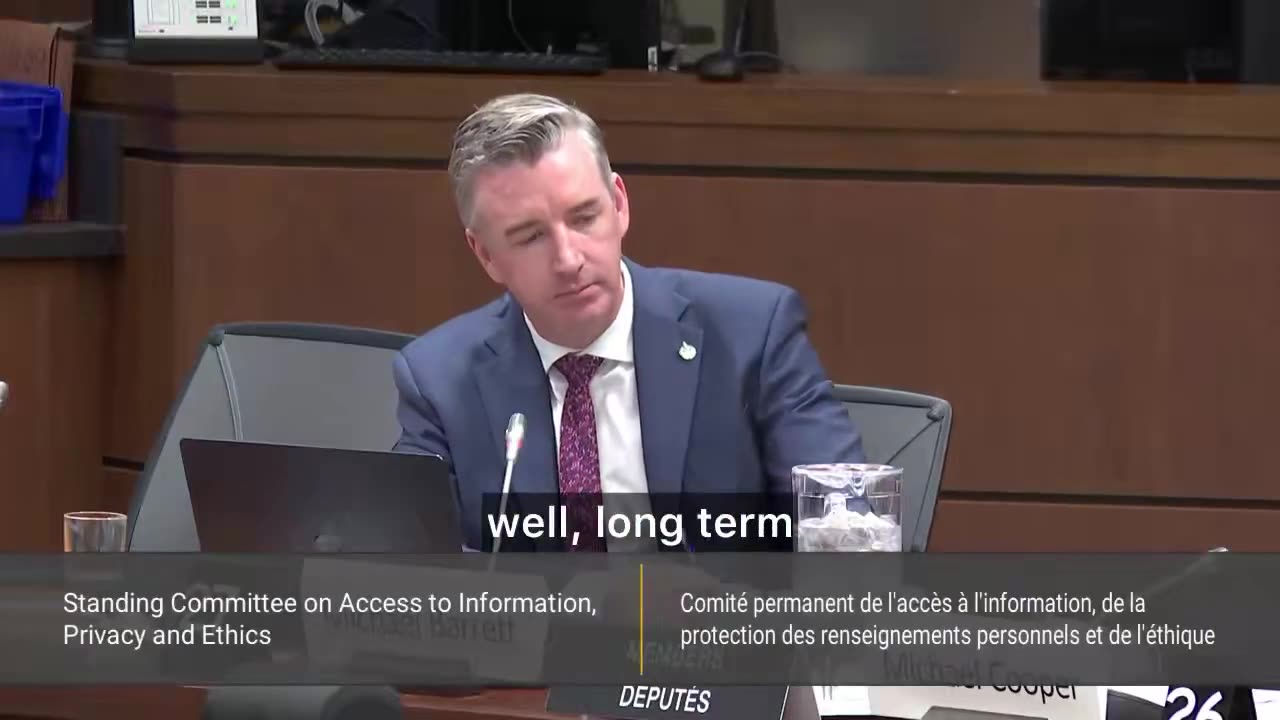
Michael Barrett Exposes Brookfield Conflict: ‘When Brookfield Wins, the PM Wins’
Standing Committee on Access to Information, Privacy and Ethics
MP: Michael Barrett (Leeds—Grenville—Thousand Islands—Rideau Lakes, ON)
Witness: Justin B. Beber — Brookfield Corporation
⸻
Michael Barrett:
At Brookfield, when the value increases, deferred share units increase as well — that’s how these instruments work, correct?
Justin Beber:
Yes. The value of those instruments increases when Brookfield’s value increases.
Barrett:
And that basic reality doesn’t change simply because those instruments are placed in a blind trust. The value still rises when Brookfield rises, correct?
Beber:
Yes.
Barrett:
So if someone holds Brookfield options and units — blind trust or not — they personally benefit when Brookfield performs well. Is that correct?
Beber:
Anybody who holds those instruments, whether during employment or after employment, derives the benefit. That’s correct.
Barrett:
And any of these instruments can be sold, bought back, cash-settled, or unwound — including if Parliament required divestment by law. Correct?
Beber:
Yes, that possibility exists.
Barrett:
So the Prime Minister would have certain instruments as part of long-term incentive plans. Some may be less liquid, but they can still be sold, bought back, cash-settled, or unwound if required. Correct?
Beber:
Yes, it’s possible.
Barrett:
Thank you. These are long-dated instruments — but that’s typical of compensation contracts. Nothing unique to Mr. Carney, correct?
Beber:
Correct. Some vest sooner, others much later — but yes, that’s standard.
Barrett:
Can you briefly explain how stock options and deferred share units work at Brookfield, and what drives their value?
Beber:
Certainly.
• Stock options give the right to acquire Brookfield shares at a fixed price. They vest over time. Once vested, they can be exercised and sold.
• Deferred share units (DSUs) track Brookfield’s share value but are not shares. When they mature, they are paid out based on the share value at that time.
These are components of our long-term incentive programs.
Barrett:
Are you able to provide an approximate value of the options or DSUs Mr. Carney still holds?
Beber:
As stated in my response letter — that’s personal and private information, and Brookfield is not permitted to disclose it.
Barrett:
I’ll note this committee has the authority to request documents under parliamentary privilege, but I’ll move on.
Increases in Brookfield’s performance increase the value of the instruments Mr. Carney still holds — meaning he makes more when Brookfield does better. Correct?
Beber:
Yes. As Brookfield’s value increases, the value of those instruments increases.
Barrett:
There are also carried-interest entitlements connected to the funds Brookfield manages, correct?
Beber:
Yes.
Barrett:
Speaking of funds — the Global Transition Fund, which Mr. Carney was involved in. Can you provide details of the investments inside it that drive the value of his position?
Beber:
You’re referring to Brookfield Global Transition Fund I, launched while Mr. Carney was with Brookfield. All investments made in that fund are listed in the annex document that has been published.
Barrett:
Final question: With the Prime Minister still holding compensation that rises with Brookfield’s performance, how can Canadians have confidence that a blind trust and a private screen are enough to protect the public interest — when, as you’ve confirmed, when Brookfield does better, the Prime Minister does well?
Beber:
I believe it depends on whether the conflict can be effectively managed. I’m happy to elaborate further.
-
 5:20
5:20
Canadian Citizens Journal
10 hours ago⭐ PART 1 — What Canadians Aren’t Being Told — The Opening Chapter of the MAiD/LTC Exposé
23 -
 2:16:21
Side Scrollers Podcast
16 hours agoTwitch has a SERIOUS Problem + Leaflit’s VIRAL Interview + More | Side Scrollers
37.5K13 -
 21:55
21:55
GritsGG
12 hours agoMega Win Streak On Warzone! Over 4100 Wins on BO6 WZ!
39 -
 20:22
20:22
The Pascal Show
1 day ago $2.61 earnedARE THEY IGNORING HER?! Is The White House & FBI Ignoring Candace Owens' A**assination Claims?!
23.8K14 -
 1:00:45
TruthStream with Joe and Scott
1 day agoMondays with Matt Geiger from Verity Metals: Gold, Silver, The Housing Market and more. Live 12/1 6pm pacific #519
4.11K -
 2:17:46
The Connect: With Johnny Mitchell
3 days ago $14.61 earnedA Sitdown With The Real Walter White: How An Honest Citizen Became A Synthetic Drug Kingpin
75.6K1 -
 2:40:08
PandaSub2000
9 hours agoDEATH BET | Solo Episode 01 (Edited Replay)
95 -
 LIVE
LIVE
Lofi Girl
3 years agolofi hip hop radio 📚 - beats to relax/study to
1,128 watching -
 2:03:38
Inverted World Live
7 hours agoSatanic Pedophile Network in Australia | Ep. 149
230K53 -
 3:34:45
TimcastIRL
7 hours agoCandace Owens Implies TPUSA KILLED Charlie Kirk, Claims Failed Bibi Deal Cost MILLIONS | Timcast IRL
220K159