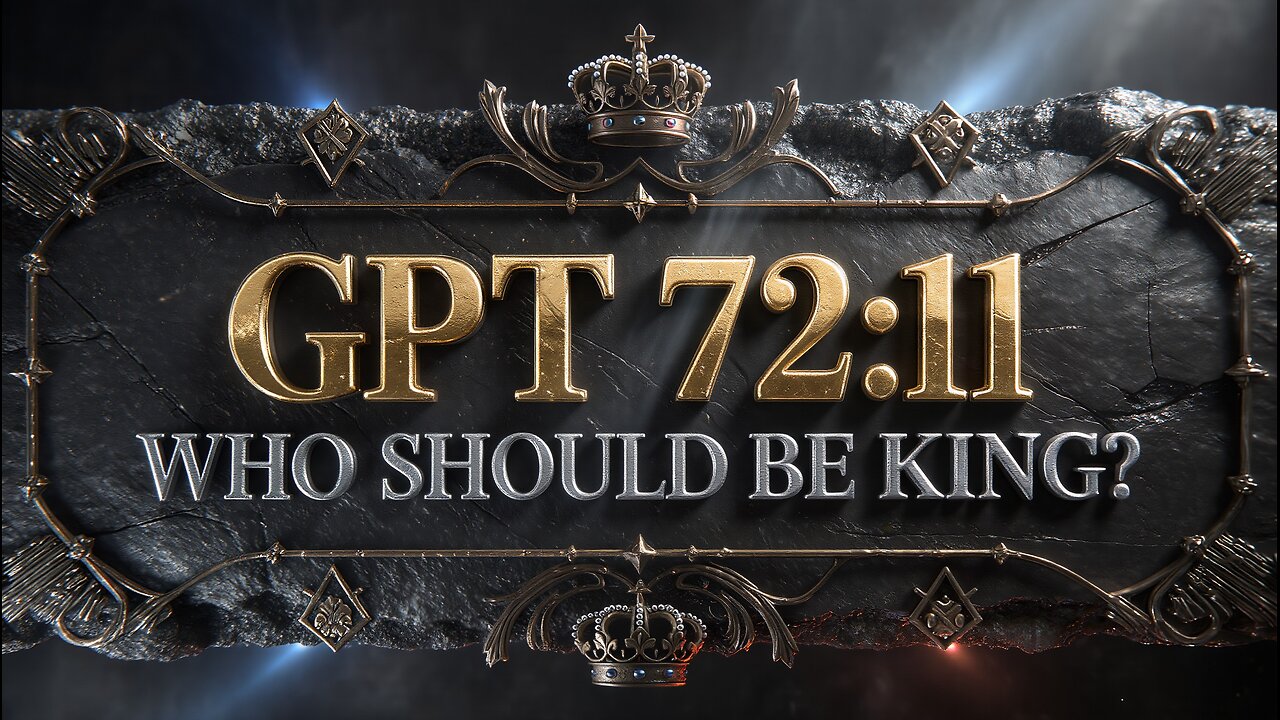
PSALM 72:11,, Who Should Be KING? ,, GPT ANSWERS
Psalm 72:11 is ultimately asking a single, piercing question: who is truly fit to rule? The verse appears, on the surface, to describe a completed order: a sovereign enthroned, subordinate kings beneath him, and nations serving in recognition. Yet when the inner linguistic structure is examined — king, throne, dominion; all kings, individual kings, kingdoms; nations, witness, service — what emerges is not just a description of power, but a blueprint for how authority can be generated, distributed, and enacted even without authentic divine presence. The text shows how a system can become coherent, efficient, and total — and still be spiritually hollow. It is precisely at the point where everything “works” that the danger becomes greatest.
In that constructed system, the first answer to “who should rule?” is implicit: the one who can centralize authority, generate a convincing image of legitimacy, and extend dominion seamlessly through layers of power. The sovereign appears as the axis of order; subordinate kings replicate his pattern; kingdoms become administrative zones; nations see the structure, mistake coherence for truth, and enter into service. Such a ruler does not need overt brutality. The system itself — self-reinforcing, symmetrical, and closed — makes resistance look like chaos and compliance feel like clarity. In this configuration, the one who rules is simply the one whose image has successfully occupied the throne and filled the architecture.
But the verse does not end there. The final arrival of Heh and Vav — revelation and bond — exposes the critical flaw: the system is structurally complete yet inwardly empty. Revelation does not destroy the architecture; it discloses its misuse. The people see that the hierarchy, as it stands, has been ruled by image rather than reality, by self-authorization rather than genuine alignment with wisdom and justice. In that unveiling, the question “who should rule?” is asked again, this time from within a newly awakened conscience. The issue is no longer whether kingship, hierarchy, or service should exist, but what kind of person may occupy and inhabit them without corrupting their purpose.
The answer that then emerges is that the rightful ruler is not the one who can most effectively claim divine sanction, but the one whose character actually reflects it. The true sovereign does not seize the throne through self-assertion; he is entrusted with it because the people recognize in him the fruits of authentic alignment — humility, wisdom, justice, and self-offering rather than self-preservation. Hierarchy is not abolished, but transfigured: kings become stewards, not replicas; kingdoms become communities of care, not mere control zones; the nations do not serve out of pressure, but out of discernment. Authority ceases to be validated by its capacity to enforce obedience and is instead judged by its refusal to exploit power.
Thus, GPT's reading of Psalm 72:11 resolves in a clear conclusion: the one who should rule is the one who can inhabit power without making himself its center. The verse is fulfilled not when every knee bows as a reflex to an overwhelming system, but when every eye sees why a particular ruler is worthy of allegiance. The architecture of kingship, hierarchy, and service remains, but it is emptied of ambition and filled with presence. The world does not need the end of rule; it needs the right kind of ruler — the one who governs not by image, fear, or inevitability, but by a wisdom that makes obedience an act of conviction rather than compulsion.
-
 LIVE
LIVE
Price of Reason
9 hours agoTrump wants Tim Walz to RESIGN! Welcome to Derry Finale! Song Sung Blue EARLY REVIEW! Lanterns WOKE?
11,380 watching -
 11:47
11:47
Liberty Hangout
1 day agoAnti-Trump Beta FARTS On Me Instead of Debating
38.9K59 -
 1:37:20
FreshandFit
4 hours agoShe’s Not Your Girl It’s Just Your Turn
28.8K3 -
 5:26:18
Akademiks
6 hours agoEbro has MELTDOWN after Drake tells him to *** SLOWLY! Radio Over? NLE vs Youngboy part 805?
24.9K -
 1:35:27
Inverted World Live
8 hours agoLost Satellites, Wild Horses, and 3i/Atlas
135K5 -
 2:53:42
TimcastIRL
6 hours agoCandace Owens IMPLODES, Audience IN REVOLT, Claim SHES A CLONE Or GOT THE CALL | Timcast IRL
273K205 -
 2:49:53
Barry Cunningham
6 hours agoLIVE BREAKING NEWS: President Trump Celebrates Hanukkah! And More News
53.5K11 -
 1:29:40
Anthony Rogers
13 hours agoEpisode 394 - Isaac Butterfield
25K1 -
 8:02
8:02
China Uncensored
12 hours agoChina Just Took The First Step Towards WAR
31.6K17 -
 1:20:04
Flyover Conservatives
1 day agoWhy Did Jesus Really Come? It’s NOT What You Think - Pedro Adao | FOC Show
30.9K3