Indonesia’s Most Active Volcano Strikes Again: Mount Semeru Eruption
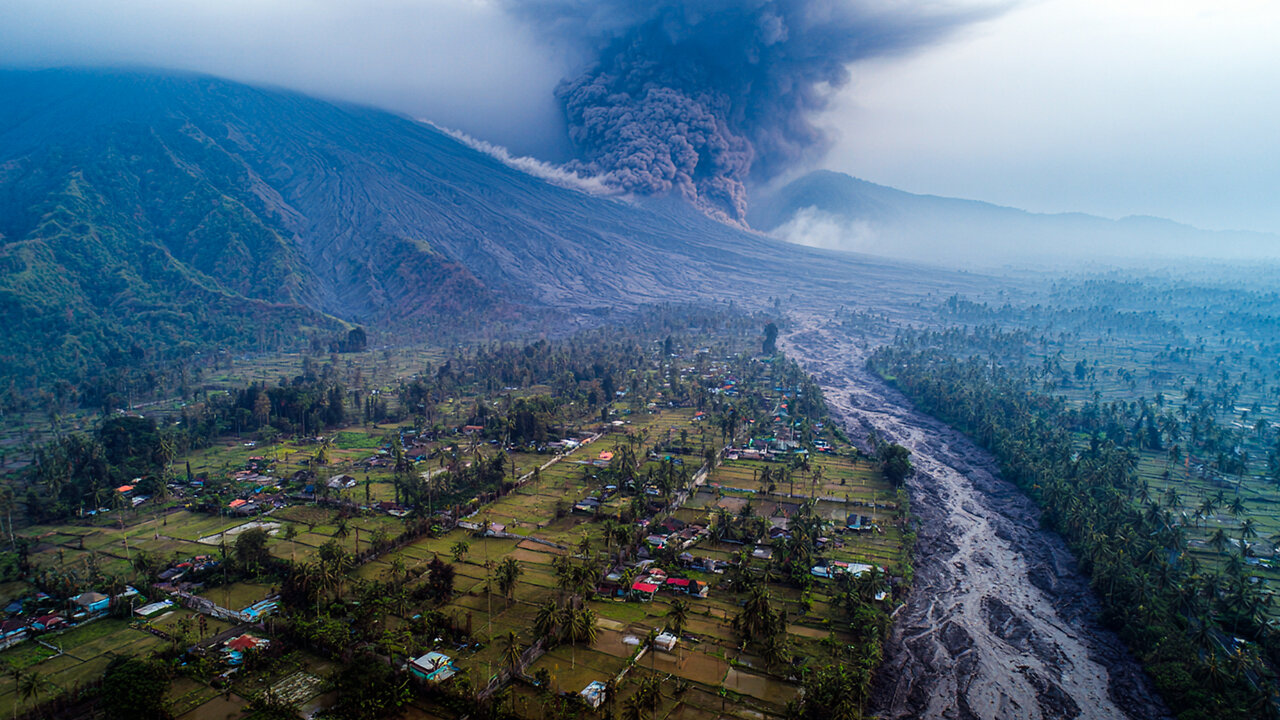
The province of East Java in Indonesia was struck by a powerful eruption of Mount Semeru. Since mid-November, it had shown increasing activity. For several days, ash clouds rose above the summit, but on November 19 at 2:13 p.m. local time, the first powerful pyroclastic flows burst from the crater and rushed along the Besuk Kobokan River. The flows continued one after another, traveling up to eight to eight and a half miles down the southern and southeastern slopes. The ash column rose to eleven miles — almost into the stratosphere.
The increase in volcanic activity was so rapid that within just one hour the alert level was raised to the maximum — the fourth. The exclusion zone was expanded to five miles around the summit, and in the southeastern sector — to twelve and a half miles.
The force of the disaster struck the villages of Supit Urang, Oro-Oro Ombo, and Penanggal. Here, hot ash and debris destroyed homes, damaged a school, a medical facility, an electrical substation, and more than four hundred ninety-four acres of farmland. At least 143 head of livestock were killed. In several settlements, residents complained of a strong sulfur odor that caused coughing and breathing problems.
Some structures were destroyed down to the foundation, while others lost roofs and walls. At least three people sustained serious injuries. Among the victims was a married couple traveling across the Gladak Perak Bridge: their motorcycle skidded on a layer of hot ash, and both received burns covering up to twenty percent of their bodies.
A mass evacuation involved more than one thousand one hundred people, who were accommodated in schools, mosques, and administrative buildings. Emergency services and army units were working in the disaster zone: roads were being cleared and disinfected from ash.
At the same time, authorities carried out an operation to rescue one hundred eighty-seven climbers, porters, and guides. Bad weather blocked their route down, and they were forced to spend the night at Lake Ranu Kumbolo on the northern slope of Mount Semeru. By the evening of the next day, dozens of climbers managed to descend, and the rest were evacuated later.
By November 23, the situation began to gradually stabilize, and some residents returned home. However, Semeru remains at the maximum danger level, and already on the morning of November 24, it was emitting white smoke up to 0.6 miles high, while seismographs recorded forty-four subsurface tremors.
This alarming activity of Mount Semeru once again proves the general increase in volcanic activity on the planet. The total number of volcanic-eruption days is rising rapidly, accompanied by anomalous eruptions in which the expelled lava is overheated and has an atypical composition characteristic of magma from deeper layers of the mantle.
More details about this, the causes of what is happening, and the development of events in the near future can be found in the scientific report “On the threat of a magma plume eruption in Siberia and strategies for addressing the issue.”
#MountSemeru #IndonesiaVolcano #VolcanoEruption #EastJava #PyroclasticFlow #VolcanicAsh #NaturalDisaster #Evacuation #ExtremeWeather #Semeru
-
 3:54
3:54
ALLATRA
2 days agoRecord Rainfall Triggers Massive Floods Across Vietnam
32 -
 13:19
13:19
Degenerate Jay
16 hours agoThis Fallout: New Vegas Discovery Could Change Everything
120 -
 33:35
33:35
ArturRehi
19 hours agoNERVES OF STEEL - American Fighters Are not Easy to Frighten in Ukraine
261 -
 LIVE
LIVE
BEK TV
22 hours agoTrent Loos in the Morning - 12/03/2025
219 watching -
 LIVE
LIVE
The Bubba Army
21 hours agoTRUMP SAYS NO MORE INCOME TAX? - Bubba the Love Sponge® Show | 12/03/25
1,465 watching -
 LIVE
LIVE
FyrBorne
12 hours ago🔴Battlefield REDSEC Live M&K Gameplay: Testing Sleeper Loadouts
113 watching -
 28:54
28:54
ZeeeMedia
15 hours agoREAL ID Non-Compliance Fees from 2026 & WW3 Escalation | Daily Pulse Ep 154
5.49K31 -
 LIVE
LIVE
PudgeTV
3 hours ago🔴 Sea of Thieves - Gaming on Rumble | The Three Rumskateers Go Sailing Again!!
204 watching -
 LIVE
LIVE
Midnight In The Mountains™
45 minutes agoMorning Coffee w/ Midnight & The Early Birds of Rumble | Pudge Made me LATE! |
136 watching -
 LIVE
LIVE
Pickleball Now
4 hours agoLive: IPBL 2025 Day 3 | Nonstop Action from India’s Biggest Pickleball League
106 watching