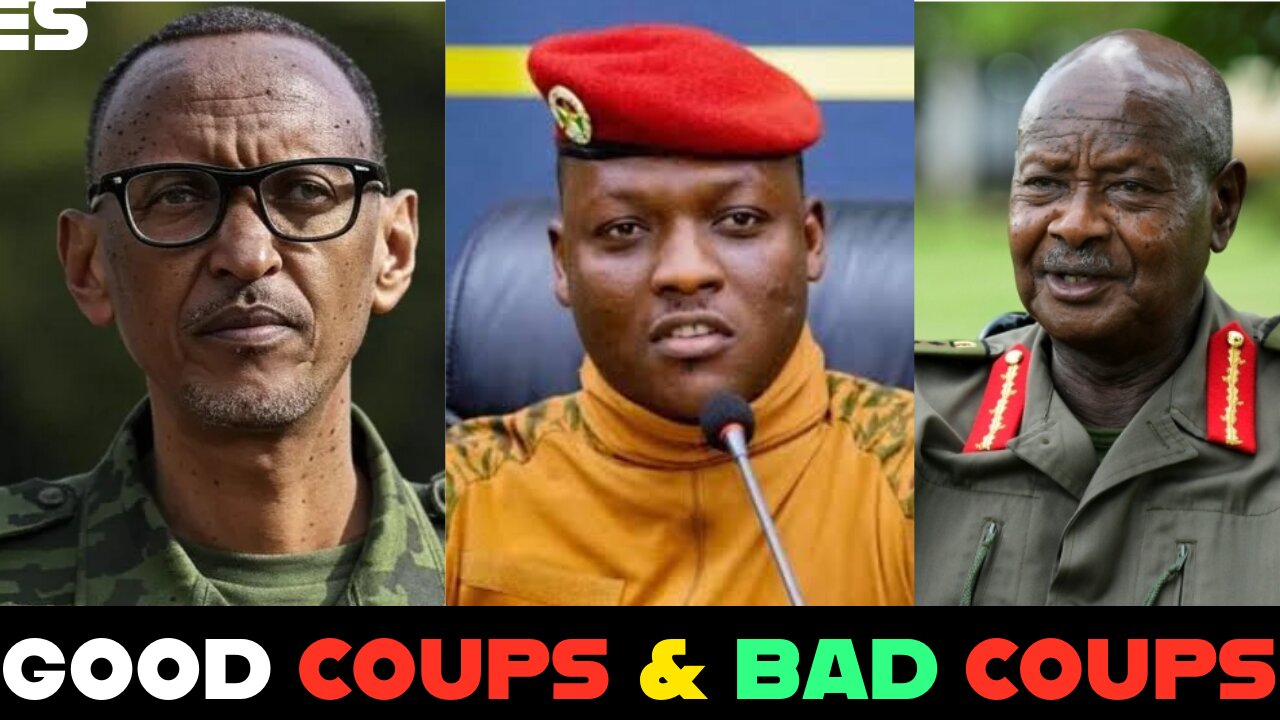
Good Coups, Bad Coups - When Military Takeovers Lead to Disaster.
Good Coups, Bad Coups - When Military Takeovers Lead to Disaster.
In a controversial stance, Rwandan President Paul Kagame stated, "For me, there are good coups and bad coups," arguing that military takeovers are often a reflection of poor governance—a symptom of leaders "lying, stealing, repressing, and manipulating elections." This video dissects this polarizing view, concentrating on the "bad coups" that failed to deliver change or, worse, plunged nations into greater turmoil.
🚨 The Peril of "Bad Coups" and Failed Promises
Kagame defines "bad coups" as those driven by "reckless officers who take power simply because they command guns." These military interventions often lack legitimate popular support, are fueled by factional or personal greed, and typically fail to address the core issues that led to the original instability.
The Cycle of Instability: Instead of fixing a nation, failed or poorly executed coups often initiate a "coup contagion," further weakening state institutions and making them vulnerable to future military interventions. This perpetuates cycles of poverty, violence, and long-term political instability.
The Worsening Outcome: Kagame warned that a coup is only justifiable "if they lead to improvement." If the new regime commits the "very things you overthrew people for—or do worse—then why did you carry out the coup?" These types of coups, where a nation replaces one corrupt or repressive regime with another, are the ultimate failure, often resulting in increased state repression rather than a reduction in it.
Case Studies in Failure: Historically, various coup attempts have failed due to a lack of military support or a failure to anticipate popular resistance, like the 2016 attempted coup in Turkey. Similarly, repeated coups in West African nations like Mali and Niger highlight how military intervention can ultimately hinder political and economic progress instead of accelerating it.
✅ The Argument for a "Good Coup" (The Benefits)
While almost universally condemned by international bodies, the theoretical "good coup" has historical and academic proponents who argue it can, under specific circumstances, be a necessary evil:
Restoring Order and Halting Decline: A military takeover can, in some views, "halt the rapid mobilization of social forces into politics and into the streets" and "defuse the explosive political situation" caused by a collapsing or highly corrupt civilian government. This is seen as a way to "restore order without the need for repression."
Removing Autocratic Rulers: Proponents argue a coup can sometimes enhance democracy and human rights by removing entrenched, autocratic rulers who have abused their power, lied, and manipulated elections.
Forcing Constitutional Reform: A successful coup can act as a shock to the political system, triggering essential constitutional reform and creating an opening for democratic elections, especially in deeply authoritarian systems where no other means of change is available.
Ultimately, the difference, according to Kagame, is one of governance. A bad coup is a reckless seizure of power, whereas a "good coup" is an extreme, stinky response to a fundamental breakdown of the contract between the ruler and the ruled.
#PaulKagame
#Coup
#MilitaryCoup
#PoliticalInstability
#GoodGovernance
#AfricanPolitics
#Geopolitics
-
 1:14:43
The Illusion of Consensus
23 hours agoModern Dating is a DISASTER — Evolutionary Psychologist Explains Why
7.31K -
 LIVE
LIVE
The Big Mig™
2 hours agoIlhan & Tampon Tim Turned Minnesota Into Mogadishu”s ATM
2,833 watching -
 LIVE
LIVE
Badlands Media
7 hours agoBadlands Daily: 12/9/25
3,598 watching -
 LIVE
LIVE
Wendy Bell Radio
6 hours agoTrump is +5
6,532 watching -
 DVR
DVR
DML
1 hour agoDML LIVE: Why We Are Losing Our Youth
14.6K3 -
 1:11:10
Chad Prather
14 hours agoThe Ripple Effect of a Changed Life: How God Uses Your Transformation
85.1K61 -
 1:40:06
MichaelBisping
11 hours agoBelieve You Me 660: UFC 323 Was A PROBLEM Ft. Chris "The Problem" Duncan
24.6K2 -
 8:03
8:03
Navy Media
4 days agoHow Aircraft Carriers Prepare 17,000 Meals A Day For 5,000 US Navy Sailors
13.4K4 -
 13:32
13:32
China Uncensored
23 hours agoChina Just Messed Up BIG
45.1K27 -
 25:32
25:32
RealReaper
23 hours ago $3.10 earnedThe New Witcher Movie - The Rats Is Unbearably Cringe
27.2K9