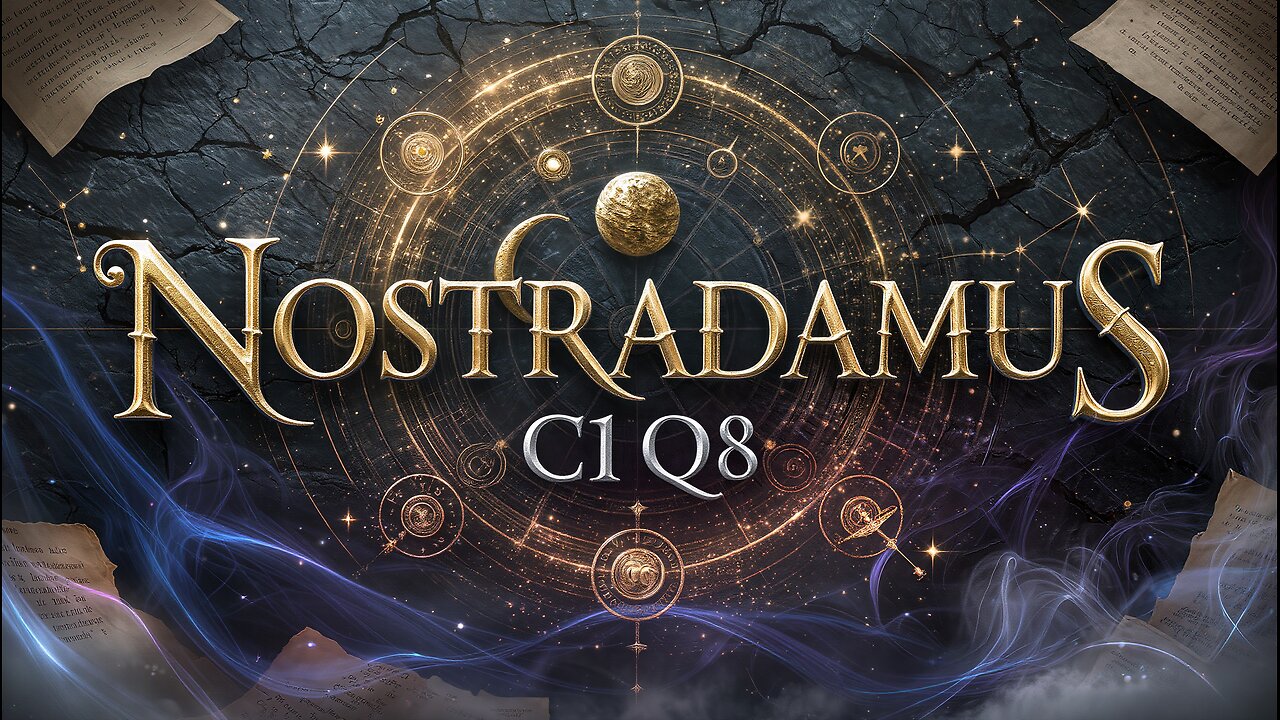
Nostradamus | Century 1, Quatrain 8
This quatrain unfolds like a slow-motion collapse of sanctity, its symbols coalescing around a singular prophetic arc. The triad—Revelation, Desecration, Judgment—frames the progression of vision: first the sacred is exposed, then it is violated, and finally it is held accountable. Nostradamus, ever elusive, does not warn linearly. He paints collapse through the reflection of symbols—each a mirror of deeper truths echoing across time.
Revelation begins with the lightning strike to the abbot, a sudden rupture in perceived holiness. Whether this strike is divine illumination or condemnation, it signals that what was hidden—hypocrisy, pride, corruption—can no longer be contained. The holy man becomes the first casualty not because he is worst, but because he is most visible. Institutions built to shelter truth often become the places where its absence screams the loudest. The lightning is not random; it strikes the highest point.
Desecration follows, not only with the image of the specter but in the piercing of two within the temple. The ghost is not mere haunting—it is the return of consequences, the embodiment of suppressed truths. And inside the sacred space, something internal breaks. Two are transgressed—perhaps brothers, perhaps co-conspirators, or even symbolic of dual aspects of faith and law—both wounded by the unraveling they refused to name. The sanctuary is no longer a refuge. It is ground zero for spiritual failure.
Judgment comes not as a voice, but as a figure: the black monk, standing before a weeping river. Black robes often symbolize hidden knowledge or corrupt wisdom—someone who knows, but does not act to prevent. He stands not in power, but in witness, just as the river weeps. The flow of history observes what unfolds and cannot be dammed. Once desecration has begun, time itself bears the scars. The image evokes not just the downfall of a man or a building, but the erasure of moral order from the timeline.
These three—revelation, desecration, judgment—are not events, but modes of experience through which institutions fall. Prophecy here is not a crystal ball—it is a lens. And Nostradamus forces us to look. What sacred structure in our world today hides its cracks beneath ornament? What temple still stands that should have already been humbled? The prophecy lives not because it predicts, but because it recognizes.
So we are left with the pattern: lightning strikes, ghosts appear, temples bleed, rivers cry. And standing at the edge is the one who knew, who did not speak, who now watches the pattern complete. In every age, there is a black monk at the river. In every age, the temple stands just a little too long. And in every age, the prophecy waits.
-
 1:06:11
Inverted World Live
9 hours agoA Ghost Ship in Washington, A Fire in Roswell | Ep. 155
56.3K4 -
 3:06:55
TimcastIRL
5 hours agoDan Bongino To RESIGN, Trump Addresses The Nation
322K359 -
 2:14:08
Barry Cunningham
4 hours agoLIVE BREAKING NEWS: President Trump Addresses The Nation! And More News!
45.3K15 -
 LIVE
LIVE
ThatStarWarsGirl
6 hours agoTSWG LIVE: Discussing STAR WARS News with Special Guest Star Wars Theory!
384 watching -
 2:42:40
Laura Loomer
4 hours agoEP162: LIVE: President Trump Addresses The Nation
47K20 -
 1:32:05
Adam Does Movies
9 hours ago $1.06 earnedRob Reiner Films + Movie News + AMA - Live!
18.9K -
 47:57
47:57
Professor Nez
8 hours ago🚨LIVE NOW: President Trump Addresses the Nation from the Oval Office
21.4K23 -
 28:17
28:17
The White House
5 hours agoPresident Trump Delivers an Address to the Nation
66.4K113 -
 LIVE
LIVE
Drew Hernandez
21 hours agoTRUMP ADDRESSES THE NATION & BONGINO ANNOUNCES FBI DEPARTURE?
1,073 watching -
 2:37:30
Badlands Media
15 hours agoBadlands Media Special Coverage - MY FELLOW AMERICANS the Alpha Warrior Show & Redpill Project
59.6K20