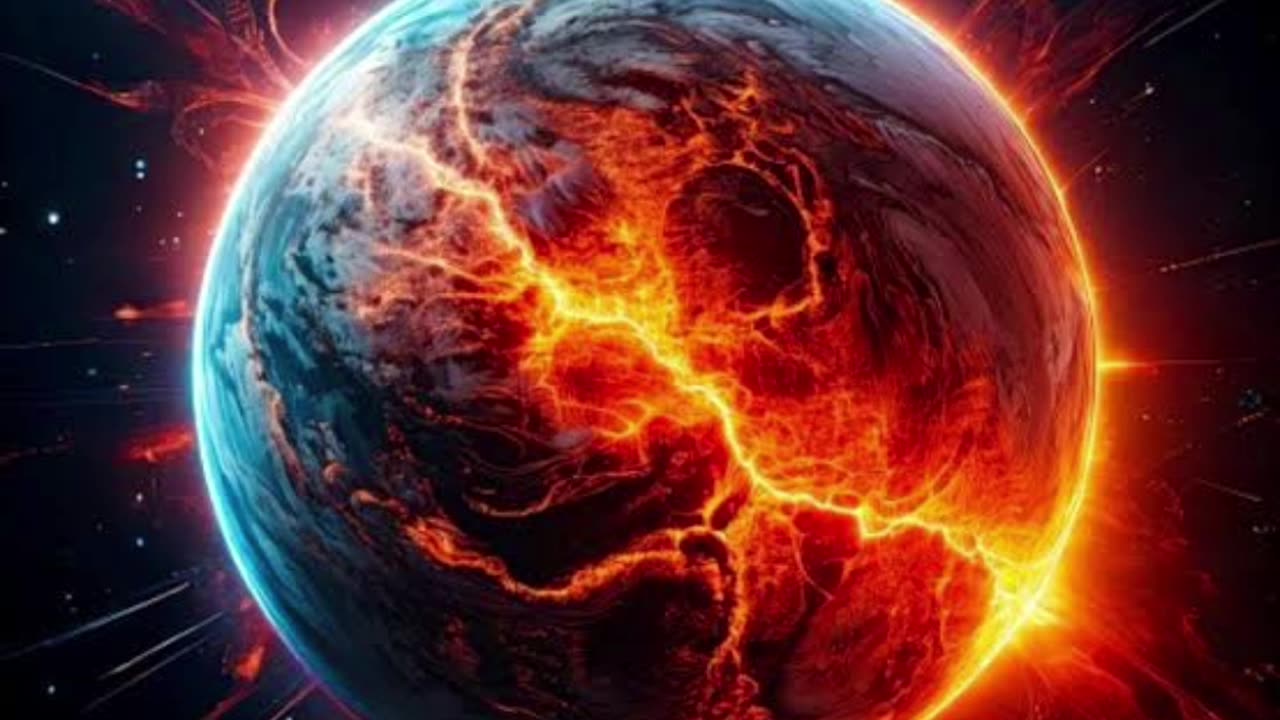
Earth’s Core Just Reversed — What That Means for You
#EarthsCore #InnerCore #Geophysics #SpaceScience #MagneticField#Seismology #EarthScience #ScienceExplained #ClimateAndSpace #Geology #ScienceNews
Earth’s core rotation reversal
Inrecent seismic studies show the Earth’s solid inner core has slowed and begun to backtrack relative to the surface, a subtle change deep below our feet that is scientifically important but poses no immediate danger to daily life.
The discovery began with careful analysis of seismic waves from repeating earthquakes and historical nuclear tests, which let researchers track tiny changes in how waves travel through the inner core. Scientists found that the inner core’s rotation slowed around the early 2000s and began to lag behind the mantle and crust by about 2008–2010, overturning earlier ideas that it steadily “super‑rotated” faster than the surface. These results come from a large dataset spanning decades and multiple seismic sources, and they give geophysicists a clearer picture of how the deepest part of our planet moves.
Saying the inner core has “reversed” its rotation is shorthand for a relative change in motion: the solid iron‑nickel sphere at Earth’s center is now rotating slower than the overlying layers and in some analyses appears to be backtracking relative to the surface reference frame, not that the core suddenly spins like a separate planet in the opposite direction. The inner core is about 3,000 miles beneath us and is surrounded by a convecting liquid outer core; interactions between the liquid flow, electromagnetic forces, and gravitational coupling with the mantle can speed up, slow down, or even reverse the inner core’s tiny differential motion over decades. These are small angular changes measured indirectly through seismic waveform shifts rather than direct observation.
Why this matters is mainly scientific: the inner core’s motion is tied to the dynamics that generate Earth’s magnetic field, which arises from flows in the liquid outer core. Changes in inner‑core rotation provide new constraints on models of core convection, viscosity, and magnetic field generation, helping researchers understand long‑term magnetic behavior and past geomagnetic reversals. In practical terms, the magnetic field that shields us from solar wind and cosmic radiation is governed by large‑scale outer‑core processes; a modest change in inner‑core rotation does not translate into an immediate collapse of that shield, but it may influence how the field evolves over decades to centuries.
For the public, the takeaway is reassuring: this is a subtle, slow geophysical process, not an abrupt catastrophe. There is no evidence that the inner‑core slowdown will cause earthquakes, sudden climate shifts, or immediate magnetic failures. Instead, the finding refines our scientific models and helps improve long‑range forecasts of geomagnetic behavior, which can matter for satellite operations, navigation, and long‑term climate proxies. Continued seismic monitoring and modeling will clarify whether this is part of a multi‑decadal oscillation or a longer trend.
-
 LIVE
LIVE
Amish Zaku
1 hour agoArc Raiders - cash runs before reset week
21 watching -
 LIVE
LIVE
Biscotti-B23
2 hours ago🔴 LIVE $100+ TOURNAMENT! TSUGUKU TRIALS 🏆 DEMON SLAYER HINOKAMI CHRONICLES 2
37 watching -
 1:45:46
I_Came_With_Fire_Podcast
12 hours agoCatching Online Predators: Sting Operations & Saving Kids
117K6 -
 2:02:00
MetatronGaming
19 hours agoDollmare is a NIGHTMARE
15.7K -
 56:57
56:57
X22 Report
8 hours agoMr & Mrs X - Accusing People Of Murder Is Dangerous, Charlie Kirk's Message Was Unity - EP 19
82K72 -
 2:09:23
SOLTEKGG
4 hours ago🔴LIVE - ALL THE GOOP - !pc
17.9K -
 1:37:19
CodeBlueParadox
4 hours ago🔴LIVE - WALKING DEAD (SEASON 1) | 0/10 SUB GOAL | #LockNLoad BASH
24.4K -
 LIVE
LIVE
Atarphriel
4 hours ago🦾Warframe🦾Returning Player🏂📰News🎮Games🍿Reacts📺Stream 65
40 watching -
 9:20
9:20
ThatStarWarsGirl
1 day agoStar Wars Fate of the Old Republic TRAILER REACTION!
37.8K12 -
 3:38:37
The Craig Stream
1 day agoBloodborne BLIND DLC - Old Hunters NIGHTMARE Begins! LIVE #9 🔪🩸
11.3K