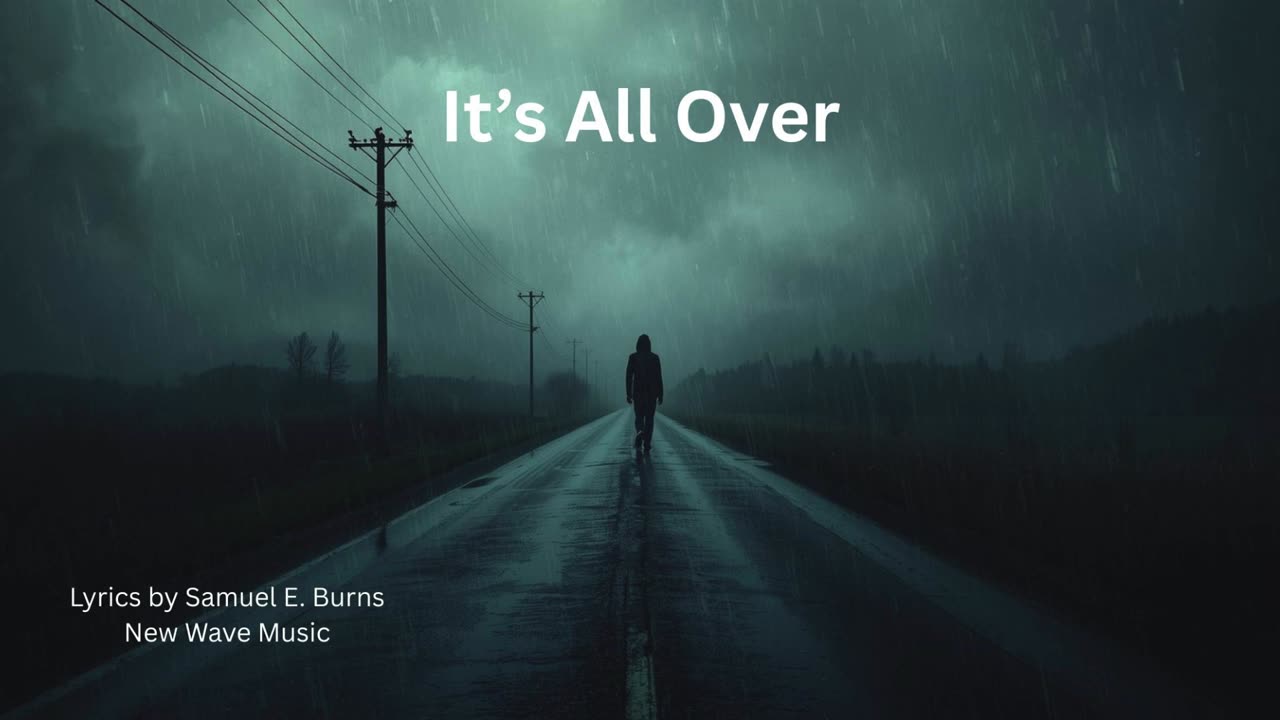
It’s All Over
It’s All Over is a somber, emotionally heavy breakup ballad that captures the cyclical nature of heartbreak the kind that repeats itself so often it becomes a familiar road, one the narrator knows all too well. Samuel E. Burns delivers a song steeped in exhaustion, disillusionment, and the quiet devastation of finally admitting an ending that has been a long time coming.
The repetition of the opening stanza “I’ve walked down this road / So many times” sets the tone: this isn’t a sudden collapse but a pattern, a wound reopened again and again. Burns uses imagery of distance and displacement “On some distant shore, a new name” to show how every ending forces the narrator to redefine himself, to rebuild the hollowed-out remnants of what was lost. It’s one of the song’s strongest metaphors, painting heartbreak as a kind of exile.
Central to the piece is the idea of an “endless game,” a relationship stuck in a loop of love, loss, and disappointment. Lines like “This world keeps shifting / But we stay the same” highlight the stagnation, the futility of fighting for something that no longer exists. The repeated refrain “They tear us apart / There’s nothing left to save” underscores the inevitability of the breakup. Even the structure of the song mimics the theme of repetition, mirroring the cycles the narrator is desperate to escape.
Burns leans into emotional rawness when he writes, “How can you stand there / With your cold, cold heart?” This line simple, almost spoken hits hard. It’s not poetic flourish but plain truth delivered with the sting of betrayal. The verse that follows, centered on promises never kept, adds depth by acknowledging not just heartbreak but the erosion of trust over time.
The song’s middle section, where the narrator confesses “I’m running in the dark / But there’s no place to hide” reveals a shift from blaming the relationship to confronting the personal scars left behind. The repetition of “No place to heal / No place to hide” is haunting an emotional echo chamber that reflects the feeling of being trapped by one’s own pain.
When the final chorus comes “It’s all over now, baby” it doesn’t feel angry or triumphant. Instead, it feels tired, resigned, almost whispered. Burns resists the urge to dramatize the ending; he lets the plainspoken phrasing carry the weight. The breakup isn’t explosive. It’s inevitable.
Overall, It’s All Over is a powerful, melancholic piece that captures the quiet devastation of a love that has failed too many times to recover. Burns writes with a weary honesty that makes the song feel lived-in, real, and deeply human. It's a breakup song not of fireworks, but of ashes a final exhale after a long, painful journey.
-
 3:09
3:09
New Wave Music
1 day agoLet’s Dance
21 -
 21:27
21:27
Tucker Carlson
4 hours agoTucker and Qatar’s Prime Minister React to Trump’s Move Against Bibi
50.9K161 -
 LIVE
LIVE
POLARHAYWYR
1 hour agoSunday stream
36 watching -
 LIVE
LIVE
OptimusDan
57 minutes agoSunday goes Jurassic.... World
47 watching -
 LIVE
LIVE
Astral Doge Plays!
9 hours agoHyrule Warriors: Age of Imprisonment ~LIVE!~ Last of the Korok Seeds
29 watching -
 LIVE
LIVE
Lofi Girl
2 years agoSynthwave Radio 🌌 - beats to chill/game to
254 watching -
 2:41:36
GamerGril
3 hours agoThe Long Awaited Playthrough 💕Resident Evil 7💕
16.9K2 -
 4:14:08
SpartakusLIVE
6 hours agoEarly ARC Stream for EXPEDITION Prep || WZ Buybacks LATER
257K9 -
 1:01:02
Jeff Ahern
5 hours ago $5.96 earnedThe Sunday Show with Jeff Ahern
33.7K14 -
 LIVE
LIVE
Spartan
3 hours agoPro Halo Player now working a full time job comes home and plays Valorant Ranked
90 watching