PCR was usually wrong
A calibration of nucleic acid (PCR) by antibody (IgG) tests in Germany: the course of SARS-CoV-2 infections estimated
https://www.frontiersin.org/journals/epidemiology/articles/10.3389/fepid.2025.1592629/full
Germany, authority-accredited laboratories (ALM)
Conducted 90% of SARS-CoV-2 polymerase chain reaction (PCR) tests
(March 2020 until January 2023)
AND
Conducted serological mass tests for IgG antibodies,
observed IgG seroprevalence trajectory.
THEREFORE
Test-positive fractions of PCR and IgG tests
Value of 0.14 found for the fitted scaling parameter
Therefore, 14% of those who were tested PCR-positively actually became infected with SARS-CoV-2.
ALSO
A quarter of the German population carried IgG antibodies from natural infections in their blood at the turn of the year from 2020 to 2021.
Second, independent analysis
Germany-specific ratio of 1:10 for ratio between one positive PCR test and the corresponding number of persons actually infected with SARS-CoV-2
Align well to perfectly with the IgG-positive fraction (92%) reported by the Robert Koch Institute at the end of 2021.
More details
Breaching the epithelial–mucosal barrier—“breach” meaning the invasion of a person’s organism by active viral material,
it is common scientific terminology to say that “the person has become infected”
Active viral material entering the mucus or epithelial cells may be bound and possibly already neutralized by IgA antibodies.
In most infection cases, particularly when symptoms occur, IgG antibodies will also become detectable in the blood.
The presence of IgG antibodies in the blood is representative of the body’s immunological memory of infections.
IgG antibodies remained detectable for up to a year in at least 90% of naturally infected SARS-CoV-2-IgG-positive individuals
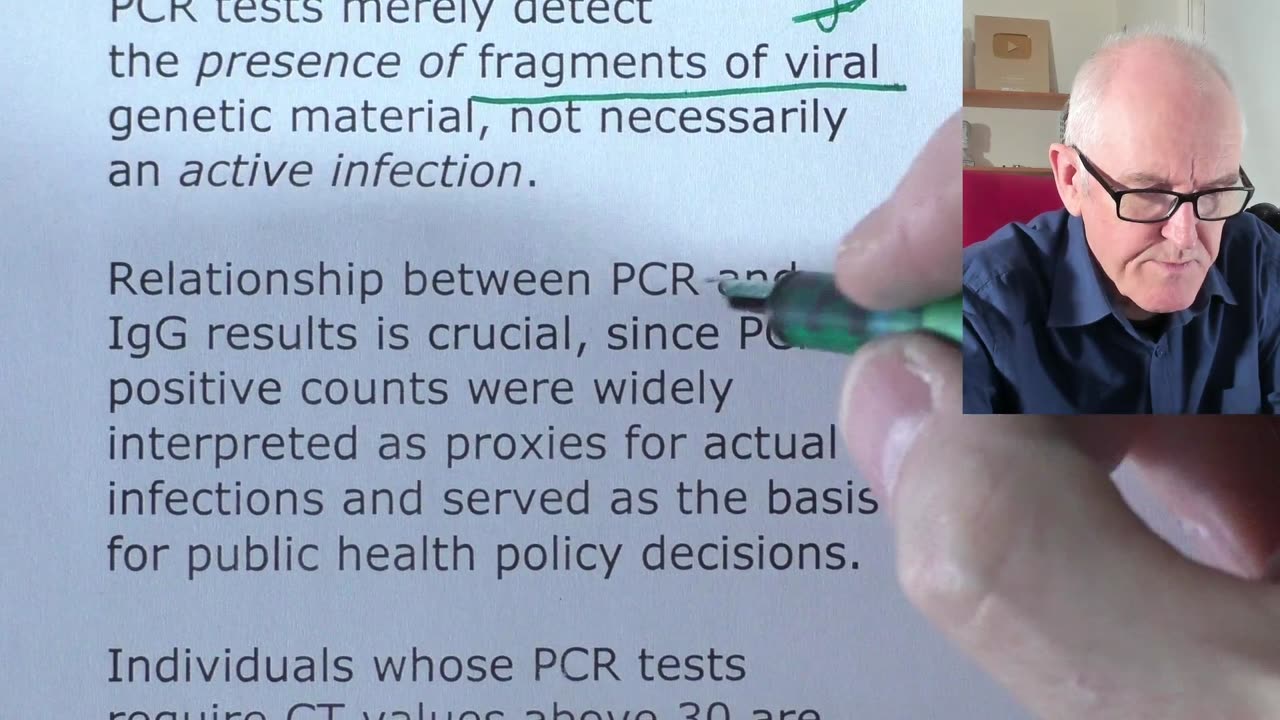
PCR tests merely detect the presence of fragments of viral genetic material, not necessarily an active infection.
Relationship between PCR and IgG results is crucial, since PCR-positive counts were widely interpreted as proxies for actual infections and served as the basis for public health policy decisions.
Individuals whose PCR tests require CT values above 30 are commonly not to be considered infectious, whereas in practice, many tests were conducted with CT values up to 40
PCR assay produced positive results on water controls at cycle threshold (CT) values between 36 and 38
In short, a PCR test provides a snapshot of an individual’s current exposure to viral genetic material at the outermost layers of the body.
Lancet, 2020
https://www.thelancet.com/journals/lanres/article/PIIS2213-2600%2820%2930453-7/fulltext
RT-PCR assays in the UK have analytical sensitivity and specificity of greater than 95%
UK Government, 2020
Examining data from published external quality assessments (EQAs) for RT-PCR assays for other RNA viruses carried out between 2004 to 2019
Results of 43 EQAs were examined, giving a median false positive rate of 2.3%
New England Journal of Medicine, 2024
https://www.nejm.org/doi/full/10.1056/NEJMc2313517
Among 11,297 participants who performed 76,610 days of testing, 1.7% had at least one false positive rapid antigen test.
-
 1:19:47
Dr. John Campbell
14 days agoFull covid interview with Professor Clancy
13.5K37 -
 2:17:03
TheSaltyCracker
6 hours agoMeme Warfare Goes Nuclear ReeEEStream 12-07-25
97.3K225 -
 1:29:32
Adam Does Movies
11 hours ago $3.13 earnedBest Action Movies! - Live
23K1 -
 3:01:37
Badlands Media
21 hours agoThe Narrative Ep. 49: The Trump Doctrine
54.5K23 -
 LIVE
LIVE
This is the Ray Gaming
4 hours ago $0.84 earnedThe Fire Rises | Rumble Premium Creator
228 watching -
 2:50:39
Joker Effect
4 hours agoDRAMA NEWS! KICK CRINGE AWARDS?! LONEWOLF INTERVIEW!??? !Shock in Chat for details. RECIEPTS HERE!
12.2K1 -
 1:09:13
Sarah Westall
6 hours agoThe Psychological Warfare Behind the Headlines w/ Mike Robinson
16.4K4 -
 2:18:57
vivafrei
16 hours agoEp. 294: Pipe Bomber Caught? Pfizer Fraud before Appeals! Venezuela Boat Strikes! EU v. Elon & MORE!
202K147 -
 5:53:00
EricJohnPizzaArtist
2 days agoAwesome Sauce PIZZA ART LIVE Ep. #72: John Lennon
20.6K6 -
 DVR
DVR
meleegames
5 hours agoSteam Roulette Sunday! - Chaos Is Back in Town
12.4K