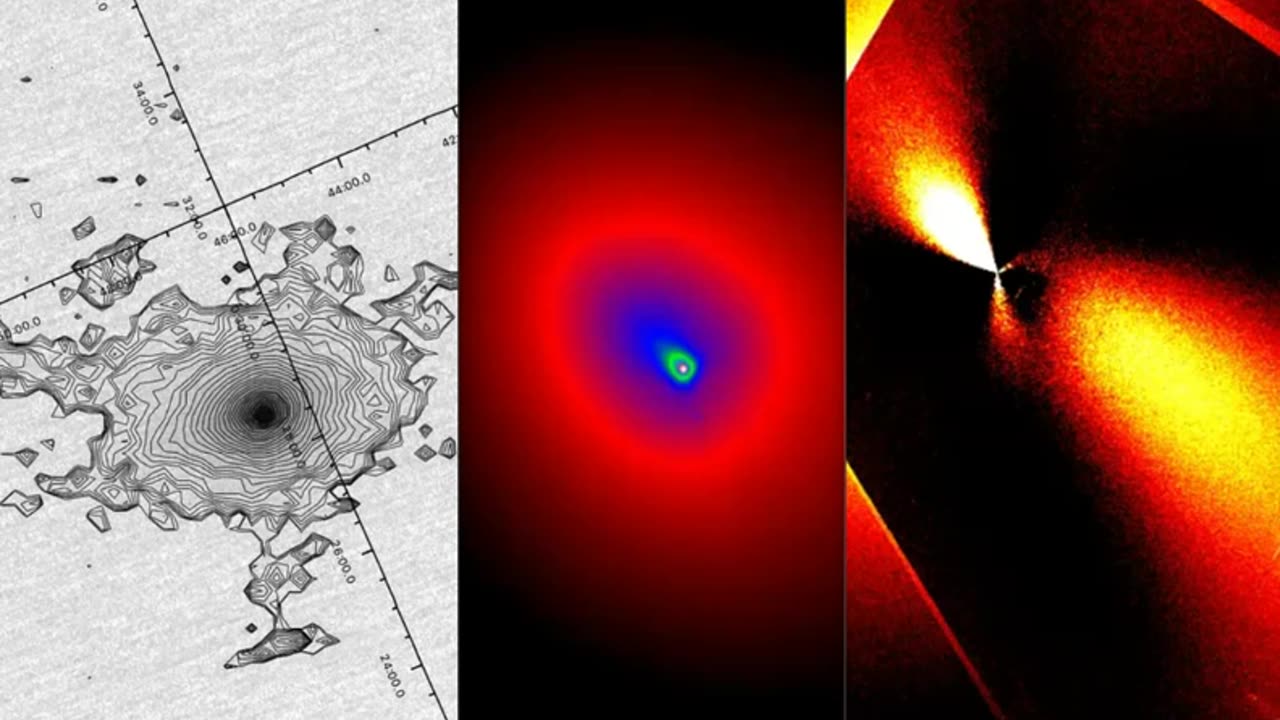
Is 3I/ATLAS Friendly or Dangerous? Interstellar Object Is Emitting Chemical Building Blocks for Life
DAHBOO77
Dec 7, 2027
Is 3I/ATLAS Friendly or Dangerous? Interstellar Object Is Emitting Chemical Building Blocks for Life
https://www.youtube.com/watch?v=hlAzTqr4BoY
The interstellar comet 3I/ATLAS is belching out carbon-rich chemical compounds at higher rates than almost any other comet in our solar system. One of these compounds is methanol, a key ingredient in prebiotic chemistry that hasn’t been seen in other interstellar objects.
Spectroscopic observations of the interstellar object 3I/ATLAS by the Atacama Large Millimeter/Submillimeter Array (ALMA), were reported here to detect methanol (CH3OH) and hydrogen cyanide (HCN). These molecules are known to form on icy dust grains in the cold interstellar medium and act as key precursors for the complex organic chemistry relevant to the origins of life.
ALMA detected methanol near 3I/ATLAS August 28, September 18 and 22, and October 1, 2025, as well as hydrogen cyanide on September 12 and 15, 2025. The pre-perihelion distances from the Sun ranged between 2.6 to 1.7 au (where 1 au is the Earth-Sun separation). The hydrogen-cyanide production was found to be depleted in the sunward direction, whereas methanol was enhanced in that direction. Some methanol was produced in the gas plume itself at distances beyond 258 kilometers from 3I/ATLAS. In contrast, hydrogen-cyanide production was found to originate from the nucleus. The methanol production rate increased dramatically from August through October with a power-law dependence on heliocentric distance to the -5.2 (+/-0.6) power. The derived ratios of methanol to hydrogen-cyanide in 3I/ATLAS are among the largest measured in any comet, surpassed only by the anomalous solar system comet C/2016 R2 discovered by PanSTARRS.
What is the biological significance of methanol or hydrogen cyanide molecules?
Methanol is abundant in star-forming regions. For example, in 2006 the MERLIN array of radio telescopes at the Jodrell Bank Observatory discovered a large cloud of methanol near a newly-formed star (as reported here), and in 2016 ALMA detected methanol in a planet-forming disc around the young star TW Hydrae.
Learn More:
https://www.newscientist.com/article/...
/ end-of-november-images-of-3i-atlas
Your Support of Independent Media Is Appreciated.
https://www.buymeacoffee.com/DAHBOO7
https://www.paypal.com/paypalme/dahboo7
SOL- 4SdUxoJs8dfRtwMdUU5QTf4RMPix6cKiUWJGk8dcBn3R
AXIOM Trade- https://axiom.trade/@dahboo7
Socials-
DLive- https://dlive.tv/DAHBOO7
Rumble- https://rumble.com/c/DAHBOO7
Instagram- / dahboo7
Surviving End Times - / dahboo777
/ dahboo7
UWN Facebook- / dahboo7
-
 24:57
24:57
Rolling With You
7 hours agoThe Angry Astronaut-13...no...12 days to go!! 3I Atlas is doing crazy things!
265 -
 16:25
16:25
GritsGG
14 hours agoWe Were Not Supposed to Regain BUT WE DID! Insane Warzone Victory!
6.5K -
 1:11:16
omarelattar
5 days agoHow I Went From Depressed w/ $0 To $500 Million Per Year In My 20's (COMFRT CEO Hudson Leogrande)
20.2K -
 24:45
24:45
Blabbering Collector
2 days agoUnboxing The 2025 Diagon Alley Advent Calendar By Carat Shop | Harry Potter
30.8K4 -
 LIVE
LIVE
Lofi Girl
3 years agolofi hip hop radio 📚 - beats to relax/study to
510 watching -
 9:48
9:48
MetatronCore
2 days agoHasan Piker ULTIMATE Crash Out!
7.4K1 -
 3:33:47
Nerdrotic
11 hours ago $16.94 earnedNerdrotic At Night 541
184K3 -
 1:22:35
Man in America
12 hours agoThe DISTURBING Truth About Child Protection Services w/ Ryan Matta
85K33 -
 14:16
14:16
Robbi On The Record
16 hours ago $23.46 earnedThe Collapse of Masculinity: What Happened to Men?
38.9K37 -
 2:32:07
Side Scrollers Podcast
10 hours agoSPECIAL OCCASSION: ADMITTING THE TRUTH...
115K8