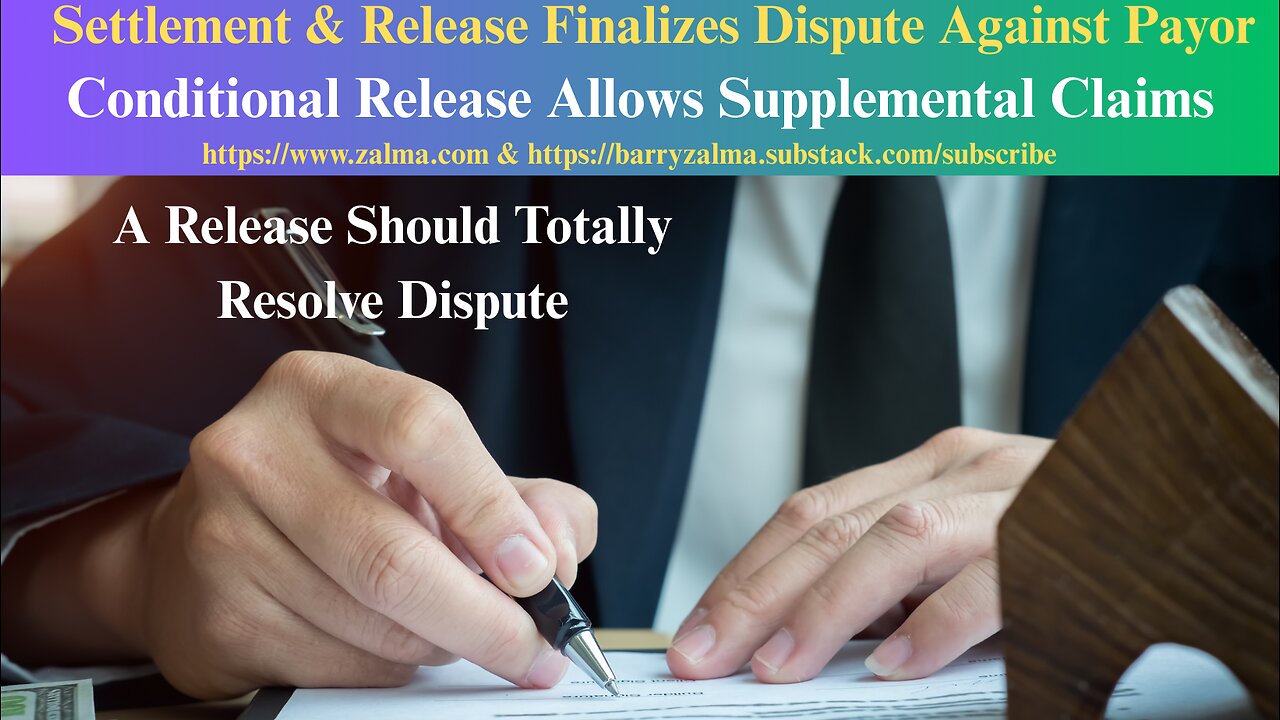
Settlement & Release Finalizes Dispute Against Payor
Conditional Release Allows Supplemental Claims
Post 5238
A Release Should Totally Resolve Dispute
I
n Harvey et al. v. Hall, No. A25A1774, Court of Appeals of Georgia, Fourth Division (December 3, 2025) Paul Harvey, an employee of Arthur J. Dovers (d/b/a 3D Mobile Home Services), drove a truck towing a trailer loaded with machinery and equipment. Harvey fell asleep, veered off the road, and crashed into a culvert, causing Lamar Hall serious injuries.
FACTS OF SETTLEMENT
On August 18, 2020, Hall signed a limited liability release under OCGA § 33-24-41.1, releasing Harvey, Dovers, and their insurer (Georgia Farm Bureau Insurance Company) from liability for the accident in exchange for $50,000, "except to the extent other insurance coverage is available which covers the claim."
Dovers's general liability insurer (Republic-Vanguard Insurance Company) denied coverage, citing a policy exclusion for bodily injuries from automobile use or entrustment. Dovers's commercial auto insurer (Wesco Insurance Company) denied coverage, stating the truck was not a covered vehicle. Hall filed a personal injury suit against Harvey and Dovers, seeking over $557,000 in medical expenses.
PROCEDURAL POSTURE
Harvey and Dovers moved for summary judgment, arguing the release barred Hall's claims absent evidence of other available insurance coverage. The trial court denied the motion via summary order without explanation. Harvey and Dovers appealed.
ISSUE
Whether the trial court erred in denying summary judgment, given the limited release and lack of evidence of other insurance coverage.
Limited Release under OCGA § 33-24-41.1:
A statutory mechanism allowing settlement with a tortfeasor's liability insurer up to policy limits while preserving claims for underinsured motorist (UIM) benefits or other available coverage.
It releases the tortfeasor and settling insurer from personal liability but permits pursuit of judgment against the tortfeasor solely to access other insurance.
Affirmative Defense Burden:
Defendant must prima facie establish the defense (e.g., via the release document). The burden then shifts to plaintiff to produce evidence creating a jury issue (analogous to surviving a directed verdict). Failure to do so warrants summary judgment.
Application:
Appellants met their burden by submitting the release and insurers' outright coverage denials. Hall produced no evidence (e.g., policy analysis or litigation against insurers) showing coverage under Wesco/Republic-Vanguard policies or elsewhere.
Rejection of Hall's Arguments:
Denial letters do not "prove existence" of coverage; they affirm non-coverage. Hall could have litigated coverage against the insurers but did not, forfeiting the claim.
HOLDING
Harvey and Dovers were entitled to summary judgment as a matter of law, as Hall failed to produce evidence of available other insurance coverage to overcome the affirmative defense of release.
ZALMA OPINION
When an insurer settles a claim against an insured it will usually obtain a release from the claimant eliminating any further claims against the insured for the accident. In this case, the release allowed the plaintiff to sue the insured again to see if it could find further insurance available to pay Hall for his injuries. Hall tried and failed in an effort that could be avoided entirely if the release was not conditional literally encouraging litigation against the insured and its insurers.
(c) 2025 Barry Zalma & ClaimSchool, Inc.
Please tell your friends and colleagues about this blog and the videos and let them subscribe to the blog and the videos.
Subscribe to my substack at https://barryzalma.substack.com/subscribe
Go to X @bzalma; Go to Barry Zalma videos at Rumble.com at https://rumble.com/account/content?type=all; Go to Barry Zalma on YouTube- https://www.youtube.com/channel/UCysiZklEtxZsSF9DfC0Expg; Go to the InsuranceClaims Library – https://lnkd.in/gwEYk.
-
 7:40
7:40
Insurance Law
3 days agoExpert's Personal Knowledge or Experience Can Assist Jury
26 -
 1:52:23
Redacted News
2 hours agoTucker Carlson Drops Epstein BOMBSHELL, DOJ deleting files with Rothschild connections | Redacted
98.3K75 -
 1:17:52
vivafrei
3 hours agoWhy Has the Civil Rights Division IGNORED Alex Jones Persecution? Matt Walsh CROSSES A LINE! & MORE!
46.4K36 -
 LIVE
LIVE
Rallied
1 hour agoWarzone LIVE Entertainment | #1 SOLO WINS | #1 SOLO KD | #1 COMMUNITY
74 watching -
 LIVE
LIVE
GrimmHollywood
8 hours ago🔴LIVE • GRIMM HOLLYWOOD x CASEY • TRADER JOE v BARGAIN BOB • ARC RAIDERS • RIVAL TRADERS •
48 watching -
 LIVE
LIVE
Meisters of Madness
1 hour agoBreaking Skyrim - Part 2
72 watching -
 1:17:00
Russell Brand
4 hours agoThe Cost of Facing the Past — SF683
103K8 -
 12:26
12:26
Clyde Do Something
7 hours ago $1.02 earnedPresident Trump SUPPORTS Alberta’s Right to Leave Canada
15.5K7 -
 7:52
7:52
Isabella Moody
2 hours agoWomen Like THIS Are Why Men Don’t Want to Get Married Anymore
9.28K11 -
 LIVE
LIVE
freecastle
6 hours agoTAKE UP YOUR CROSS- Let LOVE be WITHOUT hypocrisy. Abhor what is evil; CLING to what is GOOD!
156 watching