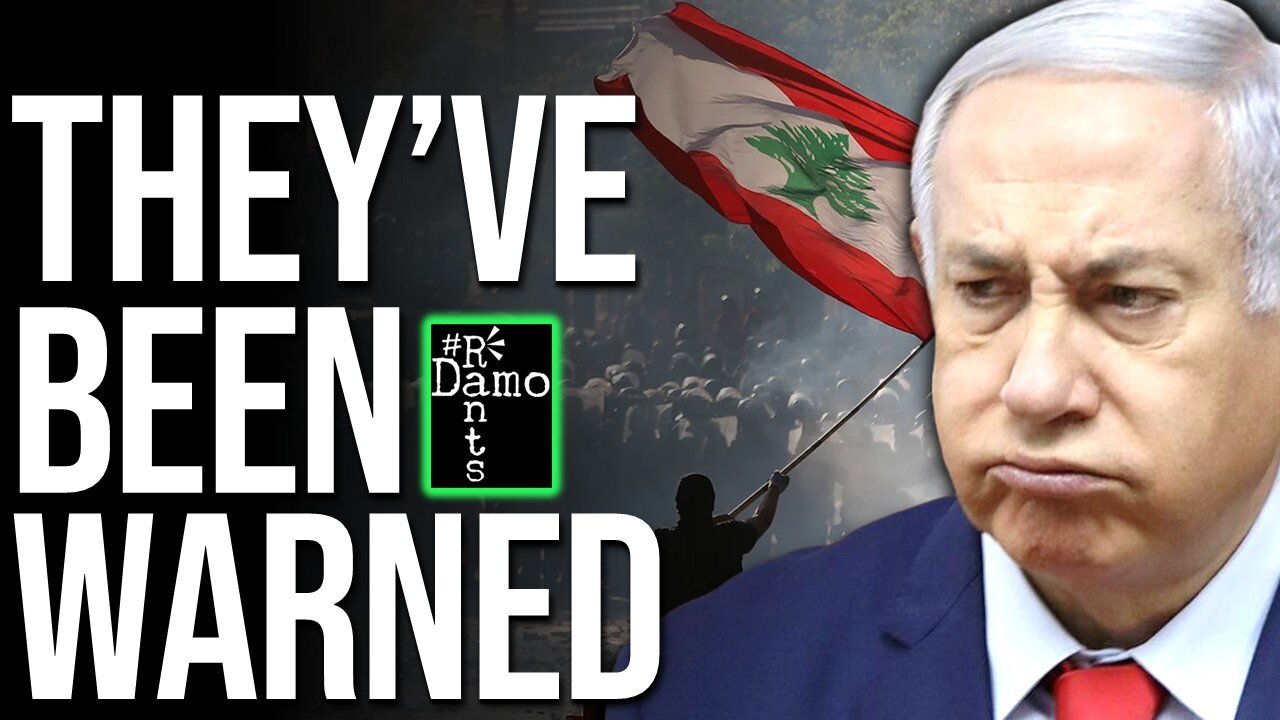
Hezbollah Reality Check From Unexpected Source Leaves Israel Reeling!
Right, so you can tell something’s gone badly wrong for Israel when the person spelling it out isn’t a critic, or some regional rival they can laugh off, but US Ambassador Tom Barrack of all people — a man who’s moved comfortably through the same US power circuits Israel depends on. When someone like that comes out and says Israel cannot defeat Hezbollah, he’s not trying to be provocative, he’s just stating the bit everyone inside the system knows already but never says. And that’s exactly why it stings so much. Israel has built years of policy on the claim that force can settle this, and here’s one of their own effectively admitting it can’t. So of course they’re rattled, because they’ve threatened to start up war on Lebanon again, not that they ever really stopped during this year long farce of a ceasefire, but also because once an insider speaks the truth plainly, you can’t stuff that line in the back of the proverbial sock drawer and pretend it isn’t true.
Right, so Israel’s cheeks are burning as they got told you aren’t big enough to win in Lebanon. That’s what has happened with Tom Barrack’s comment that Israel cannot defeat Hezbollah in effect. It isn’t an activist line. It isn’t rhetoric from one of the usual states in the region. It’s a statement made by a man who has been stitched into the political fabric of the United States for years, who has raised money for presidents, who has business ties across the Gulf, who has been treated as part of the ecosystem Israel relies on in Washington. When someone like that says Israel cannot win, he’s giving his assessment, one that mirrors what analysts and regional observers have been saying quietly for years even if officials refuse to say it out loud.
The significance of this moment is that it strips away the last layer of pretence around Israeli military doctrine in Lebanon. Because for twenty years Israel has sold the idea that Hezbollah can be degraded, cornered, or eliminated if necessary. It has demanded the Lebanese state disarm the group. It has insisted that the Israeli military remains unmatched and therefore capable of forcing any outcome it chooses. That story is central to Israeli policy. But it only works if people believe it. If the myth holds. If the image of unstoppable force remains intact. And Barrack’s statement lands precisely where that myth is most fragile: the gap between what Israel tells the world and what its own military planners already know.
Because the truth is simple. Hezbollah is not a militia Israel can uproot. It is not a temporary network. It is a deeply embedded political-military structure with a social base, an arsenal that has grown over years, and defensive positions built into geography that favours them. Israel can hit targets. It can escalate. It can flatten neighbourhoods. But none of that gets it the thing it claims to want — the disarmament or destruction of Hezbollah. And when someone like Barrack says it cannot be done, well they don’t like that. If force can’t deliver the outcome Israel keeps promising, then more strikes won’t solve anything. At that point Israel isn’t working toward a goal, it’s covering the fact it doesn’t have one. And once people see that, the usual claims of ‘necessity’ stop carrying weight.
And here’s the other truth Barrack’s admission forces into the open. If Israel cannot defeat Hezbollah, then the demand that Lebanon disarm it is not a diplomatic position. It’s a stall tactic. A blame-shifting device. A fantasy maintained because it provides Israel cover for the strikes it continues to carry out. Everyone knows the Lebanese state cannot disarm the group. The Lebanese Army knows it. Foreign diplomats know it. Israeli officials know it. That’s why Barrack called the idea unrealistic. And that’s the piece that should worry Israel the most. Because once the impossibility is spoken by someone from within their own supportive network, it all collpases. You cannot keep demanding something the world now openly recognises cannot happen.
So the question becomes: what does Israeli strategy look like once you strip away the illusion? The answer is disturbing, because it exposes how much of what Israel is doing in Lebanon is reactive rather than purposeful. The pager attack last year is a perfect example. It was designed to disrupt Hezbollah’s communication chain. It was meant to signal capacity and precision. But the extent of Hezbollah’s recovery remains unknown. And that’s the point. Israel cannot quantify the damage. It cannot measure the group’s remaining capability. It cannot map the full structure. Which means it cannot calibrate escalation effectively. And when a state with overwhelming firepower is operating without reliable information, it’s not controlling events. It’s chasing them.
That loss of control is what you see in the constant strikes across southern Lebanon, including the ones that even UN peacekeepers have now logged as violations of the border resolution. This isn’t a strategic campaign. It’s an attempt to demonstrate strength where strength is slipping away. Because if the Israeli public starts to believe that Hezbollah cannot be defeated, then political space collapses, and Israeli leaders lose the one narrative that allows them to escalate without question. So instead of confronting the limits Barrack has now articulated, they escalate further, hoping force can still carry the illusion even if it cannot deliver the reality.
But the danger here is that the more Israel escalates, the more it exposes the limits of its power. And Hezbollah’s entire strategy is built around absorbing blows and remaining operational whilst also very much keeping its cards close to its chest by remaining on stand-by throughout the ceasefire, leaving the state to try and deal with it. It doesn’t have to “win” in the sense Western strategists use the word. It just has to remain capable and with all the unknowns, how capable they are remains up in the air. And it has, even after assassination campaigns, even after strikes on convoys, even after drone attacks, and even after the pager incident. Nobody knows what Hezbollah has got back after that pager operation - whether they lost a chunk or rebuilt twice over - and that kind of uncertainty is exactly what stops Israel being able to talk about a winnable war with a straight face. You cannot defeat what you cannot fully see, cannot fully map, and cannot fully neutralise and you simply don’t know the capabilities of anymore.
Barrack’s comment about recruitment was another point Western audiences aren’t used to hearing from insiders. He used the official designation for Hezbollah — because he has to — but his point cut through the label. His point was about the pattern seen in long-standing armed political movements, where removing individual fighters does not remove the broader structure that replaces them over time. They don’t disappear when you eliminate fighters. They regenerate. And regeneration is a far more dangerous capability than firepower. Because regeneration means time favours them, not their opponent. They’ve had more than a year now. Israel’s military can destroy stockpiles. It can take out commanders. But it cannot destroy the political, social, and ideological base that produces those fighters. Barrack didn’t spell out every implication, but his wording points toward the broader structural reality that such groups are not dismantled by removing individual figures: Israel’s strategic goal is impossible because the structure it wants to dismantle does not depend on a single leader, a single bunker, or a single warehouse. It is distributed. It is embedded. It is resilient.
This is where the UN peacekeeper incidents come back into the picture, but only as evidence of a deeper point. Israel is still carrying out strikes in territory monitored by the UN. And the UN is calling these strikes what they are: violations of the ceasefire architecture. Lebanon, meanwhile, arrested six men who fired on peacekeepers. The contrast is stark. The state that is meant to be the stabilising force is undermining the very resolution designed to keep the border calm. The state that is meant to be incapable of enforcing order is doing exactly that. And you can see why Israel feels the need to push harder. Because if Lebanon is functioning in the narrow areas where Israel insists it is not, then Israel loses the argument that only its military actions can maintain stability. The narrative Israel uses to justify violations starts to break apart.
And when narratives break apart, the politics behind them start to shake. Israel’s entire regional posture relies on the perception of overwhelming superiority. The moment its adversaries, its neighbours, or its own allies start to believe that superiority has limits, Israeli deterrence shrinks. And deterrence isn’t about hardware. It’s about belief. If Hezbollah believes Israel cannot defeat it, that changes Hezbollah’s risk calculations. If the Lebanese state believes Israel cannot eliminate the group, that changes diplomatic space. If Israeli citizens begin to believe the military cannot deliver the decisive outcomes politicians promise, the domestic political cost becomes severe. And if US insiders start saying these things out loud, that tells you the foreign-policy establishment is preparing for a shift.
Because here’s the thing Israel has always understood but never admits: it survives diplomatically because its allies believe in its military competence. Competence is the foundation of indulgence. Allies overlook violations because they think Israel delivers stability, or at least prevents worse outcomes. But if someone like Barrack is saying Israel cannot achieve its primary strategic objective in Lebanon, that confidence erodes. And once confidence erodes, so does indulgence. States stop covering for you when they think you’re escalating out of insecurity rather than strength. And that is exactly what the current pattern looks like.
Israel is not acting like a state with strategic clarity. It is acting like a state boxed into a corner it helped build. It has spent years insisting Hezbollah can be destroyed. It has spent years insisting Lebanon must disarm the group. It has spent years insisting every strike, every escalation, every breach, is part of a necessary long-term plan. But if the plan is impossible, then the actions become incoherent. And incoherent action is dangerous — not just for Lebanon, but for Israel.
That’s why Barrack’s statement matters. Not because it introduces new information, but because it removes the last excuse for ignoring what has been true for years. Hezbollah is not a beatable opponent. What Barrack has done is put the truth into the one place Israel cannot easily dismiss: the mouth of someone from inside its own orbit.
So you might be thinking by this point: Damo, if Israel cannot defeat Hezbollah, then what is the point of continued escalation? What is the purpose of pushing strikes deeper and deeper into Lebanese territory? What is the aim behind violating border arrangements that have held for years? Well, if the goal is deterrence, the strikes are failing. If the goal is elimination, the strikes are meaningless. And if the goal is to pressure Lebanon into policing the group, then Israel is undermining the very state capacity it claims to want. You cannot bomb a border region, violate a UN resolution, and then insist the Lebanese state demonstrate stability. That contradiction exposes the emptiness of the entire strategy surely?
The Lebanese arrests matter because they prove the Lebanese state can act when it chooses. The UN statements matter because they prove Israel is not acting within the bounds it claims. But these are supporting details. The core remains what Barrack put on the table. Israel cannot win the war it threatens to start. And once you accept that, everything happening on that border starts to look less like strength and more like an attempt to mask strategic failure.
And here’s the thing Western audiences are not used to confronting: Israeli military doctrine in Lebanon has been running on fumes for years. The idea of “mowing the grass” — periodic strikes to degrade capability — only works if the grass doesn’t grow back faster than you cut it. Hezbollah’s structure ensures it does. It absorbs loss. It decentralises. It disperses. It embeds. It regenerates. Israel’s strategy requires decisive outcomes. Hezbollah’s strategy requires survival. Those two aims are very different. One is far harder to achieve. And it is the impossible one Israel keeps claiming it can deliver.
So when Barrack says Israel cannot defeat Hezbollah, he is not announcing a shift in military reality. He is announcing a shift in political willingness to pretend otherwise. Once that illusion goes, Israel faces a crisis of strategic identity. Because Israel’s entire posture depends on convincing its neighbours, its public, and its allies that it is capable of decisive, surgical, overwhelming military victory. The state is built on the idea that it cannot be cornered. But that image depends on maintaining the fiction that all problems can be solved by force.
And the more Israel lashes out — with strikes, with assassinations, with cross-border operations — the more it demonstrates that it is hitting walls, not windows. When you strike out of weakness, not strength, every action becomes a tell. And the tells are everywhere. The admissions from analysts that a full-scale war would be catastrophic. The concern from military planners that northern Israel is unprepared for sustained missile fire. The acknowledgement from US officials that they could not back another major regional conflict. And now Barrack’s statement, which cuts through the political fog and names the strategic reality: Israel cannot achieve the objective it has built its rhetoric around.
And this is the part that leaves Israel politically exposed. If you cannot defeat Hezbollah, then demanding its disarmament is a diplomatic non-starter. If disarmament is impossible, then escalation becomes pointless. And if escalation is pointless, then violating the UN buffer zone is simply reckless. Israel’s actions in the UNIFIL area show a state trying to project dominance where dominance is slipping away. The strikes aren’t part of a plan. They are part of an identity crisis — a refusal to accept limits, even as those limits close in.
Lebanon’s arrest of the gunmen who attacked a UN patrol is symbolic, but not because it shows strength. It’s symbolic because it shows functionality. And functionality undermines Israel’s claim that Lebanon is incapable of policing the border. If the Lebanese Army can move quickly when peacekeepers are shot at, then Israel’s argument that only it can guarantee stability begins to fall flat too. And when the UN publicly logs Israeli violations of the ceasefire framework, the moral hierarchy collapses further.
But again, these are supporting details. The heart of the matter is what Barrack exposed: Israel’s military cannot deliver the victory it promises. And once you strip away that promise, the politics that rely on it become hollow. What does deterrence mean when the other side knows you cannot win decisively? What does escalation mean when the aim is unachievable? What does regional diplomacy look like when Israel’s allies quietly begin adjusting to a reality where Israeli power is not absolute but constrained?
A constrained Israel is not something Washington likes to discuss openly. It prefers the story of partnership, shared values, mutual interests. But those narratives depend on Israel being a reliable regional enforcer of Western objectives. If Israel is now seen as a state whose military options are narrowing, whose deterrence is slipping, and whose political leadership is trapped in cycles of escalation that cannot deliver success, then Washington’s calculus begins to shift. Barrack’s statement is a signal of that shift — an early, careful, establishment-friendly way of saying the quiet part out loud: Israel cannot do what it says it can.
And that has consequences. Because once doubt creeps in, it spreads. US strategists begin to reconsider red lines. Regional governments begin recalculating risk. Hezbollah feels less pressure to compromise. Iran sees confirmation of its long-term strategy. Lebanon, fragile though it is, gains a sliver of diplomatic space. And Israel loses the one thing it cannot afford to lose: the perception of inevitability.
Israel’s power has always been part real, part performative. The real part is substantial: sophisticated weapons, backed by the world’s most powerful military partner, with intelligence networks and technological reach few states can match. But the performative part — the idea that Israel always wins — is just as important. And that performative part is collapsing. Barrack didn’t cause the collapse. He named it.
You can see why Israeli officials would be furious. Because if the perception of inevitable victory disappears, then deterrence fractures, diplomacy shifts, and domestic politics destabilise. Israeli leaders know they cannot publicly admit limitations. So when an insider does it for them, the political cost is severe. It tells the public that the threats they’ve been hearing have no deliverable ending. It tells the military that escalation will not bring security. It tells opponents that Israel is stretched. And it tells allies that Israel is not the anchor they thought it was.
This is the moment when states either reassess or double down. And Israel is doubling down. The strikes across the south. The violations of the buffer zone. The refusal to acknowledge what the UN is documenting. These are the actions of a state that cannot afford to appear constrained even as the world begins to see the constraints clearly. It is political theatre performed with live ammunition. And the risk is enormous.
Because if Israel cannot defeat Hezbollah but continues to act as though it can, it moves closer to a conflict it cannot win. And a conflict Israel cannot win is not simply a military failure. It is an existential political rupture. Israeli society is built on the belief that the state can keep its citizens safe. Hezbollah’s capabilities — thousands of rockets, anti-tank systems, hardened defensive positions — threaten that belief. And Barrack’s admission forces the public to confront it.
This is where the deeper strategic problem lies. Israel has no path to eliminate Hezbollah. It has no path to force disarmament. It has no path to reconstruct Lebanon’s politics through military means. And it has no path to restore deterrence through continued low-intensity strikes. The strategy is broken. And Barrack, intentionally or not, just said so.
The Lebanese state, fragile as it is, understands this balance better than most. That’s why it plays a careful game — enforcing stability where it can, avoiding provocations where it cannot, and maintaining enough distance from Hezbollah to placate Western donors while remaining realistic about power on the ground. The Lebanese Army’s actions after the peacekeeper attack fit that pattern: demonstrate responsibility, avoid escalation, uphold international law. It is the only workable posture for a state trapped between internal factions and an aggressive neighbour. And that posture becomes more credible, not less, when Israel’s own strategy is exposed as hollow.
This is the political reality Barrack has laid out in plain English, whether he intended to or not. Israel cannot defeat Hezbollah. It can destroy infrastructure. It can level neighbourhoods. It can escalate. But it cannot dismantle the group. And if it cannot dismantle the group, it cannot achieve the outcome its political rhetoric promises. The gap between rhetoric and reality is now too wide to ignore. And once that gap becomes visible, the political centre cannot hold.
Israel is escalating on a front where escalation cannot deliver victory. It is violating a ceasefire framework it claims to uphold. It is undermining stability in a region where it insists only its strength prevents chaos. And now, even its own allies are saying the quiet part out loud: the enemy Israel wants to eliminate is not one it can defeat. That truth does not weaken Hezbollah. It weakens Israel’s political foundations. Because you cannot build a strategy on wishes. You cannot fight a war you cannot win. And you cannot keep pretending inevitability is strength when someone from inside your own camp has just told the world the opposite.
That’s why Israel is reeling. Not because Hezbollah has changed. But because the story Israel tells about itself has cracked, and now the world can see the fracture. And once the story breaks, power shifts. Sometimes slowly. Sometimes fast. But it always shifts. And it has just shifted against Israel.
Somewhere else it has shifted against Israel is apparently in Egypt, the mediator state, the erstwhile ally of Israel, why would they clash? Well Israel talking of opening up Rafah and letting people into Egypt will do it. Israel claims Egypt is onside with this, Egypt claims no knowledge at all, so what is going on? Find out here.
Please do also hit like, share and subscribe if you haven’t done so already so as to ensure you don’t miss out on all new daily content as well as spreading the word and helping to support the channel at the same time which is very much appreciated, holding power to account for ordinary working class people and I will hopefully catch you on the next one. Cheers folks.
-
 1:01:55
VINCE
3 hours agoIs This Why They Were Hiding The Evidence? | Episode 192 - 12/19/25 VINCE
170K111 -
 LIVE
LIVE
Badlands Media
7 hours agoBadlands Daily: 12/19/25
3,346 watching -
 14:45
14:45
Bearing
3 hours agoFROGAN Gets BODIED 💥 Caleb Hammer, Asmongold + the $20k Rejection 💰
10.7K11 -
 1:10:23
Graham Allen
3 hours agoTensions ERUPT At AMFEST, Is Our Party Too Far Gone?
118K533 -
 LIVE
LIVE
Caleb Hammer
2 hours agoThis Has Never Happened Before | Financial Audit
271 watching -
 LIVE
LIVE
The Big Mig™
3 hours agoTrump Drops Bombshell: Weed Reclassified to Schedule III
2,627 watching -
 23:17
23:17
The Car Edition Ltd
8 hours ago $0.69 earnedFord Fiesta 1.4 Titanium Full Overhaul | Suspension, Brakes, Tyres & Engine Repair - The Car Edition
12.4K -
 LIVE
LIVE
Wendy Bell Radio
7 hours agoHouston, We Have A Problem
5,894 watching -
 1:06:37
Chad Prather
18 hours agoHearing God, Confronting Deception, and Walking in Spirit-Filled Authority
90.8K22 -
 2:20:42
Game On!
20 hours ago $5.90 earnedNFL Week 16 BEST BETS Revealed NOW!
56K7