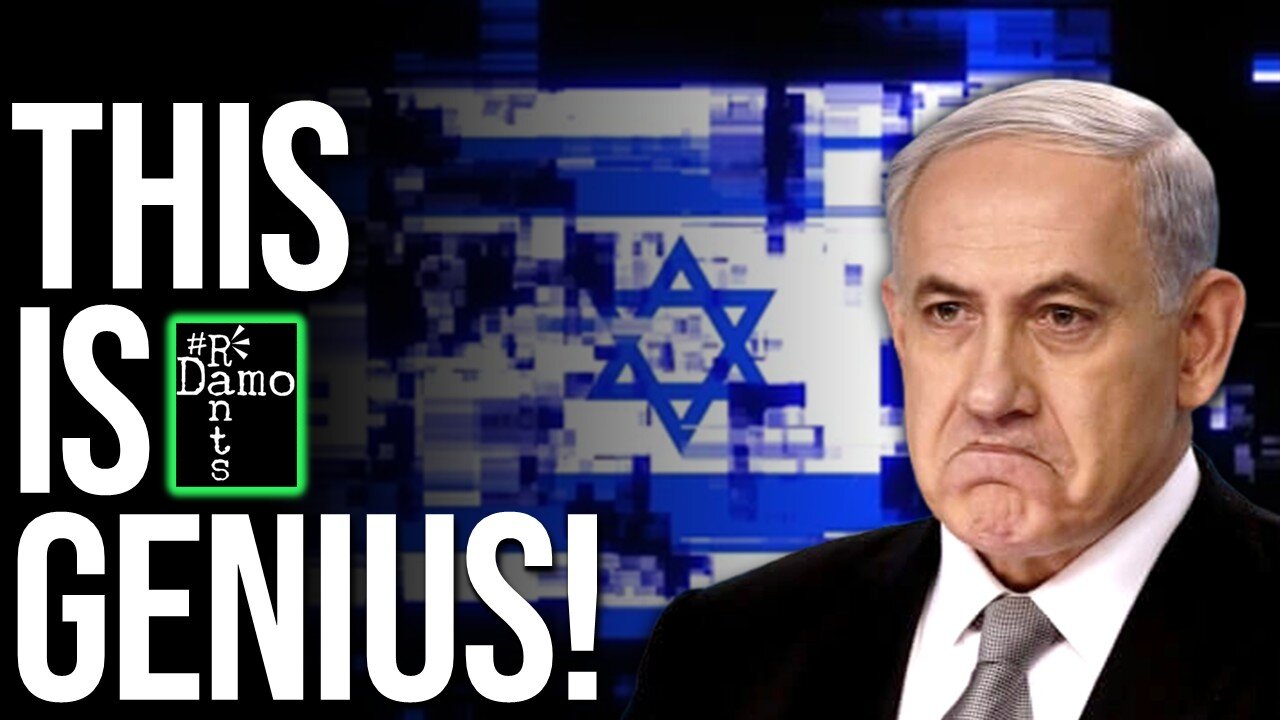
Iran Just Hit Israel’s Weakest Point — And the Collapse Has Started
Right, so Iran hasn’t fired a shot, hasn’t launched a drone, hasn’t even rattled the regional cage this time, yet Israeli media are acting like the Ayatollah has kicked a hole through their living-room wall. And all it took was a news channel being launched in Iran in Hebrew. They’ve gone spare, because Israel’s built its whole information system on the assumption that it alone gets to decide what Israelis hear, and suddenly that assumption isn’t worth the bandwidth it’s broadcast on. The military censor can gag a journalist, but it can’t gag a VPN. It can control a newsroom, but it can’t control Tehran speaking Hebrew back at them. And when the state that censors everything it can starts panicking about something it can’t, you know the real story isn’t the broadcast — it’s the breach. Iran have moved on from 12 days of warfare back in June to launching information warfare instead!
Right, so Israel has spent decades building a system that treats information as part of national defence, because it knows its politics, its military posture and its internal cohesion all depend on keeping control of the national story. And you can see that logic in everything the state does with its military censor, its gag orders, its wartime communications rules and its obsession with framing. It isn’t about transparency. It’s about containment. It’s about ownership. It’s about making sure the version of events that reaches the Israeli public is the one the government feels it can manage. But that entire architecture has been hit from a direction the state didn’t prepare for, because Iran has launched a Hebrew-language news service that sits completely outside Israeli jurisdiction, and the reaction inside Israeli media circles has exposed something the government never wanted the public to see: a censorship regime that works only until someone finds the door around it.
Because this isn’t just another foreign broadcast. Iran isn’t speaking English to an international audience or Arabic to its neighbours. It’s speaking Hebrew, deliberately, directly, to Israelis, in a language the Israeli state assumed it could monopolise. And when you look at the way Israeli commentators have reacted – talking about psychological warfare, talking about threats to morale, talking about manipulation in wartime – you’re hearing the panic that comes from recognising that the one tool the state depends on, the tool that shapes public consent and political stability, doesn’t work on content that originates beyond its borders. That is the part doing the damage. Not the message itself. The fact that the state cannot stop the message.
You only understand the full stakes when you look at how Israeli censorship actually functions. The military censor can block whole categories of reporting. Journalists know that certain topics need pre-approval. Entire investigations are reduced to skeletons. And when a crisis hits – a conflict, a scandal, a diplomatic embarrassment – the net tightens. It’s dressed up as security, but the real function is to keep the public inside a frame the government can control. And that frame is fragile. It depends on compliance. It depends on trust. It depends on the public accepting that the information they receive has passed through state-approved channels. The moment someone speaks around that system, especially in Hebrew, the structure begins to wobble.
This is why Iran’s move matters. Iran already broadcasts in multiple languages. It already runs channels designed to compete with Western media. But moving into Hebrew isn’t symbolic. It’s a direct challenge to the Israeli state’s assumption that Hebrew belongs to them, that the language itself is a barrier, that information flow can be contained by the mechanics of jurisdiction. Iran has taken one look at Israel’s core vulnerability – its dependence on information discipline – and pushed straight into it. And because the platform is offshore, because the distribution is decentralised, because the access is digital, the Israeli state is powerless to censor it. It can block a domestic outlet. It can silence a journalist. It cannot silence a broadcaster in Tehran reaching Israelis through VPNs and mirrored channels.
The Israeli commentators saying this is a threat are right, but not for the reasons they think. The danger isn’t that Israelis will suddenly adopt Iran’s worldview. The danger is that Israelis now have proof that the state cannot control what they see. And once you know that, you start asking why the state has been trying so hard to control it in the first place. That’s the real breach. The collapse of the illusion. The moment people realise censorship is not a shield but a crutch, and that the crutch is giving way.
Israeli society is already stretched thin. Public trust in government is low. The military command has been questioned after repeated failures. The political class is divided, exhausted and mired in corruption. The judicial crisis is still a wound. The hostage issue has shaken the public’s faith in state competence. People are angry. People are sceptical. People are already primed to question official narratives. Iran hasn’t manufactured that mood. It has walked straight into it. And once a population feels it’s being spoken to without censorship, even by a hostile state, curiosity alone is enough to destabilise the government’s hold over the national story.
If you want to see the mechanics of collapse, look at every country that tried to seal its population off from external narratives. The fall never starts with belief. It starts with access. The first crack in the wall is the worst one, because it shows the public that the wall can be breached. Iran knows this better than most. It has lived through decades of foreign broadcasts pushing alternative narratives into its own society. And now it’s turning that logic back on Israel. Israel is not used to being narrated. It is used to narrating. It is used to being the one speaking, not the one being spoken to. And that’s why the state sounds shaken.
And the deeper problem for Israel is that its censorship regime isn’t built for a world where information flows don’t respect national borders. It’s designed for a media environment where newspapers, broadcasters and journalists operate within the state’s legal reach. But that world is gone. Everything is digital now. Everything is transnational. And a Hebrew-language broadcast from Tehran is simply another stream of content that Israelis can access without any of the old filters. When you try to run a twentieth-century censorship model in a twenty-first-century information ecosystem, the model breaks. And you can see it breaking in real time.
It also matters that Israel’s political leadership can’t mount an effective counter-narrative, because the contradictions inside its own messaging are too visible. You have ministers contradicting each other. You have official statements walked back. You have military claims later disproven. You have entire stories suppressed and then exposed. The state has created an environment where people assume they are not being told the full truth. And in that context, a foreign broadcaster doesn’t have to be trusted to be influential. It only has to be uncensored.
And this is where Iran has been strategic. This isn’t a one-off experiment. It’s the next phase in a longer confrontation. After the summer conflict, which exposed flaws in Israel’s air-defence posture and raised questions about its military decision-making, Iran has shifted into a domain where Israel doesn’t have dominance. Israel can intercept drones. It can pre-empt strikes. It can pressure foreign governments. But it cannot intercept a broadcast. It cannot censor a message that originates outside its territory. And it cannot hide the fact that it can’t. That’s the part Iran is exploiting. It’s a demonstration of vulnerability, not a propaganda push.
The panic you see inside Israel is the panic of a state that has never had to face this kind of challenge. It can’t overreact without looking authoritarian. It can’t underreact without looking weak. It can’t ban access without confirming the fear it denies. It can’t ignore the broadcasts because its own commentators have already described them as a threat. And it can’t out-message the problem because it no longer owns the space where the message circulates. Every option exposes something the state has tried to keep concealed: that its control of the narrative is conditional, not absolute.
This is why the global context matters. Iran isn’t only speaking to Israelis. It’s speaking to the region, to the Global South, to states watching Israel’s internal crisis with growing scepticism. It’s showing them that the state that has always relied on its reputation as a disciplined, unified actor is now struggling to manage its own internal communications environment. That has diplomatic consequences. When narrative supremacy fades, influence fades. Israel has relied on narrative dominance for decades to justify military operations and maintain international support. Now it is visibly losing that dominance.
Let’s be clear: Israel is not about to collapse because Iran launched a news channel. But it is entering a new kind of conflict where its traditional strengths don’t matter. Information warfare is asymmetric. It rewards the side that can exploit internal vulnerabilities. And Israel is carrying a lot of vulnerabilities right now: political instability, public mistrust, social division, military strain and a government leaning harder than ever on censorship. When those conditions exist, even a small breach can alter the balance.
And this breach isn’t small. It is symbolic, strategic and structural all at once. It’s symbolic because it shows Hebrew is no longer the state’s protective barrier. It’s strategic because it exposes a weakness at the heart of Israel’s national security model. And it’s structural because it breaks the assumption that censorship can hold the line against foreign influence. Iran hasn’t built a new weapon. It has used the simplest tool available – speech – and it has landed harder than any strike in months.
I’ll come back to the core point because it deserves to be stated plainly: the threat to Israel isn’t the content of the broadcasts. It’s the breach of the censorship perimeter. Once the public sees the perimeter can be breached, they start to question why it existed in the first place. They start comparing stories. They start noticing gaps. They start spotting contradictions. And the government can no longer say, “This is the only version of events you need.” Because it’s not.
This is how narrative authority erodes. Not because someone else persuades your population, but because your population stops assuming you’re the only one allowed to speak.
And that erosion is happening now, because Israelis are already questioning their government, already doubting their institutions, already tired of being managed rather than informed. When a society reaches that point, an outside voice doesn’t need to be trusted to be disruptive. It only needs to be accessible. And Iran has made its messaging accessible in the one language Israel cannot defend itself against without proving its own point: that the state is afraid of what people might learn if the filter is removed.
That’s the part the government can’t say out loud, because the minute it admits this is a threat, it admits that censorship is not about security but about political fragility. You can hear that unspoken fear in the tone of Israeli analysts trying to explain why a single Hebrew broadcast from Tehran matters so much. They talk about morale. They talk about psychological warfare. They talk about manipulation. But the subtext is clearer than the analysis: they are afraid Israel can’t win an information fight on open ground.
And they’re right to be afraid, because Israel has never practised open information warfare. It has practised controlled information warfare – the kind where the state chooses what can be said, who can say it and when it can be said. Iran is doing the opposite. Iran is speaking without permission. Iran is speaking in Hebrew. And Iran is not waiting for Israel to set the terms. That inversion is the part Israeli officials cannot counter, because it forces them into a reactive position. A state that relies on narrative control loses its footing the moment it encounters a narrative it didn’t produce.
You can see the political consequences emerging already, even before the full impact becomes clear. If Israel tries to block access to the broadcasts, it reveals the insecurity at the heart of its censorship model. If it does nothing, it looks weak. If it attacks the content, it amplifies it. If it declares it harmless, it contradicts the panic coming from its own commentators. Every pathway exposes something: inconsistency, weakness or authoritarian instinct. Iran has manoeuvred Israel into a position where every response is an admission of vulnerability.
And the vulnerability is deeper than Israel wants to acknowledge, because the state’s narrative has been fraying long before Iran launched this channel. Domestic divisions have widened. Public trust has declined. Military failures have been harder to hide. Investigations have been harder to suppress. The political system has been consumed by infighting. And the Israeli public has had to make sense of a government that increasingly uses national security rhetoric to shield itself from accountability. That’s the climate Iran is stepping into. It’s not creating the cracks. It’s pointing at them.
And when a foreign actor points at cracks in your national cohesion and does so in your own language, you cannot dismiss it without confronting the cracks themselves. That’s the dilemma Israel now faces. It wants to blame Iran without acknowledging why this messaging resonates, even at the level of curiosity. And it wants to maintain the fiction that it is a unified, stable state while reacting like a state that fears it isn’t. That tension is visible in every piece of commentary that has come out since the launch: the insistence that this is dangerous, paired with the refusal to say the danger comes from inside, not outside.
This is where you see the real significance of this new information front. It is a battlefield Israel cannot dominate. It is a battlefield Iran can enter at will. And it is a battlefield where control – Israel’s most valued political resource – becomes impossible to enforce. You don’t need drones or missiles to destabilise a state built on narrative discipline. You only need to show its citizens that the discipline can be broken. And that is what Iran has done.
And the truth is, Israel cannot afford another destabilising force right now. Its political leadership is brittle. Its military is stretched. Its economy is under pressure. Its alliances are strained. And its public is divided and exhausted. Iran has identified the point of least resistance – the gap between what the government says and what the public believes – and driven a wedge straight into it. And because the message comes from outside, Israel cannot seal the breach without becoming the kind of state it claims to oppose, the kind of state that blocks foreign media and criminalises access to information.
That is the strategic brilliance of the move. Iran has not forced Israel to reveal military weakness. It has forced Israel to reveal informational weakness. And informational weakness is worse, because it speaks to legitimacy, not capability. A state can recover from a failed operation. It cannot recover easily from a public that stops trusting what it hears from its own institutions. Once that trust erodes, every government message sounds defensive. Every clarification sounds like spin. Every denial sounds like concealment. And when that happens, a foreign broadcaster becomes not a threat but an alternative, and alternatives are fatal to a censorship-based security model.
And this isn’t the end point; it’s the beginning. Iran’s Hebrew service is the opening move. It demonstrates capacity. It demonstrates reach. It demonstrates that Israel’s information defences are porous. And it demonstrates that a long conflict can be fought without crossing borders. Israel is used to confronting Iran in the air, in the sea, through cyber operations, through covert actions. It is not used to confronting Iran in the minds of its own citizens. And that is the domain where Israel is least prepared, because it has never had to compete. It has only had to control.
Iran did not strike Israel with drones or missiles. It did not sabotage infrastructure. It did not infiltrate networks. It did something far more disruptive. It spoke to Israelis directly, in Hebrew, outside the reach of the censor, and forced the Israeli state to confront a truth it has avoided for decades: a state built on narrative control is one breach away from narrative collapse. And once the story slips out of the government’s hands, it doesn’t come back.
That’s the real impact of this launch. Not persuasion. Not propaganda. Exposure. Iran exposed a weakness the Israeli state hoped nobody would test: that censorship only works until someone speaks around it. And now someone has.
Exposure of ties to Israel can have just as devastating effect in the grand scheme of things as well. Microsoft is finding this out now, as the worlds largest Sovereign Wealth Fund is fixing on voting against its leadership and its under the eye of regulators in Ireland and the common denominator is the blue and white apartheid state, so get all the details of that story here.
Please do also hit like, share and subscribe if you haven’t done so already so as to ensure you don’t miss out on all new daily content as well as spreading the word and helping to support the channel at the same time which is very much appreciated, holding power to account for ordinary working class people and I will hopefully catch you on the next one. Cheers folks.
-
 1:00:45
Graham Allen
2 hours agoLive From AMFEST 2025: Day 2
23.2K36 -
 LIVE
LIVE
LFA TV
9 hours agoLIVE & BREAKING NEWS! | FRIDAY 12/19/25
2,349 watching -
 LIVE
LIVE
The Mel K Show
2 hours agoMORNINGS WITH MEL K-The Lawfare Squad Takes a Victory Lap-Indefensible Idiocy is to Blame! 12-19-25
806 watching -
 LIVE
LIVE
The Shannon Joy Show
2 hours ago🔥SJ LIVE Dec 19 - Friday Midday Matinee W/Shannon Joy! Featuring "American Experience: Jonestown"🔥
32 watching -
 1:02:48
Trumpet Daily
1 hour agoTrumpet Daily LIVE | Dec. 19, 2025
2.85K1 -
 1:01:55
VINCE
4 hours agoIs This Why They Were Hiding The Evidence? | Episode 192 - 12/19/25 VINCE
204K209 -
 1:55:26
Badlands Media
8 hours agoBadlands Daily: 12/19/25
42.6K17 -
 14:45
14:45
Bearing
5 hours agoFROGAN Gets BODIED 💥 Caleb Hammer, Asmongold + the $20k Rejection 💰
21.9K13 -
 1:10:23
Graham Allen
5 hours agoTensions ERUPT At AMFEST, Is Our Party Too Far Gone?
130K569 -
 1:30:43
Caleb Hammer
4 hours agoThis Has Never Happened Before | Financial Audit
24.5K1