Hydrant Hygiene
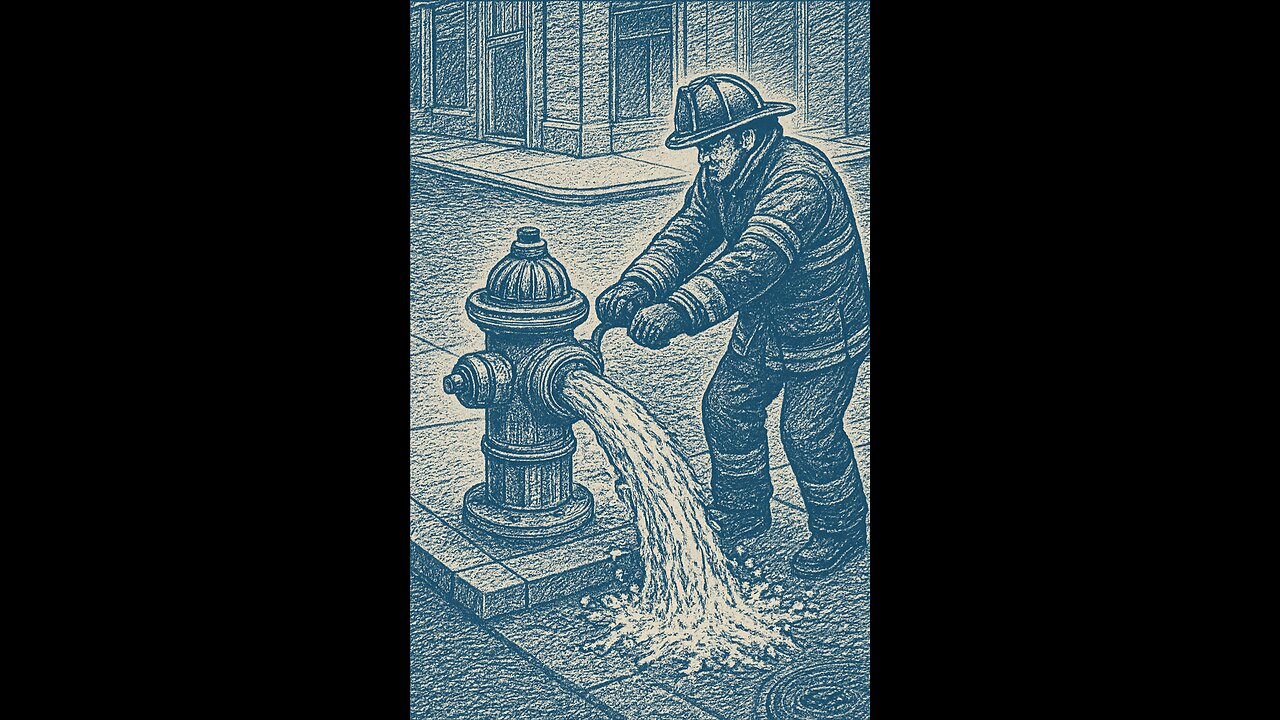
Firefighters and municipal water departments routinely perform hydrant flushing and flow testing to keep fire hydrants operational, protect water quality, and verify adequate fire-flow capacity across a city’s distribution network.
During these tests, crews open hydrants in a controlled sequence to scour sediment, rust, and biofilm from water mains, while calibrated pitot gauges and diffusion cones are used to safely direct high-velocity water and measure pressure and flow rates.
Static, residual, and flow pressures are recorded to calculate available gallons per minute and to identify partially closed valves, pipe obstructions, or weak pressure zones that could compromise firefighting operations.
The process also includes lubricating valve stems, inspecting caps and threads, checking barrel drainage to prevent freeze damage, and color-coding hydrants based on verified flow capacity, making hydrant release and testing a critical element of municipal fire protection and infrastructure safety.
-
 LIVE
LIVE
Trumpet Daily
29 minutes agoTrumpet Daily | Dec. 26, 2025
68 watching -
 1:47:33
Badlands Media
11 hours agoBadlands Daily: 12/26/25
98.1K4 -

Wendy Bell Radio
7 hours agoClean It ALL Up, Mr. President
93.7K89 -
 8:36
8:36
Buddy Brown
2 hours ago $1.59 earnedBuddy Brown Journaled For 1 YEAR & God SHOCKED Him With His Own Words!
5.34K1 -
 LIVE
LIVE
GloryJean
1 hour agoBirthday Boy Getting some GOOP
99 watching -
 LIVE
LIVE
The Big Mig™
2 hours agoHollywood Superstar Isaiah Washington Mar-A-Lago Insiders Edition
2,742 watching -
 LIVE
LIVE
Amish Zaku
2 hours agoRaiders of the Lost Arc
84 watching -

RG_GerkClan
3 hours ago🔴LIVE - New Event...Lets Dominate - Escape From Tarkov - Gerk Clan
3.47K1 -
 LIVE
LIVE
DannyStreams
3 hours agoCoffee & Raids
66 watching -
 LIVE
LIVE
Lofi Girl
3 years agolofi hip hop radio 📚 - beats to relax/study to
205 watching