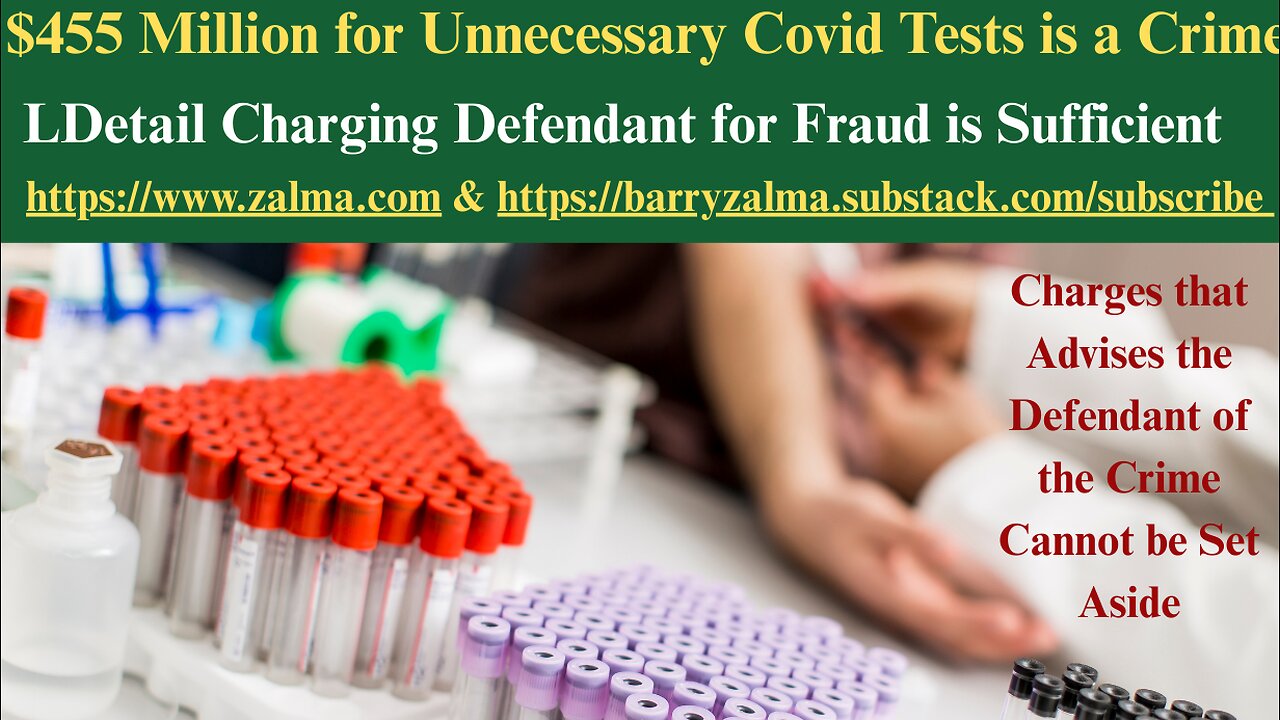
$455 Million for Unnecessary Covid Tests is a Crime
Detail Charging Defendant for Fraud is Sufficient
Post 5242
Charges that Advises the Defendant of the Crime Cannot be Set Aside
In United States Of America v. Lourdes Navarro, AKA Lulu, No. 25-661, United States Court of Appeals, Ninth Circuit (December 4, 2025) Lourdes Navarro appealed the district court's denial of her motion to dismiss the indictment and enter final judgment was in error.
FACTUAL BACKGROUND
The indictment alleged that insurers reimburse only for medically necessary services. Navarro performed unnecessary respiratory pathogen panel (RPP) tests on nasal swabs collected from asymptomatic individuals for COVID-19 screening.
Navarro billed over $455 million to insurers for those additional RPP tests that she knew to be medically unnecessary. These allegations constituted a plain, concise, and definite written statement of the essential facts constituting the offense charged and the indictment had adequate detail to inform the defendant of the charge.
Navarro contended that regulations in effect during the COVID-19 pandemic lifted the statutory requirement that participating providers are required to ensure that any services rendered to Medicare recipients are supported by sufficient evidence of medical necessity. But the regulations did nothing to alter the medical-necessity requirement; they merely suspended the traditional physician-order requirement for otherwise necessary COVID-19 testing.
ANALYSIS
When HHS published § 410.32(a)(3), it explained that it did nothing "to permanently or temporarily waive the reasonable and necessary statutory requirement, which . . . cannot be waived." [85 Fed. Reg. 27550, 27595.] The COVID-19 regulations and guidance Navarro cited neither waived the medical-necessity requirement nor authorized the mass testing of healthy individuals for additional illnesses. Since the indictment was facially sufficient, and Navarro's guilty plea to one count of conspiracy to commit healthcare fraud was valid.
Navarro also contended that RPP tests on asymptomatic individuals in high-risk settings were, in fact, medically necessary (and therefore not fraudulent). Because the indictment alleged the RPP tests were unnecessary and fraudulent – and nothing in the regulations or guidance establishes the contrary proposition - the indictment placed the matter of medical necessity properly in dispute for trial.
Had Navarro pleaded not guilty and proceeded to trial, it would have been for a jury to decide whether the tests were medically unnecessary and, if so, whether Navarro billed for them with the requisite scienter.
Navarro's arguments based on regulations and extrinsic sources may have yielded viable arguments at trial, but they were not grounds to dismiss the facially sufficient indictment.
CONCLUSIONS
The district court correctly rejected Navarro's argument that § 1347 is unconstitutionally vague. Navarro failed to identify any ambiguous term in the plain text of the statute. Navarro's concerns with regulatory ambiguity were inapt because neither the indictment nor the statute relies on or incorporates any regulatory standard.
Finally, § 1347's requirement that a jury find that Navarro "knowingly and willfully" committed healthcare fraud is a scienter requirement that alleviates vagueness concerns, narrows the scope of the statute's prohibition, and limits prosecutorial discretion.
Inclusion of a willfulness-scienter requirement mitigates a law's vagueness, especially with respect to the adequacy of notice to the complainant that his conduct is proscribed.
The District Court was affirmed.
ZALMA OPINION
Fraud Perpetrators seem to have no concern over reality nor concern for the time of the court who must deal with serious problems. Navarro pleaded guilty to one count of fraud and then moved the District Court to let her go and dismiss the indictment to which she had pleaded guilty. The District Court rejected her move and she appealed to the Ninth Circuit who also rejected her arguments because they had no basis in the facts or the law. This conduct should be considered by the sentencing judge when deciding how long she spend in Federal Prison.
(c) 2025 Barry Zalma & ClaimSchool, Inc.
Please tell your friends and colleagues about this blog and the videos and let them subscribe to the blog and the videos.
Subscribe to my substack at https://barryzalma.substack.com/subscribe
Go to X @bzalma; Go to Barry Zalma videos at Rumble.com at https://rumble.com/account/content?type=all; Go to Barry Zalma on YouTube- https://www.youtube.com/channel/UCysiZklEtxZsSF9DfC0Expg; Go to the InsuranceClaims Library – https://lnkd.in/gwEYk.
-
 8:06
8:06
Insurance Law
8 days agoAn International Convention Requiring Enforcement of Foreign Arbitration Award Doesn't Apply
461 -
 1:14:37
Flyover Conservatives
1 day agoHow to Win 2026 Before It Starts — Clay Clark’s Goal-Setting Blueprint | FOC Show
43.9K1 -
 12:52
12:52
The Kevin Trudeau Show Limitless
2 days agoBeyond Good And Bad: The Hidden Reality Code
90.4K21 -
 1:03:11
BonginoReport
12 hours agoBrown U Security Failures EXPOSED - Nightly Scroll w/ Hayley Caronia (Ep.201)
164K49 -
 51:09
51:09
Patriots With Grit
8 hours agoWill A.I. Replace Doctors? | Dr. Stella Immanuel MD
29.4K4 -
 4:10:32
Nerdrotic
13 hours ago $17.05 earnedHollywood's DOOMSDAY! WB FIRESALE! - Friday Night Tights 385 w Zachary Levi
88.2K22 -
 12:25:53
LFA TV
1 day agoLIVE & BREAKING NEWS! | FRIDAY 12/19/25
207K31 -
 1:08:59
Edge of Wonder
11 hours agoNASA’s Intergalactic Spacecraft, Real Dwarves Spotted & Research Roundup
31K7 -
 1:21:27
Kim Iversen
13 hours agoPutin Says Russia is Ready for WAR With Europe
50.6K104 -
 1:24:41
The Daily Signal
11 hours ago $7.87 earned🚨BOMBSHELL: 315,000+ Illegal Ballots in Georgia, Terrorists Released, Rubio Slashes Foreign Aid
37.7K13