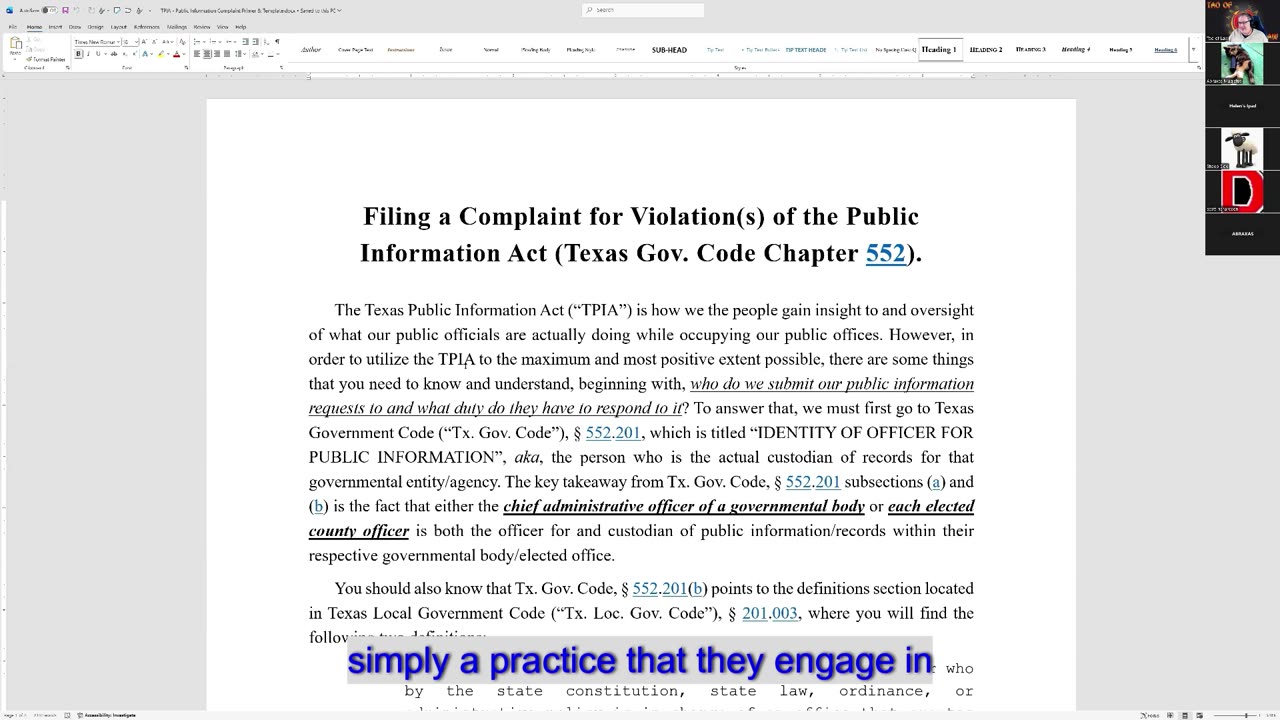
TAO of Law Free Class with Eddie Craig 12-4-2025
Legal Challenges and Personal Experiences
The discussion revolves around personal legal challenges faced by individuals, particularly in relation to property disputes and traffic violations.
• A participant shares their experience of settling a civil case involving property fraud, costing them approximately $40,000.
• The individual expresses frustration with their attorney, who charged a $10,000 retainer but failed to provide adequate representation.
• The conversation highlights the importance of understanding attorney-client privilege and the implications of retainers in Texas law.
Understanding Legal Statutes and Definitions
The conversation emphasizes the importance of understanding legal statutes and their definitions in Texas law.
• Participants discuss the Texas Government Code, specifically chapters 311 and 312, which provide definitions applicable across all Texas law.
• The definition of "person" in Texas law is highlighted as crucial for understanding legal arguments.
• The discussion includes the need to read and comprehend legislative drafting manuals to better interpret statutes.
Traffic Violations and Legal Arguments
The participants discuss strategies for contesting traffic violations based on Texas law.
• A participant mentions that offenses under 15 miles per hour over the speed limit may not be punishable.
• The conversation stresses the distinction between arguing merits of a case versus challenging the validity of charges.
• Participants are encouraged to focus on jurisdictional arguments and the lack of evidence for charges against them.
Attorney Misconduct and Legal Recourse
The discussion touches on the potential for legal recourse against attorneys for misconduct.
• A participant plans to file a bar complaint against their attorney for unprofessional behavior and inadequate representation.
• The importance of recording conversations with attorneys is emphasized to protect clients' rights.
• Participants are advised to seek compensation for attorney fees if they believe they were wronged.
Historical Context in Legal Interpretation
The conversation highlights the significance of historical context in interpreting legal documents and statutes.
• Participants discuss the value of using older dictionaries to understand the original meanings of legal terms.
• The Federalist Papers are mentioned as a resource, but the focus is on finding historical dictionaries for accurate legal interpretation.
• Understanding the historical context of legal terms is deemed essential for proper legal arguments.
Criminal Complaints Against Public Officials
The discussion includes strategies for filing criminal complaints against public officials for misconduct.
• A participant shares plans to file complaints against a district attorney and a judge for not following legal procedures.
• The conversation emphasizes the importance of holding public officials accountable for their actions.
• Participants discuss the potential for filing multiple complaints to address systemic issues within the legal system.
Legal Accountability and Court Procedures
The discussion revolves around the importance of understanding legal procedures and holding authorities accountable for their actions.
• The speaker has not filed lawsuits but has successfully won court cases and helped others.
• Emphasizes the need for individuals to be educated about court procedures before representing themselves.
• Highlights the importance of checking court records frequently to catch any procedural errors by authorities.
• Discusses a specific case where a prosecutor and judge were caught tampering with records, leading to a case dismissal.
Importance of Legal Education
The necessity of being well-informed about legal processes before engaging in court is stressed.
• Individuals should understand court procedures and rules to avoid being taken advantage of.
• The speaker suggests that if someone struggles to grasp legal concepts, they should seek professional legal counsel.
• Observing court proceedings is crucial for understanding how the system operates.
Strategies for Winning Court Cases
The conversation includes strategies for effectively navigating the legal system.
• Having a clear plan and understanding the rules of engagement in court is essential for success.
• The analogy of chess is used to illustrate the importance of strategic thinking in legal arguments.
• The speaker emphasizes the need to anticipate the opponent's moves and respond accordingly.
Issues with Law Enforcement Practices
Concerns about the legality of police practices and their implications for civil rights are discussed.
• The speaker recounts a personal experience with police overreach during a traffic stop.
• Highlights the issue of police stopping individuals based on assumptions rather than concrete evidence.
• Discusses the need for accountability in law enforcement and the potential for civil rights violations.
Challenges in Navigating Legal Systems
The complexities and challenges of dealing with legal systems, particularly in different states, are examined.
• The speaker shares experiences with vague laws and inconsistent enforcement across jurisdictions.
• Emphasizes the importance of understanding specific state laws and procedures to effectively challenge legal actions.
• Discusses the need for reform in policing and legal education to improve accountability and justice.
Cop Mentality and Tattoos
The discussion highlights the association between tattoos, particularly among police officers, and a certain aggressive mentality.
• Tattoos, especially sleeves and symbols like the Punisher, are often linked to a "badass" attitude.
• Officers with tattoos may exhibit aggressive behavior or a desire to project toughness.
• There is a stereotype that heavily tattooed officers may also be using steroids.
Recording in Courtrooms
The conversation addresses the challenges and legality of recording in court settings.
• Recording devices like spy pens can be unreliable and may not be permitted in court.
• There are legal risks, such as contempt of court, for recording without permission.
• The need for transparency in court proceedings is emphasized, advocating for mandatory audio and video recording in all courts.
Legal System and Government Control
The dialogue critiques the legal system's structure and the influence of attorneys on government operations.
• The speaker argues that attorneys monopolize government branches, undermining public rights.
• There is a call for reform to prevent attorneys from holding public office in any government branch.
• The Texas Constitution's Article 2 is cited, stating that no person in one government branch can exercise power in another.
Rights to Record Public Officials
The conversation touches on the legal rights to record public officials and the limitations in court settings.
• Various court cases support the right to record public officials in public spaces.
• Courtrooms, while public, have specific rules that can restrict recording to maintain order.
• The speaker advocates for all court proceedings to be recorded and made publicly accessible.
Legal Definitions and Traffic Violations
The discussion focuses on the legal definitions related to traffic laws and the implications for speeding violations.
• Arkansas and Texas statutes share similarities in defining reasonable and prudent speed.
• The absence of a collision is crucial in proving that speed was reasonable and prudent.
• The conversation emphasizes the need to understand legal definitions to effectively challenge traffic citations.
Discovery Requests in Legal Cases
The dialogue explores the importance of comprehensive discovery requests in legal cases, particularly traffic violations.
• A wide range of documents should be requested, including officer training records and radar gun maintenance.
• The effectiveness of broad discovery requests is debated, with caution advised against overwhelming the case with irrelevant information.
• The speaker stresses the importance of using legal arguments based on statutes and definitions to challenge citations effectively.
-
 12:25:53
LFA TV
17 hours agoLIVE & BREAKING NEWS! | FRIDAY 12/19/25
182K26 -
 1:08:59
Edge of Wonder
3 hours agoNASA’s Intergalactic Spacecraft, Real Dwarves Spotted & Research Roundup
4.39K1 -
 1:21:27
Kim Iversen
6 hours agoPutin Says Russia is Ready for WAR With Europe
29.2K74 -
 1:24:41
The Daily Signal
4 hours ago $2.74 earned🚨BOMBSHELL: 315,000+ Illegal Ballots in Georgia, Terrorists Released, Rubio Slashes Foreign Aid
17.7K9 -
 1:53:45
The Mike Schwartz Show
6 hours agoTHE MIKE SCHWARTZ SHOW Evening Edition 12-19-2025
13.2K4 -
![[Ep 814] LIVE From AmFest 2025 with Kaitlin Bennett](https://1a-1791.com/video/fwe2/7e/s8/1/6/O/v/J/6OvJz.0kob-small-Ep-814-LIVE-From-AmFest-202.jpg) 37:38
37:38
The Nunn Report - w/ Dan Nunn
5 hours ago[Ep 814] LIVE From AmFest 2025 with Kaitlin Bennett
39.7K12 -
 27:40
27:40
Stephen Gardner
7 hours agoYES! Rubio & Hegseth Get Trump's 2 National Security Orders
48.7K42 -
 1:48:18
vivafrei
6 hours agoBrown Shooter Identified - Suspect or Patsy? Judge CONVICTED for Aiding Illegals! Bongino Resigns!
65K57 -
 48:41
48:41
Turning Point Tonight
8 hours ago $3.01 earnedJobob LIVE at AmFest 2025!
44K -
 4:13:55
Barry Cunningham
8 hours agoLIVE BREAKING NEWS: President Trump Makes Another Address To The Nation! And More News!
45.4K32