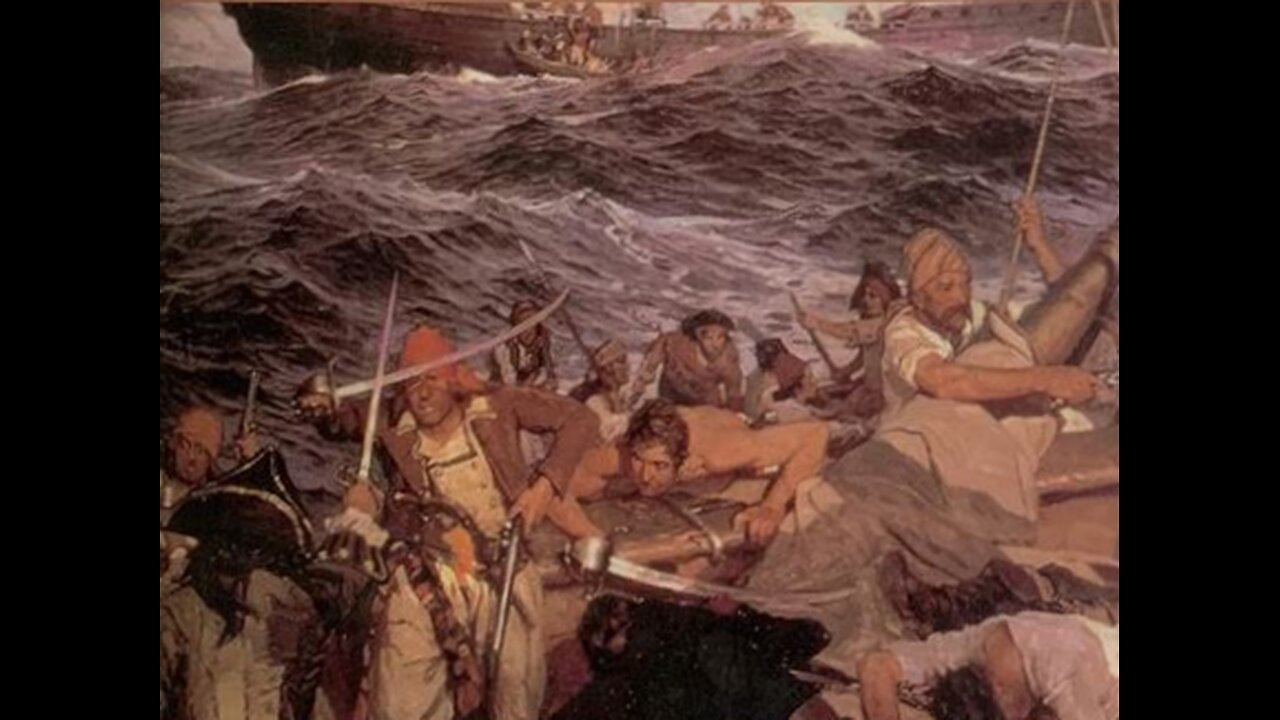
The Atrocities of the Pirates by: Aaron Smith (1724)
The Atrocities of the Pirates is a severe contemporary account documenting the crimes, violence, and moral collapse associated with piracy during the early eighteenth century. Written by Aaron Smith, Ordinary of Newgate Prison, the book draws directly from his role as spiritual attendant to condemned pirates awaiting execution. Smith had personal access to prisoners in their final days and recorded their confessions, recollections of crimes, and states of mind before death.
The work focuses on concrete acts of piracy rather than adventure or legend. It records murders, torture, beatings, robberies, forced compliance, marooning, and executions as related by the pirates themselves or preserved through legal proceedings. Smith presents these events plainly and directly. Victims are often identified, methods of cruelty are described without euphemism, and the cumulative effect is deliberately sobering and confrontational.
Smith’s purpose is explicit. The book is written as both a moral warning and a factual record. Piracy is portrayed as a path leading inevitably to brutality, despair, and death. Considerable attention is given to the pirates’ final hours, including their confessions, expressions of remorse or defiance, and reactions to impending execution. These moments are recorded not for drama, but to demonstrate the psychological and moral consequences of sustained violence.
The tone is uncompromising. Smith does not soften language to protect the reader, nor does he embellish events for entertainment. The brutality described is factual, restrained only by the conventions of early eighteenth-century prose. The absence of romantic framing makes the violence feel relentless rather than theatrical.
Historically, The Atrocities of the Pirates is significant because of its immediacy. The author was recording accounts from men recently active at sea, often within days or weeks of their crimes. This proximity gives the book a stark authenticity and makes it a rare primary-source window into pirate behavior, confessions, and end-of-life reckoning.
The book does not hold back. Its intent is to expose piracy as it was experienced by its victims and perpetrators alike, leaving little room for illusion, justification, or myth.
About the Author:
Aaron Smith was an English Anglican clergyman who served as Ordinary of Newgate Prison in London during the early eighteenth century. In this role, he was responsible for providing spiritual counsel to condemned prisoners in the days and weeks leading up to their executions. His position placed him in direct, sustained contact with some of the most violent criminals of the period, including pirates captured during the height of the Golden Age of Piracy.
As Ordinary, Smith routinely recorded confessions, final statements, and personal histories of those under sentence of death. These accounts were not collected for literary effect, but as part of his clerical duty to document repentance, moral reflection, and preparation for execution. His writings reflect the perspective of a moral witness rather than a storyteller, emphasizing accountability, consequence, and judgment.
Smith’s access was immediate and personal. He spoke privately with prisoners in their cells, observed their mental and emotional states as execution approached, and heard firsthand descriptions of crimes committed at sea. This proximity gives his work a factual weight that distinguishes it from later retellings or secondhand compilations. The material he recorded often came directly from the mouths of the condemned, sometimes within hours of death.
His prose is plain, direct, and severe, shaped by the conventions of early eighteenth-century religious writing. Smith did not seek to entertain or romanticize criminality. His intent was to warn the public, instruct morally, and preserve a truthful record of human behavior stripped of illusion. Violence is presented as consequence rather than spectacle.
Aaron Smith’s work stands as a rare example of prison-based documentation from the period, capturing piracy not as adventure, but as a pattern of brutality followed by inevitable collapse. His writings reflect the worldview of a cleric confronting crime at its endpoint, making his contribution valuable not only to maritime history, but to the study of crime, punishment, and moral thought in early modern England.
-
 12:49:02
Deus Meum Que Jus
2 days agoThe General History of the Pyrates by: Captain Charles Johnson (pseudonym, first published 1724)
711 -
 57:22
57:22
Flyover Conservatives
22 hours agoChina and India are Draining Silver — Prices Are Responding Fast - Dr. Kirk Elliott; Natural Remedy You Don't Know About - Dr. Troy Spurrill | FOC Show
22.8K1 -
 LIVE
LIVE
MissesMaam
3 hours agoARC NOOBS 💚✨
171 watching -
 LIVE
LIVE
Anthony Rogers
9 hours agoEpisode 393 - Psychic Readings
115 watching -
 44:52
44:52
Donald Trump Jr.
7 hours agoShip Outta Luck, Plus FBI Foils LA Terror Plot and Much More | Triggered Ep.300
237K108 -
 12:50
12:50
Dr. Nick Zyrowski
4 days agoThe AMAZING Health Benefits of NAC ( N-Acetyl Cysteine) - Must See!
40.5K19 -
 1:15:43
We Like Shooting
16 hours ago $3.15 earnedDouble Tap 440 (Gun Podcast)
22.1K -
 59:03
59:03
BonginoReport
7 hours agoEvil Terrorists Target Jewish Celebration - Nightly Scroll w/ Hayley Caronia (Ep.197)
64.1K64 -
 1:02:27
The Nick DiPaolo Show Channel
8 hours agoRob Reiner, Wife Slaughtered | The Nick Di Paolo Show #1828
52.4K41 -
 22:03
22:03
Jasmin Laine
12 hours agoCBC Host Left SPEECHLESS as Poilievre Uses Their OWN Words Against Them
29.8K25