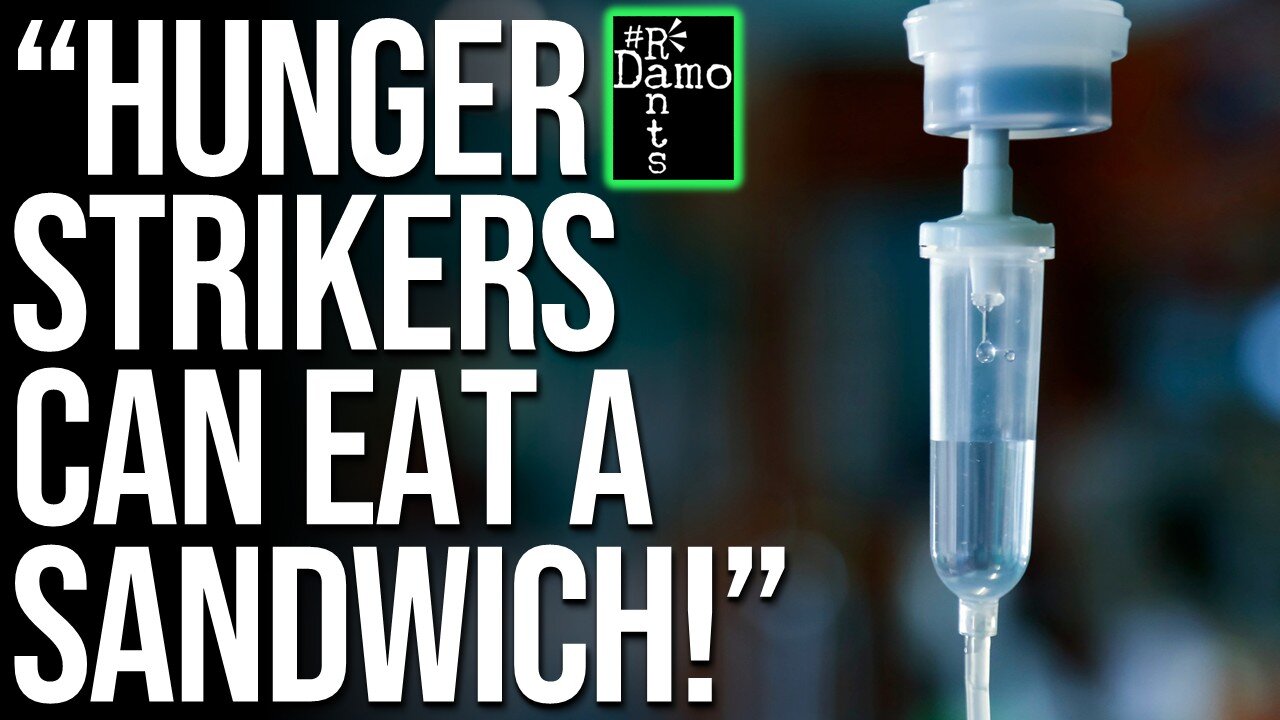
Hunger Strike Mocked as Protester Collapses in Prison
Right, so you know exactly what you’re dealing with when a newspaper in Israel looks at people more than forty days into a hunger strike and decides the right response is a headline telling them to “eat a sandwich.” You don’t get that from a society grappling with the seriousness of starvation; you get it from one that has trained itself to treat other people’s suffering as background noise. And when several of those hunger strikers are now in hospital, with one deteriorating sharply overnight, the joke doesn’t just fall flat — it tells you everything about who is speaking. Because only a culture that’s spent years mocking the hunger of others could pretend this is clever. It isn’t clever. It’s contempt wearing a smirk, and they were so pleased with themselves, they were proud enough to print it.
Right, so you don’t get a headline like this one from the Jerusalem Post by ac by accident, and you don’t get it from a publication that pretends to operate in a moral vacuum, you get it from a political culture that has spent years teaching itself that some forms of suffering matter and others don’t, and the dividing line isn’t humanity, it’s allegiance. When an Israeli newspaper looks at people who have refused food for more than forty days and decides the appropriate framing is a jeer dressed up as journalism - 'Hungry? Eat a sandwich': Palestine Action protesters hospitalized as hunger strike exceeds 40 days - you’re not seeing a rogue decision or a misread of the moment, you’re seeing a system talking to itself, reassuring its own audience that the humanity of these hunger strikers is irrelevant, because the story was never about them in the first place. It’s about protecting a narrative that cannot survive even a moment of empathy directed at the wrong people, which is why the contempt comes so quickly and so confidently.
A hunger strike is not ambiguous. It isn’t messaging, it isn’t some clever tactic designed for headlines; it’s a human body being pushed beyond the point where most people could last, and the reason people resort to it is because all of the ordinary routes for being heard have been cut off already, leaving them with no other course of action. Every day without food comes with consequences that aren’t theoretical. After a week, you lose strength. After two, you lose clarity. After three, you start to lose muscle mass. By day forty, you’re dealing with the collapse of systems that keep you alive. The body stops being able to compensate. Most people will never experience anything like this because they shouldn’t have to. So when a newspaper responds to that level of danger with a headline that essentially tells the strikers their suffering is a joke, it tells you the paper never saw them as people in the first place. And that is where the real story sits, not in the slur but in the confidence behind it.
Because the truth is that Israel’s political and media ecosystem has long treated hunger strikes as an affront rather than a warning. The moment individuals use their bodies to expose injustice, the entire apparatus kicks into defensive mode. You’ve seen this over years of coverage of Palestinian detainees who begin hunger strikes in Israeli custody. The official line often slides immediately into dismissal, calling these protests manipulative, irresponsible, or even a form of psychological warfare, as if the act of refusing food until your organs begin to shut down is somehow a game. And the point isn’t whether officials believe the rhetoric; the point is that this framing keeps the public from engaging empathetically with the strikers, because empathy creates moral discomfort, and moral discomfort leads to questions the state doesn’t want asked.
What you’re looking at here is the export version of a domestic reflex. Israeli institutions have had decades to normalise responses that strip dignity from opponents and trivialise their suffering. When hunger strikes emerge inside Israel or its detention system, the conversation is rarely about the conditions that produced the protest. Instead it becomes a performance of state resolve, a show of refusing to “give in,” as if the person starving themselves is not a human being making the last argument available but a tactical opponent to defeat. That mindset doesn’t disappear at the border. It travels into the rhetoric used about anyone who is perceived—even indirectly—to challenge Israel’s actions or provide moral weight to its critics. And that’s how a hunger strike in Britain ends up being treated the same way as hunger strikes inside Israeli prisons: not as a crisis but as something to belittle.
There is a structural logic behind this. Israel’s political messaging has always depended on emotional control. The state invests more than most in shaping the perceptions of policymakers and the public, building its legitimacy around the idea that Israeli suffering must be foregrounded and the suffering of others must be contextualised, minimised, or treated with suspicion. If you accept that emotional asymmetry, then you also accept the behaviours that reinforce it, and mockery becomes a tool for policing the boundaries of permissible empathy. A hunger strike challenges those boundaries because it forces the audience to confront the reality of people willing to die to expose injustice. That breaks the emotional monopoly Israel tries to maintain. So the response becomes ridicule, because ridicule is the quickest way to push those emotions back into the approved lanes.
And this is where the cruelty becomes institutional, because it is not the product of a single editor or commentator but the ongoing effect of a political environment conditioned to see certain forms of suffering as illegitimate. You can trace this through years of speeches, press briefings, and media coverage in Israel where dehumanising language is used casually to describe opponents. Once a system has normalised describing entire groups as less than human, the step to mocking the hunger strike of people in another country becomes trivial. There’s no moral speed bump left. The culture has done away with it. Mockery slides into place as easily as a headline editor typing out a taunt for the front page. And the public, trained for years to see Palestinian solidarity as suspect or dangerous, is expected to absorb it without question.
This is not about free expression or harsh political rhetoric. It is about how a state and its aligned media protect themselves from moral accountability. Hunger strikes are uniquely dangerous to systems built on controlling the narrative, because they take suffering out of the abstract and into the immediate. You cannot talk around a hunger strike. You cannot bury it in a committee report. Someone is losing weight, losing consciousness, losing the ability to stand. The protest is happening in real time, and that makes it politically radioactive. For Israel, the risk is not that the hunger strikers succeed in whatever legal or political demands they have; the risk is that the public sees them as human. And once that happens, Israel’s habitual framing of its critics unravels. So the response is to shut down that empathy before it takes hold.
You can see the defensive impulse here, because the mockery is not simply contempt, it is a pre-emptive strike against the moral force the hunger strike might accumulate. If the strikers become symbols of injustice, then attention shifts to the actions they are protesting, and that is precisely what Israel cannot allow. So the message must be degraded. Reduce the hunger strike to farce. Make the suffering invisible. Signal to your audience that there is nothing to see here. That’s why this headline doesn’t just insult the strikers; it instructs the readership on how to interpret the event. The instruction is simple: treat these people as unserious, treat their suffering as unimportant, treat their protest as something beneath your attention. That is how narrative control is maintained when reality starts pushing back.
And the striking part is the confidence. You don’t run a headline like that unless you are certain you’ll face no meaningful pushback from your audience, your political class, or your major allies abroad. It demonstrates a belief that the system is insulated enough that mockery will not cost you anything. And that belief didn’t materialise out of nowhere; it was built over years of getting away with narrative behaviour that would be unthinkable elsewhere. If you never have to apologise for dehumanising language, if you never face consequences for dismissing suffering, then eventually you begin to believe you are entitled to do it whenever you want. And that entitlement is the point. The cruelty is not the exception; it is the expression of a system that has trained itself not to care.
This is what makes the slur so revealing. It tells you what the media culture feels safe saying. It tells you who the system believes is beneath empathy. It tells you which suffering is allowed to register and which suffering must be mocked or ignored. And because the hunger strike was happening outside Israel, far from the dynamics of occupation or domestic policing, the speed with which the contempt appeared shows how deeply ingrained this reflex has become. The geography doesn’t matter. The protest doesn’t matter. The specific individuals involved don’t matter. What matters is the alignment, and anyone seen as challenging Israel’s legitimacy, even indirectly, gets pushed into the same rhetorical category as Israel’s internal “enemies.” That is why the mockery came so quickly and so easily.
And here’s the part that lands hardest, because it returns us to the basic moral reality: these hunger strikers are not symbols or strategic actors, they are people whose bodies are breaking down. They are at the stage of hunger strike where the medical risk becomes very real. They are living through an experience most people will never have to imagine. And the reaction from this Israeli outlet was to laugh. There is no political justification that makes that make sense. There is no strategic context that turns that into anything other than cruelty. And systems that normalise cruelty in their public discourse eventually reveal what they think of the people on the receiving end of it. In this case, the answer is simple: nothing. These strikers are treated as nothing, because treating them as something would force an uncomfortable conversation Israel has no interest in having.
And just to underline the obscenity of the timing, one of the hunger strikers—Qesser Zuhrah—experienced a severe deterioration overnight. I’m mentioning that once, here, at the end, because I’m covering this story in more detail separately, but at time of writing the prison had not called an ambulance for Qesser Zuhrah despite serious risk of collapse, and an MP was seeking to press management for urgent medical assessment in light of this, but it does matter. It matters because while Israel’s newspaper was cracking its joke, someone on the other end of this protest was crossing a medical threshold that puts them in real danger. And if the response to that is to jeer, then the problem is not the protest. The problem is the political culture that thinks this kind of suffering is something to laugh at. That’s the truth the headline exposed, even if it never meant to.
This story is very much ongoing and critical right now and as much as it is blowing up in Israel’s face here with their reprehensible stance, it is backfiring on the UK government too, seemingly prepared to let the worst happen to people being held on remand, with their court dates in some cases still over a year away, making the process part of a punishment they have not yet been convicted of anything over. Get all the details of the part of this story here.
Please do also hit like, share and subscribe if you haven’t done so already so as to ensure you don’t miss out on all new daily content as well as spreading the word and helping to support the channel at the same time which is very much appreciated, holding power to account for ordinary working class people and I will hopefully catch you on the next one. Cheers folks.
-
 LIVE
LIVE
Sean Unpaved
55 minutes agoThe College Football Playoff Begins Today With Alabama vs. Oklahoma | UNPAVED
110 watching -
 1:36:33
Misfits Mania
2 days ago $9.01 earnedMISFITS MANIA: Weigh-In & Award Ceremony
27.8K6 -
 LIVE
LIVE
Dr Disrespect
2 hours ago🔴LIVE - DR DISRESPECT - ARC RAIDERS - THE FINISH LINE
1,150 watching -
 47:31
47:31
Watchmen Action: Ezekiel 33:6 - Equip The Church To Engage The Culture
3 hours agoThe Watchmen Brief LIVE From AmFest2025!
2.6K1 -
 1:00:45
Graham Allen
2 hours agoLive From AMFEST 2025: Day 2
23.2K36 -
 LIVE
LIVE
LFA TV
9 hours agoLIVE & BREAKING NEWS! | FRIDAY 12/19/25
2,349 watching -
 LIVE
LIVE
The Mel K Show
2 hours agoMORNINGS WITH MEL K-The Lawfare Squad Takes a Victory Lap-Indefensible Idiocy is to Blame! 12-19-25
797 watching -
 LIVE
LIVE
The Shannon Joy Show
2 hours ago🔥SJ LIVE Dec 19 - Friday Midday Matinee W/Shannon Joy! Featuring "American Experience: Jonestown"🔥
32 watching -
 1:02:48
Trumpet Daily
1 hour agoTrumpet Daily LIVE | Dec. 19, 2025
2.85K1 -
 1:01:55
VINCE
4 hours agoIs This Why They Were Hiding The Evidence? | Episode 192 - 12/19/25 VINCE
204K207