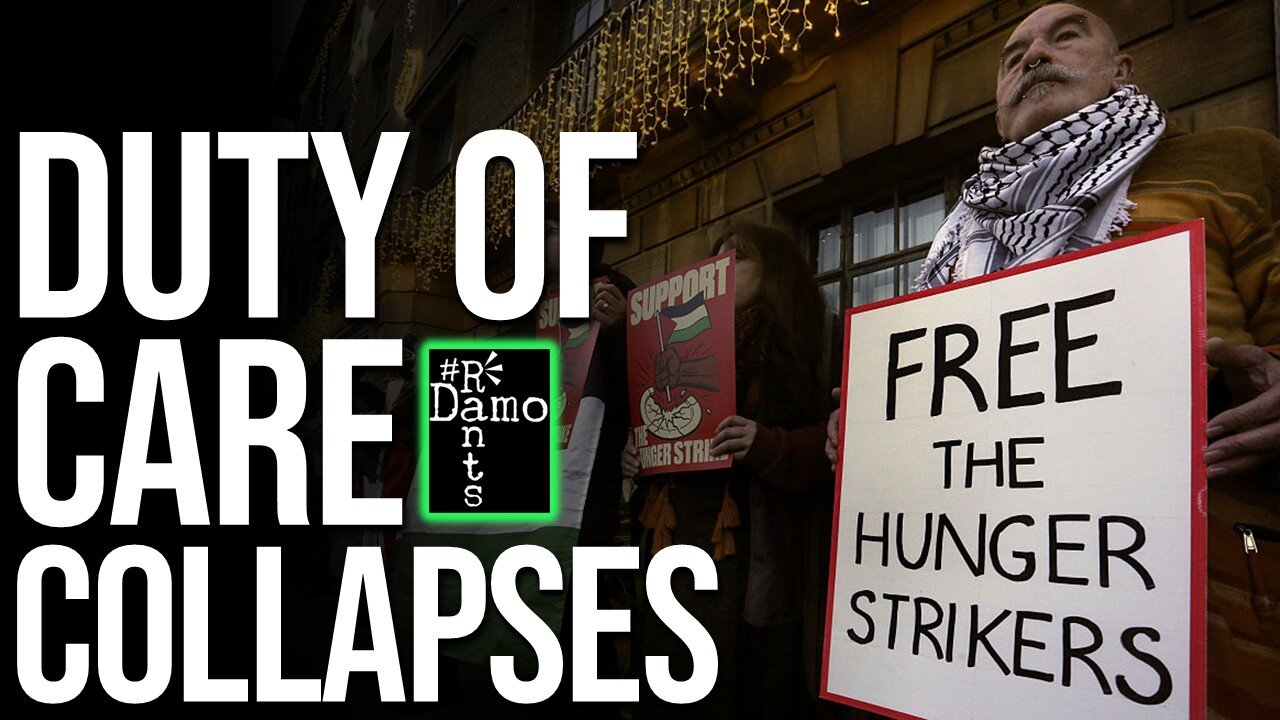
A Dying Prisoner Forced Their Hand — And They’ve Absolutely Lost It
Right, so it tells you everything about Britain right now that a woman can be on Day 46 of a hunger strike, collapsing on the floor of her cell, drifting in and out of consciousness, and the people in charge still think the real emergency is an MP and two NHS doctors turning up to ask why no ambulance has been called. That’s where we were as of the early hours of this morning. A Filton hunger striker, Qesser Zuhrah is dying, the decline has been predictable for weeks, the warnings have been shoved under ministerial carpets, and the prison’s first instinct was to shut the doors and hope the problem stayed out of sight. And when that didn’t work, they called the police on the people trying to save her life, which is the moment the state showed you exactly whose safety it values and whose it doesn’t.
Right, so a prisoner is dying on hunger strike in Britain at time of writing, about half past eight in the morning as we are right now, and the state is still trying to pretend it isn’t happening, which tells you everything you need to know about where power sits in this country when someone decides to challenge the government’s favourite arms companies and the government’s favourite client state. Qesser Zuhrah is on Day 46 without food, she has collapsed repeatedly, she has drifted in and out of consciousness, her legs have been shaking uncontrollably, her chest pains have radiated into her neck and shoulder, and the people running Britain’s largest women’s prison looked at that deterioration and decided their priority was to keep an MP, two NHS doctors and a pair of journalists outside the building until the situation became impossible to ignore. That is what you’re dealing with here. A medical emergency that has been allowed to develop in full view of ministers because confronting it would mean admitting their political use of terror legislation is collapsing in real time.
The plain truth is that this crisis didn’t begin at three-thirty this morning when Zarah Sultana turned up at HMP Bronzefield after getting word that a prisoner had been left on the floor of her cell again. It began weeks ago as the hunger strike passed Day 30, then Day 35, then Day 40, with lawyers sending urgent warnings to the Justice Secretary, David Lammy telling him that death was now a realistic possibility, and that these prisoners were showing every clinical marker of severe physiological decline. And because this is the Starmer administration, and because these prisoners are tied to Palestine Action, and because the government has spent the last eighteen months trying to make an example of anyone confronting Britain’s arms trade with Israel, the warnings were ignored. Lammy refused to meet them. Lammy refused to meet their families. Lammy claimed not to know what was happening at all. A death was foreseeable, the signs were there, and ministers looked away because the consequences of looking directly at the situation would have undermined the entire legal and political approach the government has taken since proscribing Palestine Action.
And the thing about hunger strikes is that they expose the system that holds the body in front of them. You can see that mechanism clearly here because the deterioration has been predictable from the start. Qesser Zuhrah has lost thirteen percent of her body weight. Other prisoners have lost ten and twelve kilos. Several now have dangerously low blood sugar and high ketone levels, which is your body telling you it has run out of fuel and is now breaking itself down. At least five of the hunger strikers have been hospitalised, and that is before we get to the collapse, the dizziness, the shaking limbs, the shortness of breath, the muscle twitches and the vision deterioration that have been recorded across multiple prisoners. These aren’t ambiguous signals. These are textbook thresholds for emergency escalation, and the people inside Bronzefield know that because prison clinicians have clear guidelines on what to do when a hunger strike crosses the point where survival can no longer be taken for granted. Yet this is the same prison where, a few nights ago, Qesser was allegedly told by a nurse that she didn’t decide whether she was going to hospital, the nurse did. And then when she asked for an ambulance, the request was denied.
So when her body finally gave way again overnight, and she fell into that cycle of shaking and collapsing and drifting in and out of consciousness, the prison stuck to the same logic. They refused to call an ambulance, even as an MP stood outside telling them that a prisoner might not make it through the night. They refused to let two NHS doctors in, even though those doctors were there for no other purpose than to assess whether this woman was in immediate danger of death. They refused to let journalists witness what was happening because the last thing the state wants is transparency at the moment it denies medical care to someone whose only crime is being accused of damaging the business operations of a weapons company. And then, when it became impossible to stall any further, they called the police on the MP, on the doctors, and on those journalists from The Canary, which is where the whole performance cracked, because the police then walked into the prison to ask why no ambulance had been called for someone collapsing on Day 46 of a hunger strike.
That’s the point when the system runs out of excuses. Because when the police have to ask prison staff why they aren’t calling an ambulance, you’re not looking at a misunderstanding or a paperwork delay or a misread medical note. You’re looking at a system that has decided not to act because acting would expose the political logic behind this entire prosecution.
The thing that cuts through all the excuses the state keeps leaning on here is that none of this is optional for them, because once someone is in custody the government doesn’t just control their movements, it controls their health, their safety, and their access to emergency care, and that responsibility is written into every layer of the system whether the people running it want to acknowledge it or not. The prison can tell you they’re assessing the risk. They can tell you they’re monitoring the situation. They can tell you an ECG looked fine. But the basic legal position is brutally simple: if someone is in your custody and their life is in danger, you are under a direct duty to preserve that life. Not theoretically, not when it’s convenient, but immediately and in full. That’s the duty of care, that’s Article 2, that’s long-established case law on the right to life, and it is not something the Ministry of Justice can handwave away because the politics of this case happen to be awkward.
And when you map that duty against what actually happened in Bronzefield, you see the breach forming in real time. A prisoner collapsing on the floor on Day forty-six of a hunger strike isn’t a grey area. Severe weight loss, chest pain radiating through the shoulder, loss of consciousness, unstable vital signs, and metabolic markers showing starvation aren’t medical mysteries. They are red flags that trigger mandatory escalation. The system knows this. That’s why prisons have clear thresholds for sending hunger strikers to hospital, and it’s why clinicians are expected to move fast the moment a prisoner shows signs they cannot maintain physiological stability. So when the prison refuses an ambulance, when it turns away NHS doctors, when it treats a medical emergency as a security issue, the problem isn’t just negligence. It’s structural defiance of the responsibilities the state is legally bound to follow.
And here’s the thing: once an authority takes someone into custody, it loses the one defence the rest of us have, which is that the person could have sought help for themselves. Qesser couldn’t do that. She couldn’t call an ambulance. She couldn’t walk into A&E. She couldn’t choose her doctor. Every avenue for protecting her own life had been transferred to the state, and the state decided not to act. You can see how sharp that failure becomes when the police walk into the prison to ask why no ambulance has been called, because at that point even another arm of the state is registering that the duty of care has snapped. And when ministers are told repeatedly that the risk of death is real, and that these prisoners are well beyond the point where recovery is guaranteed, and they refuse to meet the lawyers or the families or the MPs raising the alarm, the institutional responsibility moves upwards. That’s how accountability works. Responsibility climbs the chain until it reaches the people who had the power to intervene and chose not to.
So when people talk about this crisis as if it’s a disagreement over clinical judgement, they’re missing the real story. The law doesn’t give prisons the discretion to ignore a collapsing prisoner. It doesn’t give ministers the option to pretend they didn’t know. Once the state takes custody of a body, it takes custody of the duty to keep that body alive, and when that body is showing every sign of imminent collapse and the state still blocks access to hospital care, you’re not looking at an institution struggling to cope. You’re looking at an institution appearing to break its own obligations because the politics mattered more than the life in front of it.
These are political prisoners. That’s not a metaphor. The deputy leader of the Green Party has said it openly. Amnesty has said the terrorism laws were misused. The lawyers representing these detainees warned that death was a likely outcome if ministers kept refusing to intervene. And every institutional decision that followed reinforced the point. Qesser has been held for seventeen months without trial. Others have been held for over a year. All of them were accused of involvement with Palestine Action before the government proscribed the organisation, which is why lawyers, campaigners and MPs have been saying from the beginning that the process here is the punishment, that the state is using the terror framework to deter political dissent because the normal criminal process would not carry the same political message.
So when you look at what Bronzefield did in those early hours, it sits exactly inside that political logic. A government that escalates protest activity into terrorism cases is a government that needs the defendants to be seen as dangerous. A government that needs them to be seen as dangerous has every incentive to treat them as security risks rather than people whose lives need safeguarding. And a government that needs to maintain that story will always choose institutional control over immediate medical care, because admitting that these prisoners are in danger would force the government to admit that the case being built against them is political. That is the thread connecting the proscription, the remand periods, the ambulance refusals and the ministerial silence. And when you follow that thread to the present moment, you arrive at a prisoner dying on hunger strike because the state valued the political narrative more than the human being.
And yes, this is the biggest hunger strike Britain has seen since nineteen eighty-one, and that matters because the fatal timeline established during those strikes tells you exactly how close Qesser is to the edge. Martin Hurson died on Day forty-six. Two other Filton prisoners hit Day forty-five before collapsing. The lawyers flagged this explicitly to ministers, because they knew what those numbers meant. So when you see a similar pattern unfolding today, and you see the same combination of collapse, severe weight loss, chest symptoms, loss of consciousness and metabolic instability, you know the risk is not hypothetical. The danger is baked into the day count. There is no ambiguity, and the government has been told that repeatedly.
And you can see the political incentives lined up behind the response. Britain has tied itself to Israel’s military campaign, to its arms supply chain, to its diplomatic protection, and to its narrative that anti-genocide protest is extremist by definition. The proscription of Palestine Action wasn’t about safety. It was about shielding weapons manufacturers and closing off the one avenue of direct resistance that had forced the government to confront its own complicity. So when those activists continued their resistance inside prison, this time by refusing food, the state needed to keep control of the story. And a hunger strike that exposes political detention and medical negligence is a threat to that control, which is why ministers pretended not to know, why the prison stalled on emergency care, and why the government has tried to keep the public at arm’s length until the situation became unavoidable.
The thing about systems like this is that they reveal themselves most clearly at their breaking points, and a hunger strike is a breaking point by design. Qesser’s body is showing the collapse that any medical professional would expect at this stage, yet it took an MP streaming from a car park at three in the morning to force the institution to finally let someone inside to ask questions. And that’s the deeper truth here. The state is only responsive when it is exposed. It only moves when the public is watching. And when it comes to political detainees tied to Palestine activism, the instinct is always to suppress, delay, deny and blame the prisoner for their own condition, because acknowledging the crisis would require acknowledging the politics behind the case.
So yes, this is a story about a woman dying on hunger strike. But it’s also a story about the government refusing to act even as the risk became undeniable. It’s a story about a justice system that has been retooled to punish political dissent long before anyone reaches trial. It’s a story about a prison service that prioritised institutional control over emergency care. It’s a story about a minister who ignored repeated warnings because admitting the truth would collapse the narrative he was relying on. And it’s a story about a country that calls itself a democracy while allowing a political prisoner to collapse twice on the floor of her cell without calling an ambulance.
You can see where this leads. If the state will withhold medical intervention from a prisoner collapsing on Day forty-six of a hunger strike, then the state has already answered the question of whose life is valued and whose isn’t. And when that decision sits inside a prosecution built on an inflated terror framework, enforced through year-long remand and defended by ministers who refuse to meet the people raising the alarm, the political meaning becomes impossible to dodge. A system that will not call an ambulance for a dying prisoner has already decided how far it is willing to go.
Time of recording is now about half 3, at this point an ambulance finally took Qasser to hospital, the police then turned on the protesters and have according to Canary journalists on the scene now arrested the only black man who attended, one of the doctors as he is, they’ve literally arrested an NHS doctor now, we’ll very much keep following events here on this channel, solidarity to the protesters involved who made this happen, I don’t believe for one moment Qasser Zuhrah would be attending hospital now without them.
Making the whole situation worse is the fact that Israel, the state the Starmer regime is widely seen to be doing much of this in aid of, several MPs had a laugh about in parliament this week of course, has literally been mocking and jeering at these hunger strikers, with one headline even going so far as to tell them to eat a sandwich. Yet we’re supposed to feel sorry for them all the time aren’t we? Get the details of that grotesquery here.
Please do also hit like, share and subscribe if you haven’t done so already so as to ensure you don’t miss out on all new daily content as well as spreading the word and helping to support the channel at the same time which is very much appreciated, holding power to account for ordinary working class people and I will hopefully catch you on the next one. Cheers folks.
-
 8:50
8:50
Sideserf Cake Studio
23 hours ago $15.92 earnedPillow Cat Cake Challenge! (Gabby's Dollhouse Ready to Party)
82.7K8 -
 LIVE
LIVE
DBoss_Firearms
1 hour agoD'Boss Firearms is LIVE with The King of Camo and The Arms Room!
59 watching -
 13:14
13:14
Upper Echelon Gamers
23 hours ago $3.63 earnedThe "Slop YouTubers" Are Angry... (And the Reason is Hilarious)
22.2K10 -
 1:06:28
A Cigar Hustlers Podcast Every Day
1 day agoHustler Every Week Day Episode 433 "Oscars And Chill"
25.3K -
 4:26
4:26
GreenMan Studio
1 day agoGREENMANS STOCKING STUFFERS 5 – GREENMAN AI
23.2K5 -
 5:00
5:00
SethDrums
4 days ago $9.46 earnedStaind – It's Been Awhile if it was 1980s
83.1K18 -
 20:18
20:18
itsSeanDaniel
2 days agoCandace Owens CALLED OUT by Piers Morgan, So She FIRES BACK
39.2K27 -
 4:57:14
Akademiks
15 hours ago21 Savage Wants Young Thug, Wham & Gunna to SQUASH IT! Future Sneak Dissing? Jim Jones Pays 50 Cent?
412K13 -
 6:01:38
Right Side Broadcasting Network
3 days agoLIVE: President Trump to Deliver Remarks in Rocky Mount, NC - 12/19/25
164K66 -
 3:24:48
VapinGamers
14 hours ago $51.07 earnedDestiny 2 - Dungeons and Loot with Friends - !rumbot !music
124K1