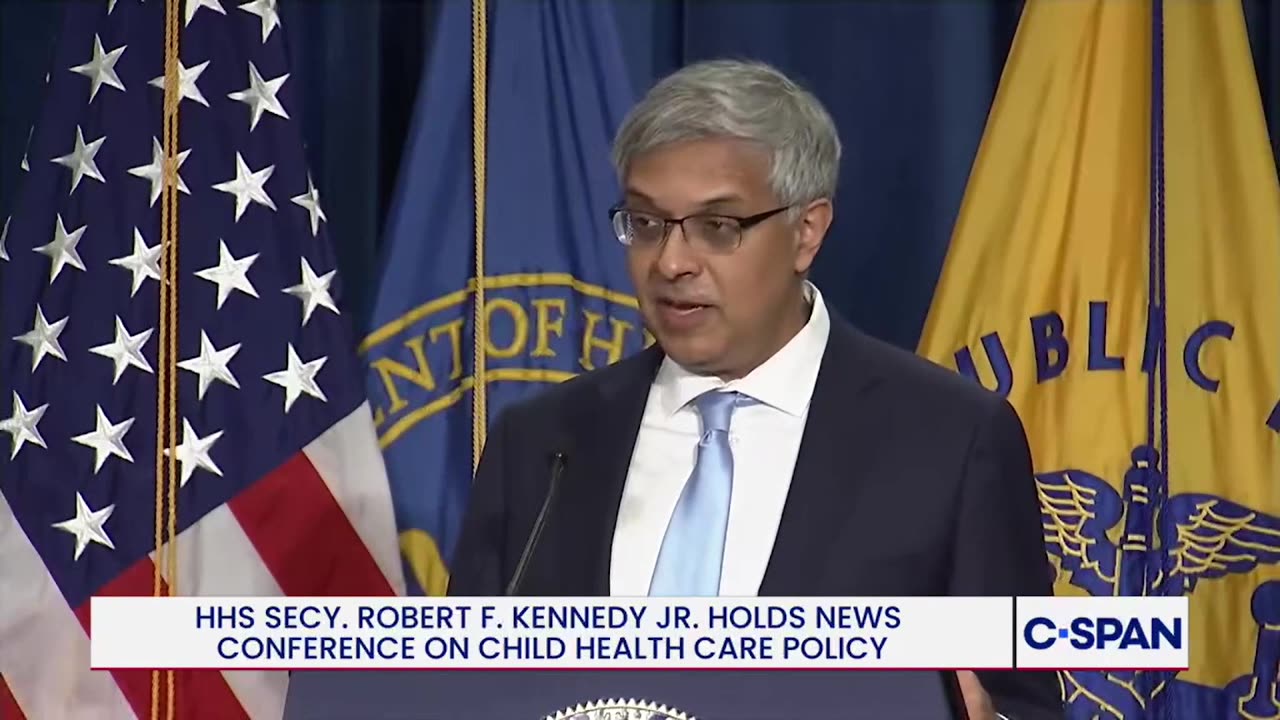
NIH Director Dr. Bhattacharya Calls Pediatric Gender Transition a Failure of Scientific Integrity
In this address, Dr. Jay Bhattacharya, Director of the National Institutes of Health, reflects on what he describes as a troubling chapter in modern medical history—the misuse of scientific authority to promote gender-transition interventions for children without solid evidence. He argues that during recent years, scientific institutions and journals were overtaken by ideological groupthink, suppressing dissent and elevating weak or nonexistent evidence into dogma.
At the center of his remarks is the claim that children who are denied medical transition are more likely to commit suicide. Dr. Bhattacharya explains that this assertion was treated as settled science despite the absence of credible supporting evidence. Major reviews—including the HHS report, the UK’s Cass Review, and findings from Scandinavian countries—have since concluded that the evidence for such claims is extremely weak or nonexistent.
He criticizes the scientific culture that discouraged researchers from questioning these extraordinary claims, noting that fear of professional or ideological backlash prevented honest debate. As an example, he recounts an NIH-funded study that found no increased suicide risk for children who did not transition, but whose researcher refused to release the results due to ideological pressure. Dr. Bhattacharya calls this a serious violation of scientific integrity.
Dr. Bhattacharya announces two major policy actions. First, the NIH has ended support for research promoting pediatric gender transition, calling much of it “junk science,” with remaining funding to be fully eliminated by year’s end. Second, the NIH will fund rigorous, gold-standard research to help children and families affected by transition and detransition, acknowledging the real harm and distress experienced by many.
He closes by thanking the administration and lawmakers for their leadership, expressing hope that science will return to its core principles—questioning assumptions, following evidence, and prioritizing the protection of children—so that this period is remembered as a cautionary lesson never to be repeated.
-
 2:54
2:54
Illinois Family Institute
13 days agoHHS Deputy Sec. O’Neill: “Children Deserve Protection, Not Ideology”
271 -
 LIVE
LIVE
Viss
53 minutes ago🔴(LIVE) - Kicking Off The New Year with Massive Arc Raiders Raids!
80 watching -
 1:00:42
The Rubin Report
4 hours agoDon’t Be Fooled, This Isn’t Normal. It’s the Beginning of a New Crisis | Arthur Brooks
34.9K16 -
 LIVE
LIVE
Midnight In The Mountains™
58 minutes agoMake RETRO GREAT AGAIN! | First Stream of the YEAR | Castlevania 200.6% Run STARTS NOW!
423 watching -
 LIVE
LIVE
GloryJean
3 hours agoHappy New Year! Becoming a better Raider
18 watching -
 DVR
DVR
Robert Gouveia
3 hours agoJack Destroys Key Witness!! Pipebomber Defense UNLEASHES! Congress Launches Probes!!
6.88K8 -
 LIVE
LIVE
GritsGG
3 hours agoHappy New Year's! #1 Warzone Victory Leaderboard! 560+ Ws!!
72 watching -
 LIVE
LIVE
FusedAegisTV
13 hours agoThe "HAHAHAHA" meme gave me AIDS - (8K Mods) Pt. 3
132 watching -
 LIVE
LIVE
freecastle
2 hours agoTAKE UP YOUR CROSS- ROCKIN' IN THE NEW YEAR!!!!
632 watching -
 LIVE
LIVE
Barbarian Mowz
3 hours agoThe Elder Scrolls III: Morrowind - The Stealthy Breton
91 watching