Pediatric Immunizations - Update 12-17-25
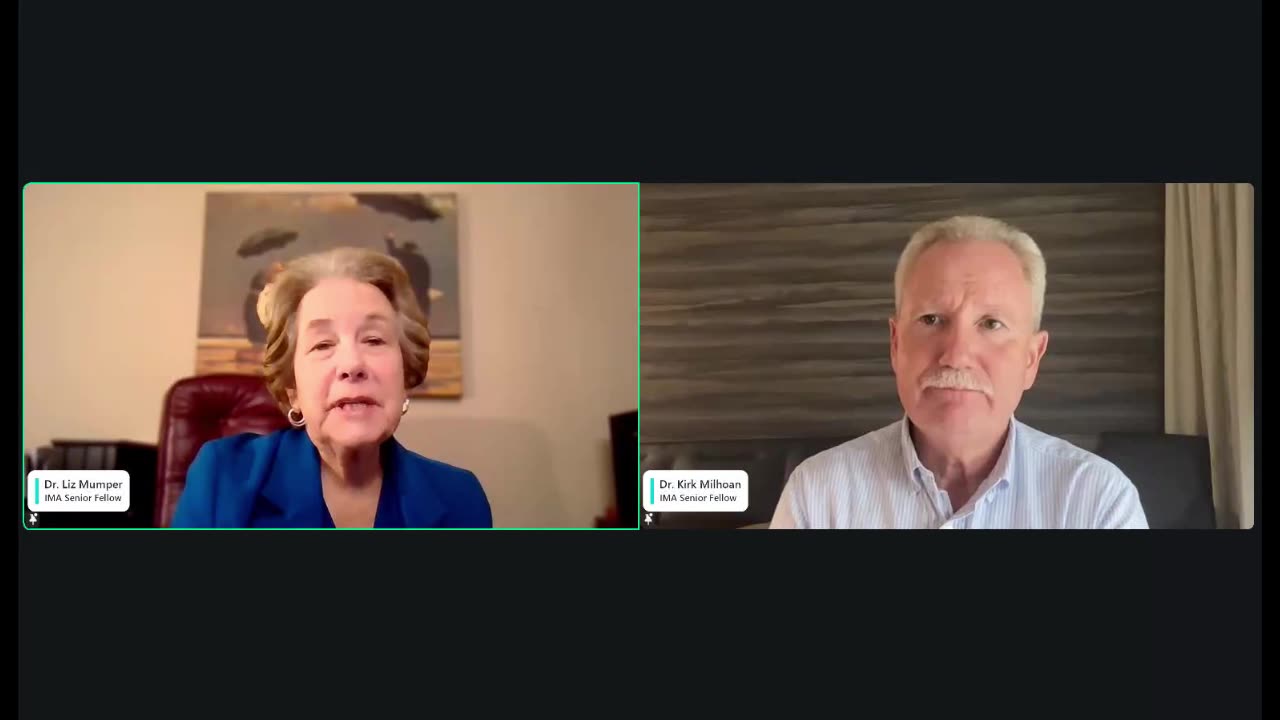
Independent Medical Alliance Webinar with pediatrician Elizabeth Mumper MD and pediatric cardiologist Kirk Milhoan MD PhD discussing the controversy over the immunization schedule. Dr Milhoan was recently appointed to head the CDC Advisory Committee on Immunization Practices (ACIP). From the IMA site:
In this episode, IMA Senior Fellow and host Dr. Elizabeth Mumper will be joined by IMA Senior Fellow and Chairman of the Advisory Committee on Immunization Practices (ACIP), Dr. Kirk Milhoan, to discuss recent changes to U.S. childhood vaccine recommendations and what they mean for parents and clinicians.
They will review updates from the Advisory Committee on Immunization Practices, including the removal of the CDC’s Hepatitis B recommendation for babies under two months in the United States, and address common immunization questions.
For decades, childhood vaccine policy in the United States has followed a familiar pattern. Recommendations are issued by federal advisory bodies, adopted by institutions, and quickly treated as nonnegotiable. For parents and clinicians alike, the space for discussion has steadily narrowed.
That is why a recent decision by the Advisory Committee on Immunization Practices has drawn such intense reaction. In this episode of IMA Weekly, pediatrician and IMA Senior Fellow Dr. Liz Mumper speaks with Dr. Kirk Milhoan, Chair of ACIP, about the committee’s decision to remove its recommendation for routine administration of the Hepatitis B vaccine to newborns under two months old when the mother is Hep B negative.
The response to that decision has been swift and, in many cases, misleading. Headlines have framed it as reckless or regressive. Critics have implied it weakens vaccine programs. But as Dr. Milhoan explains, the change reflects something far more basic: a return to medical reasoning that starts with the individual child.
Don’t miss our last webinar of 2025!
Meet the Experts
Dr. Liz Mumper
Dr. Elizabeth Mumper
IMA Senior Fellow and pediatrician. Author of the Parent’s Guide to Childhood Immunizations and host of the IMA series Kids’ Corner with Dr. Liz. Dr. Mumper has spent decades helping families navigate complex vaccine decisions with clarity, evidence, and respect for informed consent.
Dr. Kirk Milhoan
Dr. Kirk Milhoan
IMA Senior Fellow and Chair of the Advisory Committee on Immunization Practices. A pediatric cardiologist and medical missionary, Dr. Milhoan brings both clinical and ethical experience to vaccine policy discussions. His work with IMA on pediatric care and medical ethics is collected here.
Why Prevention Demands a Different Standard
One of the most important distinctions raised in the conversation is also one of the most often ignored. Preventive medicine is not the same as treatment. Vaccines are given to healthy children, not to patients who are already ill. That fact alone changes the ethical burden. As Dr. Mumper points out, for too long there has been a “default assumption” that vaccines don’t harm anyone. That’s something both doctors on the panel know is untrue from their direct experience.
If vaccines are not risk-free, the approach to their use should follow that context. Dr. Milhoan explains that when the patient is well, the tolerance for uncertainty and risk must be far lower.
“This is not a treatment of someone who’s dying. This is a well child who we’re trying to prevent something that they may or may not get or be exposed to. So our standard for making sure there is very, very, very little risk and knowing it as best as we can is very important when we’re doing preventative measures.” — Dr. Kirk Milhoan [06:35–06:57]
This is not an abstract policy argument. It is about the responsibility physicians carry when recommending interventions to families who are being asked to accept risk on behalf of a healthy child.
“But when we have a beautiful, healthy child or baby in front of us, it is really incumbent upon us to make sure that that patient is considered.” — Dr. Kirk Milhoan [07:10–07:21]
What ACIP Actually Changed
If you only read the headlines from most mainstream media, you’d think ACIP banned the Hepatitis B vaccine for babies. They didn’t.
What the committee did was remove a universal recommendation for a specific group: newborns under two months old, born to mothers who are Hep B negative. In other words, a group with virtually zero risk of contracting the disease at that age.
This change does not restrict access to the vaccine. Parents and clinicians can still choose to give it if they determine it’s appropriate. What it does is return that decision to the clinical setting, where it belongs.
“We didn’t take away any of the freedom of anyone except to take it outside of a recommendation and allowed for shared decision-making. And we used the word suggested not to start before two months.” — Dr. Kirk Milhoan [18:36–18:50]
Because recommendations often operate as de facto mandates, removing one matters. It frees clinicians to consider context instead of reflexively following a schedule—and it protects low-risk babies from receiving an intervention that offers no clear benefit.
Restoring Trust Ad
Re-centering Medicine on the Patient
Dr. Milhoan places the ACIP decision within a broader effort to restore a principle that once defined medical practice. The physician’s primary obligation is not to a system, a metric, or a population level goal. It is to the patient in front of them.
“Much of what the committee [ACIP] is going for is we’re trying to return back to one of the most important foundational ideas or concepts in medicine, and that is first do no harm. I have a relationship, a very sacred honor with my patient, and my job is to look after that patient. It’s not necessarily considered about what the public health is around the world. My first obligation is that patient.” — Dr. Kirk Milhoan [07:21–07:55]
This framing stands in contrast to a medical culture that has increasingly treated recommendations as mandates and dissent as danger.
Risk Exists, Whether We Acknowledge It or Not
Another theme that runs throughout the discussion is the refusal to pretend that vaccines are risk free. Every medical intervention carries risk, and honest medicine requires acknowledging that fact.
“The low risk patient doesn’t need a vaccine with a risk because every vaccine has a risk. Every treatment we use, antibiotics, whatever has a risk.” — Dr. Kirk Milhoan [19:10–19:20]
Determining whether that risk is justified requires individualized assessment, not blanket policy.
“Okay, what is this? How do I get to the bottom line of what I think the benefit is? And it’s not necessary for society. I have to go, okay, what’s the age? What’s the influence? Where are the genetics? What is their family history? Who’s gonna be living in the house with them?” — Dr. Kirk Milhoan [23:40–23:58]
That kind of thinking has been missing from public vaccine policy for too long. ACIP’s move reintroduces it.
⚕️ Join Us at the 2026 IMA Medical Education Conference
Join us for the 2026 IMA Medical Education Conference: Emerging Trends in Medicine, a two-day gathering dedicated to the latest innovations, research, and forward-thinking practices shaping the future of healthcare. This event offers a dynamic program of expert-led lectures, networking opportunities, and hands-on learning through Abstract Alley. Hosted in Los Colinas, Texas—just minutes from Dallas and Fort Worth.
👉 Get Tickets Now
When Even Discussing Risk Becomes Controversial
Perhaps the most striking part of the conversation is not what Dr. Milhoan argues, but what he observes about the state of medical discourse itself. Simply acknowledging risk has become unacceptable in many professional settings.
“I’m shocked how much people are opposed to just having the discussion that there’s a risk with a medical intervention.” — Dr. Kirk Milhoan [24:19–24:30]
For parents trying to navigate this environment, he offers a simple standard.
“Who can I trust? I guess the broad view I would say is someone who’s willing to sit with you and answer your questions.” — Dr. Kirk Milhoan [35:34–35:44]
Moving Past Slogans and Silence
Late in the conversation, Dr. Milhoan reflects on how appeals to authority have replaced genuine discussion.
“I think we need to get away from ‘it’s settled science, it’s safe and effective, don’t ask any questions.’ I think this requires some discussion.” — Dr. Kirk Milhoan [36:17–36:27]
He also points to the retreat of major medical organizations from open debate.
“It saddens me that some of the big medical societies, they’ve walked away. We encourage debate.” — Dr. Kirk Milhoan [37:42–37:50]
Looking Ahead to 2026
This was a conversation about restoring medical judgment.
The ACIP decision on Hepatitis B reflects a willingness to distinguish between high-risk and low-risk patients, to reject automatic protocol, and to acknowledge that not every intervention is justified simply because it exists. That shift may be modest on paper, but it represents something larger: a reassertion of clinical reasoning in a system that has increasingly sidelined it.
The takeaway for parents and clinicians alike is straightforward. When children are healthy and interventions carry risk, medicine must slow down, ask better questions, and respect individual context. That conversation has been missing for too long. This episode brings it back into the open.
-
 LIVE
LIVE
Kim Iversen
2 hours agoKash Patel and Trump Say Epstein Case Is CLOSED
1,258 watching -
 1:43:40
Redacted News
2 hours agoEPSTEIN'S SANTANIC CULT IS JUST THE TIP OF THE ICEBERG, IT'S MUCH WORSE w David Icke | Redacted
118K86 -
 1:07:13
Russell Brand
5 hours agoThe Epstein Story Isn’t Going Away — SF678
117K54 -
 LIVE
LIVE
Decoy
2 hours agoHorrifying findings
336 watching -
 UPCOMING
Badlands Media
15 hours agoSpace Revolution Ep. 4 - Information, Truth & Health
7.32K -
 UPCOMING
The Amber May Show
2 hours agoPatriot Mobile at SHOT Show, March for Life… and Qatar’s 6,000-Acre “Qatar City” in Arizona?
48 -
 1:16:10
vivafrei
3 hours agoTyler Robinsons Motion to Disqualfy! Kash Patel's Interview w/ Brett Baier!Bill Gates's Guilt & MORE
43.4K12 -
 48:45
48:45
Zach Costello
2 hours agoShocking Trial Evidence Dismantles Tyler Robinson ‘Lone Wolf’ Narrative
16.2K6 -
 7:14
7:14
Gun Owners Of America
3 hours agoBiden DOJ Settled Their "Zero Tolerance Cases" Why Wont Bondi?
2.85K1 -
 LIVE
LIVE
freecastle
6 hours agoTAKE UP YOUR CROSS- Don't withhold good from those it is due when it is in YOUR power to ACT!
218 watching