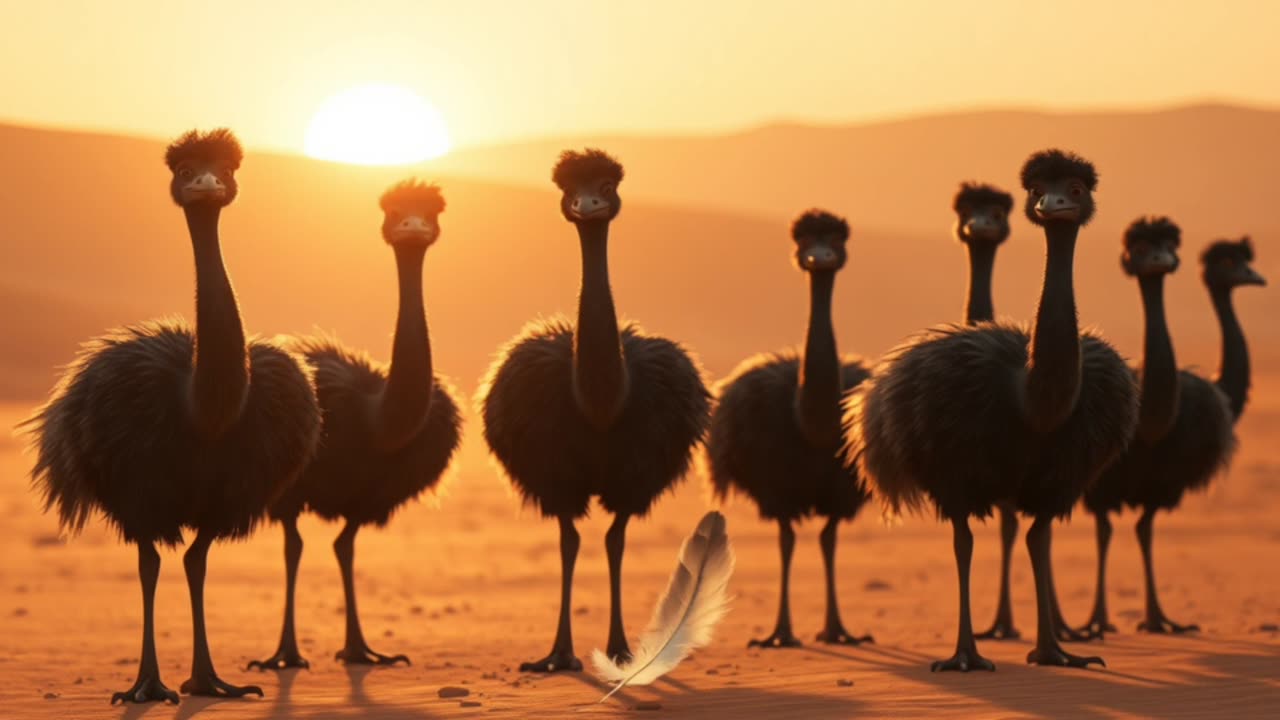
Eleven Emu Brothers
Call to Action Question for the Story:
How can we, like Jupurrurla, demonstrate unwavering commitment and sacrifice to restore harmony in our families or communities, using our skills to mend broken bonds and honor our shared connection to our heritage?
In the heart of Australia's blazing Tanami Desert, beside the sacred waterhole of Yurlpu whose waters mirror the starlit Dreamtime sky, lives a close-knit Warlpiri family: eleven bold and adventurous brothers, renowned as hunters who laugh like the wild desert breeze, and their devoted younger sister Jupurrurla, a gifted weaver whose intricate mats from spinifex and pandanus capture the patterns of the Milky Way and ancestral stories. When tragedy brings a new stepmother into their lives—a enigmatic figure with the sharp voice of a wind spirit and eyes glinting like acacia thorns—jealousy stirs beneath the bloodred moons and swirling dust storms. The Eleven Emu Brothers is a captivating Dreamtime tale of unbreakable sibling bonds, sacrifice, and the enduring power of love woven into the harsh yet sacred land, blending ancient Warlpiri traditions with timeless themes of endurance against malice.
English Folk Song: The Eleven Emu Brothers
Lyrics (Based on the Warlpiri Story):
(Verse 1)
In the Tanami’s glow, where the spinifex sways,
Eleven brothers hunted through starlit warm days.
Their sister, Jupurrurla, wove mats bright and grand,
Till a wind spirit’s curse swept their hearts from the land.
(Chorus)
Oh, the eleven emu brothers, swift in the night,
Turned to birds ‘neath the stars’ silver light.
Jupurrurla’s love, with her hands’ silent weave,
Brought them home to the Dreamtime’s reprieve.
(Verse 2)
Nampijinpa’s spell, like a storm’s bitter sting,
Made emus of men, gave them feathers for wings.
Jupurrurla trekked, with the Emu’s star guide,
Wove spinifex mats, let her silence abide.
(Chorus)
Oh, the eleven emu brothers, swift in the night,
Turned to birds ‘neath the stars’ silver light.
Jupurrurla’s love, with her hands’ silent weave,
Brought them home to the Dreamtime’s reprieve.
(Verse 3)
Her fingers bled red, yet her spirit stood strong,
Mats glowed with the stars, where the Ancestors throng.
The curse broke at last, brothers freed in the dawn,
One feather remained, where the spell lingered on.
(Chorus)
Oh, the eleven emu brothers, swift in the night,
Turned to birds ‘neath the stars’ silver light.
Jupurrurla’s love, with her hands’ silent weave,
Brought them home to the Dreamtime’s reprieve.
(Bridge)
The camp sang her name, by the waterhole’s gleam,
Love’s endurance binds kin to the desert’s true dream.
Nampijinpa’s winds fled where the starlight holds sway,
Jupurrurla’s heart lit the Tanami’s way.
(Chorus)
Oh, the eleven emu brothers, swift in the night,
Turned to birds ‘neath the stars’ silver light.
Jupurrurla’s love, with her hands’ silent weave,
Brought them home to the Dreamtime’s reprieve.
(Outro)
Sing by the fire, where the desert stars soar,
Of Jupurrurla’s love and the truths that she bore.
For a heart that holds fast, with the land as its guide,
Weaves the ties of kin where the Ancestors reside.
Challenges in Adapting the Story to a Warlpiri Context:
1. European Royalty and Setting : The original’s kings and castles are foreign to Warlpiri’s egalitarian desert culture. The family was reimagined in a camp near a waterhole, with the brothers as hunters and Jupurrurla as a weaver, aligning with Warlpiri communal roles and the Tanami’s landscape.
2. Swans and Nettles : Swans and European nettles don’t exist in the Tanami. Emus, totemic and native, replaced swans, and spinifex, a stinging desert plant, substituted nettles, maintaining the transformation and sacrifice motifs while reflecting Warlpiri ecology.
3. Christian Undertones : The tale’s religious framework, with its martyrdom and divine justice, clashes with Warlpiri spirituality. The curse was tied to a wind spirit, and the resolution came through the Emu Ancestor and Jupurrurla’s connection to country, aligning with Warlpiri Dreamtime beliefs.
4. Individual Sacrifice vs. Communal Harmony : The original’s focus on the sister’s solitary sacrifice was adapted to emphasize communal restoration, with Jupurrurla’s work benefiting the camp and the brothers’ return strengthening kinship, reflecting Warlpiri values.
Point Summary of The Wild Swans (Hans Christian Andersen, 1838)
Setting: A kingdom where a king has eleven sons and one daughter, Eliza.
Family Dynamics: The queen dies, and the king remarries a wicked stepmother.
Curse: The jealous stepmother curses the eleven princes, turning them into swans who can only become human at night.
Exile: The stepmother banishes Eliza, who discovers her brothers’ fate.
Quest for Redemption: A fairy reveals Eliza can break the curse by weaving eleven shirts from stinging nettles, remaining silent throughout the task.
Trials: Eliza endures pain from nettles, societal misunderstanding, and near execution for suspected witchcraft while weaving in silence.
Climactic Resolution: As Eliza completes the shirts on the day of her execution, the swans return; she throws the shirts over them, restoring their human forms, though the youngest has a swan wing due to an unfinished sleeve.
Triumph: Eliza’s silence breaks, she explains her ordeal, is saved from execution, and the stepmother’s evil is exposed.
Moral: Love, sacrifice, and perseverance overcome adversity.
-
 21:23
21:23
Jasmin Laine
4 hours agoTrump Leaves Canada SPEECHLESS—Demands IMMEDIATE Tariff Negotiations After SECRET China Deal
9.15K21 -

Flyover Conservatives
8 hours agoTwo Halftime Shows, Two Americas: The Propaganda Playbook Revealed; Historic 2-Week Silver Plunge — Setting up $300 - $500 by Summer? - Dr. Kirk Elliott | FOC Show
11.2K -
 1:54:12
Barry Cunningham
3 hours agoLIVE TONIGHT: Ghislaine Maxwell Deposition | Top SB Commercials | TPUSA Halftime Show Watch Party!
64.2K44 -
 8:49:05
Dr Disrespect
11 hours ago🔴LIVE - DR DISRESPECT - WARZONE - NEON HUNTER
136K13 -
 51:23
51:23
Donald Trump Jr.
7 hours agoRighting the Left’s Wrongs, Plus Explosive 2020 Revelations | Triggered Ep.315
207K85 -
 14:14
14:14
Robbi On The Record
2 months ago $15.99 earnedThe Identity Crisis No One Wants to Admit | Identity VS. Personality
124K29 -
 1:52:59
Kim Iversen
7 hours agoNew Evidence: Jeffrey Epstein Is ALIVE and in Israel
143K120 -

Akademiks
5 hours agoBad Bunny Performs at Superbowl! Cardi B leaves Steffon Diggs? YB or CB to headline next year?
43.1K4 -
 13:41:47
LFA TV
1 day agoLIVE & BREAKING NEWS! | MONDAY 2/9/26
280K20 -
 1:06:26
The Amber May Show
9 hours ago $0.02 earnedTil You Can’t: Patriot Spirit, Family Legacy & The All-American Halftime Show with Sam Anthony
34.7K4