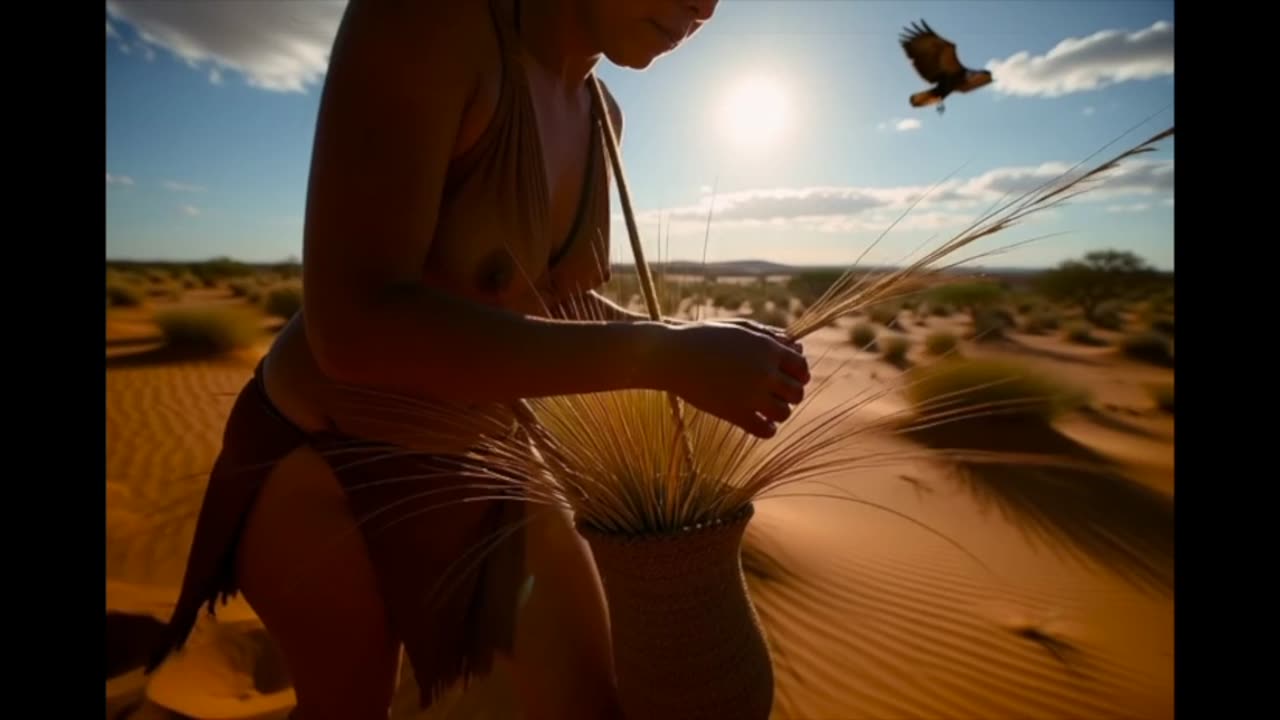
eleven emu brothers tale
How can we, like Jupurrurla, demonstrate unwavering commitment and sacrifice to restore harmony in our families or communities, using our skills to mend broken bonds and honor our shared connection to our heritage?
In the heart of Australia's blazing Tanami Desert, beside the sacred waterhole of Yurlpu whose waters mirror the starlit Dreamtime sky, lives a close-knit Warlpiri family: eleven bold and adventurous brothers, renowned as hunters who laugh like the wild desert breeze, and their devoted younger sister Jupurrurla, a gifted weaver whose intricate mats from spinifex and pandanus capture the patterns of the Milky Way and ancestral stories. When tragedy brings a new stepmother into their lives—a enigmatic figure with the sharp voice of a wind spirit and eyes glinting like acacia thorns—jealousy stirs beneath the bloodred moons and swirling dust storms. The Eleven Emu Brothers is a captivating Dreamtime tale of unbreakable sibling bonds, sacrifice, and the enduring power of love woven into the harsh yet sacred land, blending ancient Warlpiri traditions with timeless themes of endurance against malice.
The Eleven Emu Brothers
In the heart of the Tanami Desert, where the sun blazes like a molten shield and spinifex grasses flicker like tongues of fire, a Warlpiri family lived beside a sacred waterhole called Yurlpu. Its waters, kissed by the heavens, shimmered with the reflections of a starblazed sky, holding secrets whispered by the Ancestors. The family’s eleven brothers, led by the bold Jampijinpa, were renowned hunters, their lithe figures darting through mulga scrub, spears flashing like lightning as they tracked kangaroo and goanna. Their laughter, bright and wild, rolled across the dunes like a desert breeze, weaving joy into the land. Their younger sister, Jupurrurla, was their heart’s keeper, her hands crafting intricate mats from pandanus and spinifex, each pattern a story of the Milky Way’s dance, her fingers threading the cosmos into every weave.
When their mother, a gentle keeper of songs, passed into the Dreamtime, their father, Jungarrayi, a man with eyes like deep desert pools, took a new wife. Nampijinpa came to them cloaked in swirling dust, a wind spirit with a voice sharp as flint and eyes that glinted like the thorns of acacia. Her heart, cold as the desert night, burned with jealousy for the bond between Jupurrurla and her brothers. Under a bloodred moon, when the air crackled with unseen power, Nampijinpa stood atop a dune, her arms raised to the sky. Chanting forbidden words that twisted the air like smoke, she cursed the eleven brothers. A gust howled, and their bodies shuddered, twisting and stretching until they stood as eleven majestic emus, their feathers gleaming like polished ochre under the starlight. With a mournful cry, they fled, their long legs carrying them over the dunes, vanishing into the night’s vast embrace.
Jupurrurla awoke to silence, her brothers’ laughter gone, the camp empty but for the tracks of emus leading into the desert. Her heart, heavy as a grinding stone, led her to Yurlpu’s edge, where she knelt, tears falling into the water. The ripples parted, and the Emu Ancestor rose, its form shimmering like a mirage, its eyes ancient and kind. “Your brothers are bound by Nampijinpa’s curse,” it said, its voice like the rustle of feathers. “Only your silent weaving can free them. Seek the stinging spinifex, tougher than nettle, and weave eleven sacred mats. Speak not a word, or the curse will hold forever.” Jupurrurla nodded, her resolve hardening like sunbaked clay, and set out into the Tanami’s fiery expanse.
Her journey was a trial of spirit and flesh. The desert sun scorched her skin, and the winds whipped sand into her eyes, but Jupurrurla pressed on, guided by the starlit tracks of her emu brothers, their footprints glowing faintly in the night. She gathered the stinging spinifex, its barbs piercing her hands until her fingers bled like the red earth beneath her feet. At hidden soaks and claypans, she wove in solitude, her mats taking shape with patterns of stars, emus, and the sacred paths of the Dreamtime. The desert watched, its creatures bearing witness: the perentie lizard, basking on rocks, nodded in respect; the wedgetailed eagle, soaring above, guarded her from afar. Yet Nampijinpa’s malice lingered. Sensing Jupurrurla’s progress, the wind spirit summoned a tempest, a roaring wall of sand that tore at the mats, scattering strands across the dunes. Jupurrurla, her lips sealed, gathered each piece, her hands trembling but her spirit unyielding, the mats glowing faintly with ancestral power as she wove on.
Years passed, marked by the cycles of stars and the blooming of desert flowers after rare rains. Jupurrurla, now a woman with eyes deep as the waterhole, returned to her camp, her silence a mystery to her people. They whispered of her strangeness, some calling her touched by spirits, others urging her to speak. A young hunter, Jangala, drawn to her quiet strength, offered her shelter and food, his heart kind but puzzled by her mute resolve. Nampijinpa, disguised as a twisted desert shrub, crept close, hissing doubts into the camp’s ears, urging them to cast Jupurrurla out. But Jupurrurla wove on, her mats now ten in number, each a masterpiece of starlight and sacrifice, their edges humming with the songs of the Ancestors.
On the night of a great corroboree, as the camp danced under a sky ablaze with stars, Jupurrurla worked on the eleventh mat, her fingers raw, her breath steady. Nampijinpa, desperate, unleashed a final storm, lightning cracking the sky as dust devils tore at the camp. Jupurrurla stood firm, her mat nearly complete, its patterns pulsing like a heartbeat. As the storm peaked, she laid the final strand, and a great silence fell. From the desert’s edge, eleven emus emerged, their feathers catching the firelight as they ran to the waterhole. Jupurrurla placed the mats before them, and the air shimmered. Feathers fell like autumn leaves, and the brothers stood as men once more, their faces radiant with gratitude. Jampijinpa, the eldest, embraced her, though his left arm bore a single feather, a lingering mark of the curse’s trace, a reminder of their trial.
The camp, awed by the miracle, gathered around Yurlpu, their songs rising to the stars. Nampijinpa’s spirit, exposed, shrieked as the Ancestors’ light banished her to the desert’s edge, where she became a lonely willywilly, forever spinning in exile. Jupurrurla, her silence broken, spoke her brothers’ names, her voice a melody that wove the camp into unity. Jangala, now her promised, stood by her side, his eyes shining with pride.
The story of the Eleven Emu Brothers became a Dreamtime song, carried on the winds of the Tanami. It taught the Warlpiri that love, rooted in the land’s heart, endures the fiercest storms. Jupurrurla’s mats, kept at Yurlpu, glowed under moonlight, a testament to her sacrifice. And when emus crossed the dunes, their tracks were said to trace her weaving, binding the desert’s children to the stars forever.
Challenges in Adapting the Story to a Warlpiri Context:
1. European Royalty and Setting : The original’s kings and castles are foreign to Warlpiri’s egalitarian desert culture. The family was reimagined in a camp near a waterhole, with the brothers as hunters and Jupurrurla as a weaver, aligning with Warlpiri communal roles and the Tanami’s landscape.
2. Swans and Nettles : Swans and European nettles don’t exist in the Tanami. Emus, totemic and native, replaced swans, and spinifex, a stinging desert plant, substituted nettles, maintaining the transformation and sacrifice motifs while reflecting Warlpiri ecology.
3. Christian Undertones : The tale’s religious framework, with its martyrdom and divine justice, clashes with Warlpiri spirituality. The curse was tied to a wind spirit, and the resolution came through the Emu Ancestor and Jupurrurla’s connection to country, aligning with Warlpiri Dreamtime beliefs.
4. Individual Sacrifice vs. Communal Harmony : The original’s focus on the sister’s solitary sacrifice was adapted to emphasize communal restoration, with Jupurrurla’s work benefiting the camp and the brothers’ return strengthening kinship, reflecting Warlpiri values.
Point Summary of The Wild Swans (Hans Christian Andersen, 1838)
Setting: A kingdom where a king has eleven sons and one daughter, Eliza.
Family Dynamics: The queen dies, and the king remarries a wicked stepmother.
Curse: The jealous stepmother curses the eleven princes, turning them into swans who can only become human at night.
Exile: The stepmother banishes Eliza, who discovers her brothers’ fate.
Quest for Redemption: A fairy reveals Eliza can break the curse by weaving eleven shirts from stinging nettles, remaining silent throughout the task.
Trials: Eliza endures pain from nettles, societal misunderstanding, and near execution for suspected witchcraft while weaving in silence.
Climactic Resolution: As Eliza completes the shirts on the day of her execution, the swans return; she throws the shirts over them, restoring their human forms, though the youngest has a swan wing due to an unfinished sleeve.
Triumph: Eliza’s silence breaks, she explains her ordeal, is saved from execution, and the stepmother’s evil is exposed.
Moral: Love, sacrifice, and perseverance overcome adversity.
-
 15:21
15:21
ThinkStory
7 hours agoPLURIBUS Season 1 Ending Explained!
72 -
 17:55
17:55
Midwest Crime
10 hours agoThe Fake UPS Delivery That Turned Deadly
78 -
 25:05
25:05
Adam Does Movies
20 hours ago $0.09 earnedAvatar: Fire & Ash - Recap
2342 -
 10:26
10:26
ARFCOM News
15 hours ago $0.12 earnedIs Trump REALLY Pro-Gun???
213 -
 UPCOMING
BEK TV
21 hours agoTrent Loos in the Morning - 12/24/2025
149 -
 12:29
12:29
Code Blue Cam
19 hours agoThe FUNNIEST Arrest EVER Recorded
42.3K16 -
 1:07:04
Coin Stories with Natalie Brunell
19 hours agoStrategy's 2026 Bitcoin Roadmap: Phong Le on 10.75% Savings Accounts, Banks in Bitcoin and His Refugee-to-CEO American Dream Story
10.6K3 -
 4:04:33
Barry Cunningham
11 hours agoLIVE WATCH PARTY! President Trump Hosts Kennedy Center Show Featuring KISS, George Strait and MORE!
592K129 -
 29:24
29:24
Sean Unpaved
8 hours agoRoy Jones Jr. Interview
25.5K -
 18:18
18:18
Scammer Payback
15 hours agoDon't Freak Out... We Found Your House
46K9