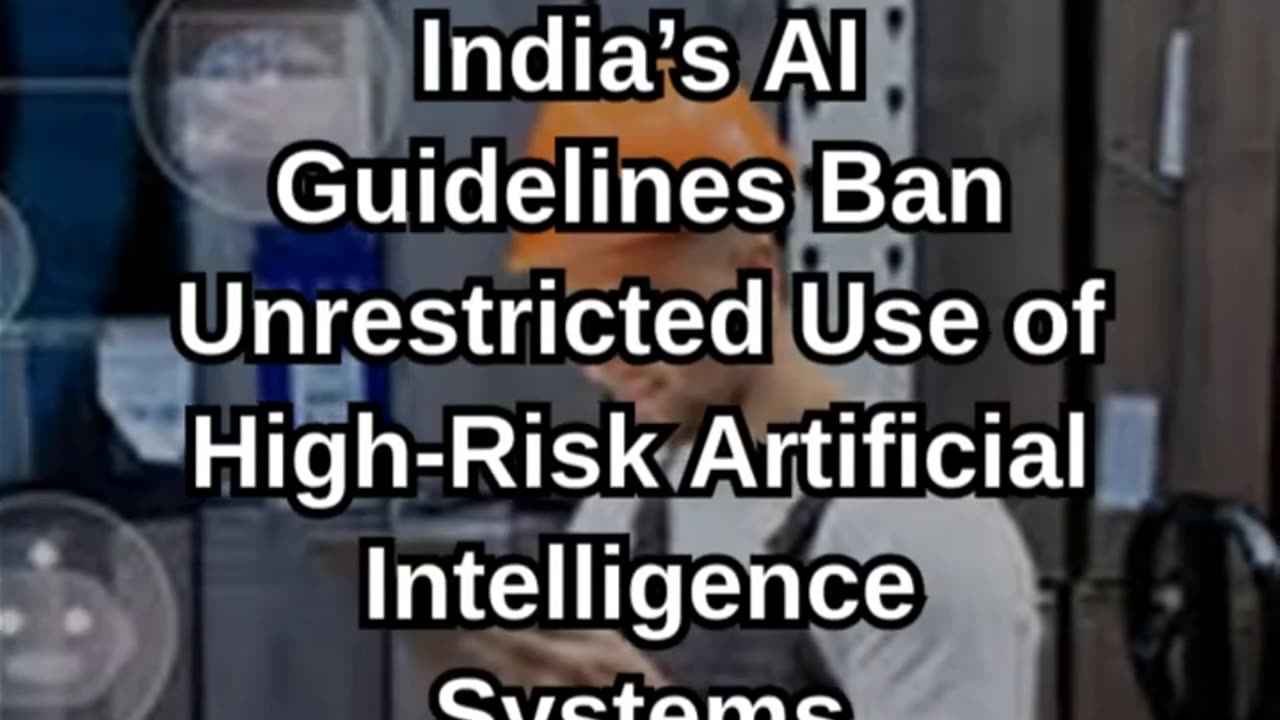
High-Risk AI Systems Under New Guidelines
India has taken a significant step toward responsible artificial intelligence governance by banning the unrestricted use of high-risk AI systems under newly issued national guidelines.
Go here to find out what tools we are using each day to be successful in our business.
https://versaaihub.com/resources/
https://versaaihub.com/media-and-entertainment/
https://www.instagram.com/versaaihub/
https://x.com/VersaAIHub
https://www.youtube.com/@VideoProgressions
https://www.youtube.com/@MetaDiskFinancial
The move reflects the government’s growing focus on balancing rapid AI innovation with safeguards that protect citizens, institutions, and democratic processes from potential harm. Rather than allowing unchecked deployment, the guidelines introduce a risk-based framework that places tighter controls on AI systems considered capable of causing serious social, legal, or economic consequences.
High-risk AI systems typically include technologies used in sensitive areas such as surveillance, biometric identification, credit scoring, recruitment, law enforcement, and critical infrastructure. Under the new approach, these systems cannot be deployed freely without adequate oversight, transparency, and accountability mechanisms. The government has emphasized that AI tools influencing fundamental rights or public safety must operate within clear ethical and legal boundaries.
The guidelines adopt a principle-based and proportionate model, avoiding heavy-handed regulation while still addressing key risks such as algorithmic bias, lack of explainability, data misuse, and discriminatory outcomes. Instead of creating a single centralized AI regulator, enforcement responsibility will largely remain with existing sectoral authorities. This allows flexibility while ensuring that AI systems comply with established laws, including data protection, cybersecurity, and consumer protection regulations.
A core element of the policy is accountability. Developers and deployers of high-risk AI systems are expected to implement strong governance practices, including risk assessments, human oversight, and mechanisms for grievance redressal. The government has made it clear that AI should support human decision-making, not replace it entirely in critical or high-stakes scenarios.
India’s stance also signals its intent to position itself as a global leader in responsible AI adoption. By encouraging innovation within defined guardrails, the country aims to attract investment, promote research, and support startups—while ensuring public trust in AI technologies. Complementary efforts, such as funding AI safety research and tools to combat deepfakes and misinformation, further reinforce this direction.
Overall, the ban on unrestricted use of high-risk AI systems marks a strategic shift in India’s digital policy. It highlights a growing recognition that while AI can drive economic growth and efficiency, its deployment must be carefully managed to ensure fairness, transparency, and long-term societal benefit.
Go here to find out what tools we are using each day to be successful in our business.
https://versaaihub.com/resources/
https://versaaihub.com/media-and-entertainment/
https://www.instagram.com/versaaihub/
https://x.com/VersaAIHub
https://www.youtube.com/@VideoProgressions
https://www.youtube.com/@MetaDiskFinancial
#IndiaAI, #AIGovernance, #HighRiskAI, #ResponsibleAI, #AIRegulation, #AIPolicy, #DigitalIndia, #EthicalAI, #AICompliance, #AIandLaw, #TechRegulation, #FutureOfAI, #AITransparency, #AIOversight, #AIAccountability, #SafeAI, #AIInnovation, #TrustworthyAI, #AIStandards, #TechPolicy
-
 0:59
0:59
WFH University
20 hours agoScam Trends to Watch in 2026
18 -
 1:02:56
The Nick DiPaolo Show Channel
13 hours agoHead of Brown Security Canned! | The Nick Di Paolo Show #1833
94.7K48 -
 9:39
9:39
Nicholas Bowling
15 hours ago $1.78 earnedShould Christians Be Pro-Choice Because of Free Will?
31.6K12 -
 2:41
2:41
Canadian Crooner
3 years agoPat Coolen | Jingle Bells
91.4K4 -
 40:40
40:40
Sarah Westall
15 hours agoWhy Curiosity Feels Dangerous in Today’s World — w/ Dr, Debra Clary
54.6K6 -
 58:47
58:47
Flyover Conservatives
1 day agoWelfare. Ballots. Speech. How the West Criminalized Truth and Protected Corruption | FOC Show
42.6K1 -
 14:37
14:37
Stephen Gardner
11 hours ago'The Entire PSYOP is COLLAPSING' says Alex Jones! New WARNING Shared from Tulsi Gabbard!!
63.7K82 -
 50:26
50:26
BonginoReport
19 hours agoCalifornia’s Future w/ Sheriff Chad Bianco - Nightly Scroll w/ Hayley Caronia (Ep.203)
132K68 -
 7:18:58
SpartakusLIVE
11 hours agoDuos w/ Sophie || #1 MACHINE is taking NO DAYS OFF
35.2K6 -
 3:48:13
RealMetatron
12 hours agoChristopher Nolan's Odyssey is a DISASTER!
41.6K5