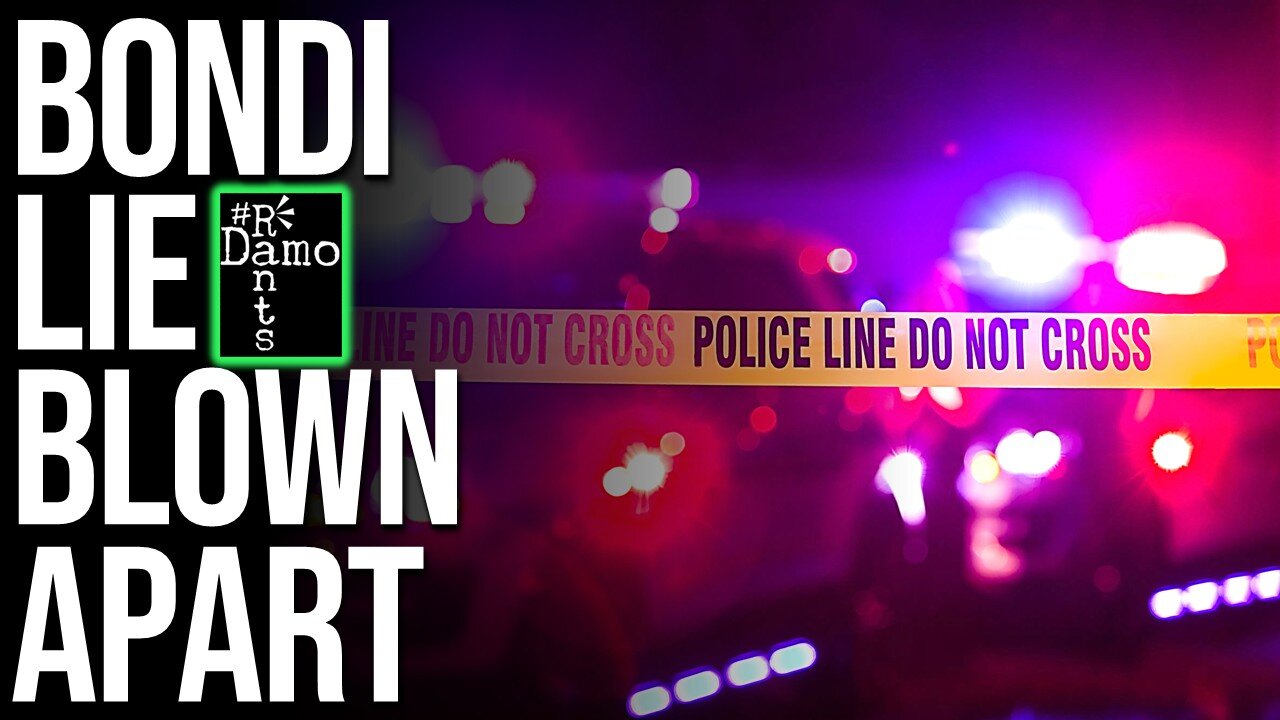
Bondi Attack Just Blew Up a Very Dangerous Lie
Right, so the Bondi attack has done something very awkward for a very familiar lie. It blew it up. And the people now stuck with the fallout are not the ones who pushed it, but the ones who paid for it. That’s the bit being carefully stepped around.
Because this was never just about a violent act in a shopping centre. It was about how quickly that act was pressed into service to suggest a wider threat that simply wasn’t there, how that framing collapsed on contact with facts, and how the damage still travelled anyway. The narrative failed upward. The consequences landed downward.
You can already see the pattern, because we’ve seen it before. An event happens, implication rushes in ahead of evidence, Muslims become the background suspect, and then reality intervenes in the most inconvenient way possible. This time, the man who stepped forward, who actually stopped things getting worse, was a Syrian Muslim. And despite that, the same old reflexes kicked in, the same old harm followed, and the same people were left dealing with it.
That’s what this is about. Not the event. But the old familiar machinery we’ve become increasingly accustomed to couldn’t help itself.
Right, so the first thing that happens after a violent event like the Bondi attack is not investigation, and it is not understanding. Meaning gets assigned, fast, because speed controls the emotional weather. Whoever fills that space early decides what the public feels before it knows anything, and once that feeling settles, facts have to fight uphill to dislodge it. That contest began almost immediately after Bondi, and it is where the most damage was done, because what followed was not a struggle to understand what happened, but a rush to make the event confirm something people already wanted it to mean.
That rush is familiar. It does not announce itself as a claim. It operates through suggestion, adjacency, implication. Names are floated, contexts are nudged into place, and the audience is encouraged to connect dots that have not been drawn. Muslims, Arabs, and whichever overseas enemies are most convenient at the time are quietly collapsed into a single category of threat. No one has to say it outright. The blur does the work. It always has.
The problem at Bondi was that that did not hold. The facts did not bend as some might have wished them to. There was no foreign sponsor named, no state direction identified, no geopolitical chain of command uncovered. When terrorism charges were later laid against the surviving gunman, they were laid under Australian law, which defines terrorism by intent and effect, not by which international enemy can be rhetorically attached to it. That distinction is basic, and it matters, because the moment you pretend otherwise, you turn law into propaganda shorthand.
And then there is the matter of that chap called Ahmed al-Ahmed.
This is where the entire framing should have collapsed on contact with reality, because this bit also came out quite quickly. The most decisive act on the day, the moment where the trajectory of the violence was interrupted, did not come from policy, police doctrine, or political messaging. It came from a Syrian Muslim man who saw what was happening and stepped in. He acted immediately, without thought for himself, without ideology, and almost certainly prevented further deaths. That fact should have anchored the entire public understanding of the event.
Instead, it created a problem.
Because you cannot sustain a story about Muslim danger when the clearest act of courage comes from a Muslim. You cannot generalise suspicion when the person who disrupted the violence belongs to the very group being quietly problematised. And so his role was acknowledged briefly, praised, and then gently moved out of the way as mainstream commentary returned to safer ground. This is how conditional belonging works. Muslim heroism is treated as an exception, never as evidence that should reset the assumptions that produced the suspicion in the first place.
That conditionality is not accidental. It is built into a wider media and political culture that has spent years flattening the Middle East and Muslim identity into a single interchangeable threat space. Iran, Hamas, ISIS, Muslims in general. The distinctions are routinely erased, even though those distinctions are not academic. They are ideological, sectarian, and often violently enforced. ISIS, the attributed inspiration behind the attack, considers Shia Muslims such as those of Iran as apostates and has carried out mass-casualty attacks there. ISIS has denounced and attacked Hamas for being insufficiently extreme, because Hamas is a nationalist movement rather than a takfiri cult. These are not obscure details. They are well-established facts. Ignoring them is not caution. It is negligence, and in some cases, it is convenience.
Because once you collapse all of that into a single mental bucket, every act of violence becomes transferable. It can be plugged into the same story again and again, regardless of relevance. And that story happens to be extremely useful to certain interests, particularly those invested in portraying Israel as permanently besieged by a unified, irrational enemy. You do not need coordination for this to operate. You need repetition, familiarity, and a media environment that rewards speed over precision. The machine runs on habit.
Bondi disrupted that habit. The legal process did not validate the insinuations. The ideological facts did not support the associations. The hero did not fit the stereotype. And that is why the narrative felt strained almost immediately. People noticed the mismatch. They noticed the reach. They noticed the attempt to drag an Australian domestic crime into a global geopolitical frame that simply did not belong there.
This is where it is tempting to take comfort, to say the propaganda failed, the public is wiser now, the old tricks do not land the way they used to. There is some truth in that. The pushback was quicker. The scepticism was louder. The seams splitting were visible. But collapse at the top does not mean safety at the bottom, and this is where the real indictment lies.
Because even as the broader narrative struggled to convince, it still poisoned the atmosphere enough to produce consequences where it always produces them, downward. In the days that followed, Muslim communities reported an increase in harassment and abuse. Women wearing hijab were targeted in public spaces. Threats circulated online. And then a Muslim cemetery in western Sydney was desecrated, pigs’ heads placed on graves in an act that was not ambiguous in its disgusting intent. You can’t put that down to confusion. That was someone acting on a licence they felt had been issued.
This is the part that is almost always treated as incidental. Islamophobic attacks are framed as community tensions, as social spillover, as regrettable but disconnected reactions. They are not treated as political outcomes. They are not traced back to the insinuations, the early framing, the blurring of responsibility that created the permission structure in the first place. Responsibility stops conveniently short of those who set the emotional tone.
That insulation is structural. There is no reputational cost for being wrong in the first twenty-four hours of a crisis, as long as you never quite say the false thing out loud. Implication is a remarkably safe place to operate from. Corrections never travel as far as insinuations, and even when they do, they rarely undo the emotional imprint that has already settled. Fear is sticky. Retraction is not.
This is why misinformation does not need to survive cognitively to survive socially. People can reject a claim intellectually and still carry the affect it produced. They can say they no longer believe it and still feel a heightened sense of threat that has nowhere accurate to attach itself. That is how you end up with a situation where the narrative has visibly failed, yet grave desecration still occurs. The lie does not need to win. It just needs to pass through.
And once again, look at the inversion. The community absorbing the backlash is the same community from which the hero emerged. The same identity that produced the person who stepped forward is treated as suspect anyway. That tells you something about how belonging is distributed. For some groups, citizenship is assumed. For others, it is conditional, revocable, and never fully settled, no matter what they do.
I will come back to that, because it sits at the heart of why the Bondi attack matters beyond the event itself. But first, there is another layer that needs to be pulled apart, and it is the legal one, because the way terrorism law was talked about after Bondi tells you a great deal about how meaning is manufactured when facts are inconvenient.
The legal layer matters because it exposes the sleight of hand that keeps this whole process alive. Terrorism law exists to describe certain acts and intents under domestic statute. It does not exist to validate foreign policy narratives or to confirm anyone’s preferred geopolitical storyline. In the Bondi case, the terrorism charge was applied within that narrow legal frame, addressing intent to intimidate or coerce the public. That is all it does. It does not point outward. It does not imply a handler, a state sponsor, or an overseas command structure. Treating it as if it does is not analysis. It is distortion.
And yet, that distortion is routine, because it is useful. The word “terrorism” is allowed to do far more work in public commentary than it does in law. It becomes a shortcut, a trigger word that invites the audience to fill in blanks with whatever threats they already associate with it. Iran. Hamas. Muslims. The details are left vague on purpose, because vagueness is what keeps the implication flexible. Precision would break the spell.
You can see how this plays out. The legal process is slow, specific, and bounded. Media framing is fast, impressionistic, and unaccountable. When the two diverge, it is almost always the legal meaning that gets quietly sidelined. The law becomes a prop rather than a constraint. And that gap between what the law actually says and what the public is encouraged to hear is not accidental. It is where fear is manufactured without anyone having to take responsibility for manufacturing it.
This is also where the insulation kicks in. Nobody is held to account for suggesting more than they can prove. Nobody is penalised for letting an association hang in the air. As long as the sentence is technically defensible, the damage is treated as someone else’s problem. The communities that absorb the backlash are expected to manage it themselves, while the people who set the emotional weather move on to the next story.
This is why Islamophobic violence is so often treated as an unfortunate side effect rather than a political consequence. A cemetery is desecrated, women are harassed, threats circulate, and the response is to talk about social cohesion, community healing, policing. All of that addresses symptoms. None of it addresses the upstream behaviour that made those outcomes predictable. The question of responsibility is quietly avoided, because asking it would require confronting how routinely implication is used as a tool.
And here is where Ahmed al-Ahmed comes back into the frame, because his role does more than disrupt a stereotype. It exposes the conditional nature of belonging in a way that is hard to ignore once you see it. His action should have reset the assumptions that were being leaned on. It should have forced a recalibration. Instead, it was treated as an exception that proved nothing beyond his own good character.
That tells you that the problem is not ignorance. It is structural reluctance. Muslim belonging is not allowed to accumulate credit. It does not compound interest. Each act of courage is treated as standalone, never as evidence that challenges the underlying suspicion. The balance sheet is always reset to zero. That is why collective blame can reassert itself so easily, even after a Muslim has quite literally put himself in harm’s way to protect others and took two bullets for it.
This is not how belonging works for everyone. For some groups, citizenship is assumed until actively revoked. For others, it is provisional, always subject to review. That asymmetry is what allows the same community to produce a hero and yet Muslims on the whole still being treated as suspect days later. It is what allows praise and punishment to coexist without anyone feeling the contradiction.
The pattern here has precedents, both in Australia and elsewhere. Violent acts are quickly folded into a familiar threat narrative. Corrections come later, if they come at all. The emotional imprint remains. The public is told to move on. The communities affected are told to be patient. And the cycle repeats. What is different now is not the mechanism, but its weakening grip.
The propaganda model that relies on fear and blur is no longer hegemonic. It does not command automatic belief. It has to work harder, repeat itself more often, and even then it frequently fails to persuade a broad audience. That is the collapse people are sensing. But collapse does not mean dismantling. A weakened machine can still do damage, especially when there is no accountability for misuse.
In some ways, this phase is more dangerous than the old one. When propaganda succeeded wholesale, there was at least the possibility of mass challenge when it was exposed. When it half-fails, it creates noise without resolution. Enough people reject it to prevent consensus, but enough absorb the emotional residue for harm to occur at the margins. That is exactly what Bondi illustrates.
So when people say the lie has collapsed, they are only half right. It has collapsed as a persuasive narrative. It has not collapsed as a generator of consequences. And that distinction matters, because it explains why events like Bondi can simultaneously produce scepticism and scapegoating, disbelief and backlash, clarity and cruelty.
This is where responsibility needs to be named, not abstractly, but structurally. Meaning-making power is concentrated. The people who frame events early do so with institutional backing and minimal risk. They are insulated from the outcomes of being wrong. The people who live with the outcomes have no such insulation. That imbalance is not a flaw in the system. It is how the system is designed to function.
You can see the incentive structure clearly. Speed is rewarded. Caution is punished. Implication travels further than correction. Familiar frames feel safe. Precision feels risky. And so the same moves are repeated, even as their credibility erodes, because they still serve certain interests and cost very little to deploy.
Bondi put all of that under stress. It did not just expose a lie. It exposed how reliant some people are on that lie to make sense of the world, and how little room there is in that worldview for facts that complicate it. The hero did not fit. The law did not cooperate. The ideology did not line up. And the result was a scramble to manage the failure rather than confront it.
That scramble is what left the wrong people paying the price. The lie did not survive intact, but it survived long enough to do harm. And because there is no mechanism to force accountability for that harm, there is no reason to expect the behaviour to change next time.
This is the point where the comfort story ends. The idea that exposure alone is enough, that debunking is sufficient, that narrative collapse is a victory. It is not. Not when the cost of failure is borne by people who had nothing to do with the crime and everything to do with stopping it.
The Bondi attack did not confirm a civilisational threat. It did not validate a geopolitical storyline. It did not prove what some people were eager for it to prove. What it did was reveal, very clearly, how fragile truth still is in the first moments after violence, how eagerly fear is repackaged for familiar ends, and how unevenly the consequences are distributed when that process breaks down.
There is one final piece that needs to be said, because without it the picture remains incomplete, and it goes to the question of what responsibility would actually look like if anyone were serious about preventing this from happening again.
Another aspect of this story that has rapidly done the rounds are allegations that this might have been some kind of false flag attack engineered by Israel, it certainly played out as one either way so did that really matter? Well possibly. Check out more on that story right here.
Please do also hit like, share and subscribe if you haven’t done so already so as to ensure you don’t miss out on all new daily content as well as spreading the word and helping to support the channel at the same time which is very much appreciated, holding power to account for ordinary working class people I am taking my Christmas break from today, take some time out with the family before things get completely mad! I will be back on the 27th and I will hopefully see you then. May I wish you all a very Happy Christmas. Cheers folks.
-
 4:04:33
Barry Cunningham
4 hours agoLIVE WATCH PARTY! President Trump Hosts Kennedy Center Show Featuring KISS, George Strait and MORE!
208K68 -
 29:24
29:24
Sean Unpaved
58 minutes agoRoy Jones Jr. Interview
-
 18:18
18:18
Scammer Payback
8 hours agoDon't Freak Out... We Found Your House
8752 -
 LIVE
LIVE
Badlands Media
7 hours agoDEFCON ZERQ Ep. 023: Q MEETS BITCOIN
4,741 watching -
 LIVE
LIVE
DLDAfterDark
2 hours agoThe Very Merry Christmas Hotdog Waffle Stream! Gun Parts, Gun Stuff, Gun Gear & Knives etc!
223 watching -
 1:53:08
megimu32
6 hours agoON THE SUBJECT: The Christmas Nostalgia Wrap-Up 🎄
7.81K3 -
 1:02:56
The Nick DiPaolo Show Channel
6 hours agoHead of Brown Security Canned! | The Nick Di Paolo Show #1833
54.9K44 -
 9:39
9:39
Nicholas Bowling
9 hours agoShould Christians Be Pro-Choice Because of Free Will?
2.45K4 -
 2:41
2:41
Canadian Crooner
3 years agoPat Coolen | Jingle Bells
31.9K3 -
 40:40
40:40
Sarah Westall
9 hours agoWhy Curiosity Feels Dangerous in Today’s World — w/ Dr, Debra Clary
7.18K