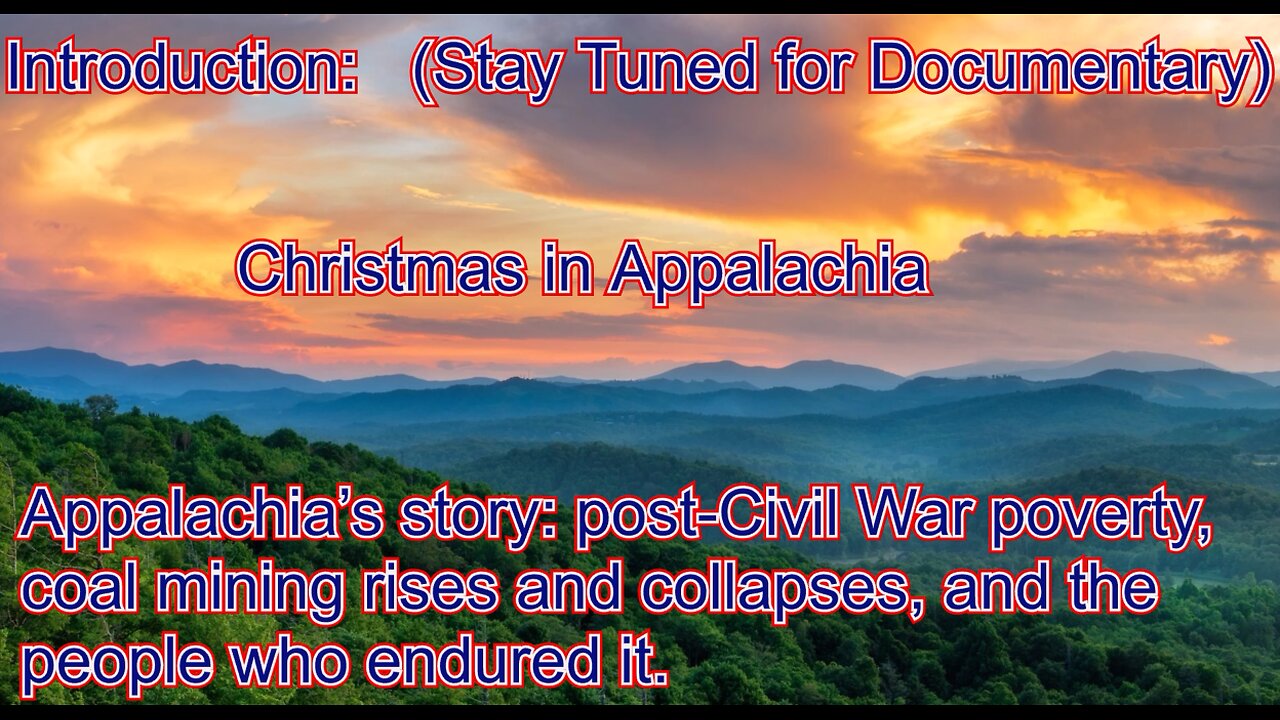
Christmas in Appalachia - Documentary
Christmas in Appalachia - A wake up call for a new generation.
After the Civil War, Appalachia entered the modern era carrying a burden that would shape its identity: poverty. The war shattered the region’s fragile agrarian economy, leaving isolated mountain communities with little access to capital, infrastructure, or markets. What followed was a powerful mix of resilience and struggle that ran through generations. Companies from outside the region seized this moment. They purchased mineral rights cheaply, gaining control over vast coal reserves beneath Appalachian land. Railroads were pushed into the mountains not to lift local economies, but to extract their wealth and ship it outward.
The coal industry defined Appalachian life from the late 1800s onward. During boom years, coal towns sprang up almost overnight—company-built houses, company stores, and entire communities depending on one pay envelope. Families found steady work, new wages, and a sense of pride in dangerous labor that powered American industry. But the booms were always followed by painful crashes. Markets shifted, seams thinned, mechanization reduced jobs, and mines closed. Every collapse left unemployment, abandoned towns, and lasting trauma.
Coal companies’ control over housing and commerce deepened generational poverty. Mine pay was often low, scrip systems trapped workers in debt, and union battles were fought just to secure basic rights and livable wages. The early 20th century saw tragedies like mine explosions, black lung disease, and violent clashes between miners and private armies. Yet, for many families, mining was the only path to survival.
The mid-20th century brought another wave of hope and disappointment. World War II and postwar manufacturing drove coal demand upward, but automation quickly began replacing miners. Between the 1950s and 1980s, entire counties emptied as jobs disappeared. A single modern machine could replace dozens of men. Poverty spiked. Schools closed. Migration toward northern industrial cities—Detroit, Cleveland, Chicago—tore apart communities rooted in land and kinship.
Government programs tried to help. The “War on Poverty” in the 1960s spotlighted Appalachian hardship, bringing infrastructure projects, healthcare access, and new roads. But these efforts never replaced the economic foundation that coal once provided. When the industry declined further in the late 20th and early 21st centuries—not just from automation, but from global competition and energy transitions—the region was left exposed.
Modern Appalachia faces persistent challenges: limited broadband access, underfunded schools, scarce job diversity, and some of the highest opioid addiction rates in America—symptoms of decades of economic displacement and cultural grief. Strip mining and mountaintop removal have scarred the land, removing what many hoped would become tourism or agricultural revenue streams.
Yet the story is not only pain. Appalachia’s identity is built on music, faith, storytelling, and a fierce sense of place. New industries—craft agriculture, outdoor recreation, renewable energy projects, small manufacturing, and cultural preservation—are slowly emerging. Community groups are revitalizing main streets, protecting forests, and teaching young people that success does not require abandoning their home.
From the post–Civil War collapse to the rise and fall of coal, Appalachia has weathered one of the most profound cycles of exploitation and survival in American history. Poverty did not define Appalachians’ character—it revealed it: hardworking, inventive, family-centered, and unyielding. The region remains a symbol of how national wealth can be built atop local sacrifice, and how a people, despite generations of hardship, can continue to carve hope from stone.
This story—of mines roaring to life and falling silent, of boomtown lights and hollowed-out valleys—still shapes Appalachia today.
Fixed Version - original had bad editing, sorry
-
 LIVE
LIVE
Matt Kohrs
11 hours agoLIVE! Trump Speaks At Davos World Economic Forum
992 watching -
 1:13:02
Chad Prather
14 hours agoWhen the Gospel Shakes the Marketplace
72.3K19 -
 LIVE
LIVE
The White House
1 hour agoPresident Trump Delivers a Special Address to the World Economic Forum
4,454 watching -
 LIVE
LIVE
LFA TV
12 hours agoLIVE & BREAKING NEWS! | WEDNESDAY 1/21/26
2,633 watching -
 LIVE
LIVE
The Chris Salcedo Show
14 hours ago $2.35 earnedAmerica IS NOT Europe's BITCH! ... As Long As Dems Aren't In Charge
563 watching -
 1:38:40
Game On!
19 hours ago $1.01 earnedThe Patriots Will Be The LUCKIEST Team To Make A Super Bowl!
25.5K2 -
 19:56
19:56
DeVory Darkins
12 hours agoTim Walz suffers MAJOR LEGAL BLOW after DOJ issues subpoenas
17.8K31 -
 37:26
37:26
ZeeeMedia
15 hours agoNorwegians Told to Prepare for Wartime PROPERTY SEIZURES! | Daily Pulse Ep 179
17.5K52 -
 1:10:40
Crypto Power Hour
13 hours ago $2.06 earnedTrade Smarter On Crypto Exchanges w/ Crypto Trade Analyzer
42.5K4 -
 26:46
26:46
Uncommon Sense In Current Times
18 hours ago $0.79 earnedWhen Protest Crosses the Line: Church Disruptions, ICE, and Religious Freedom
28.9K1