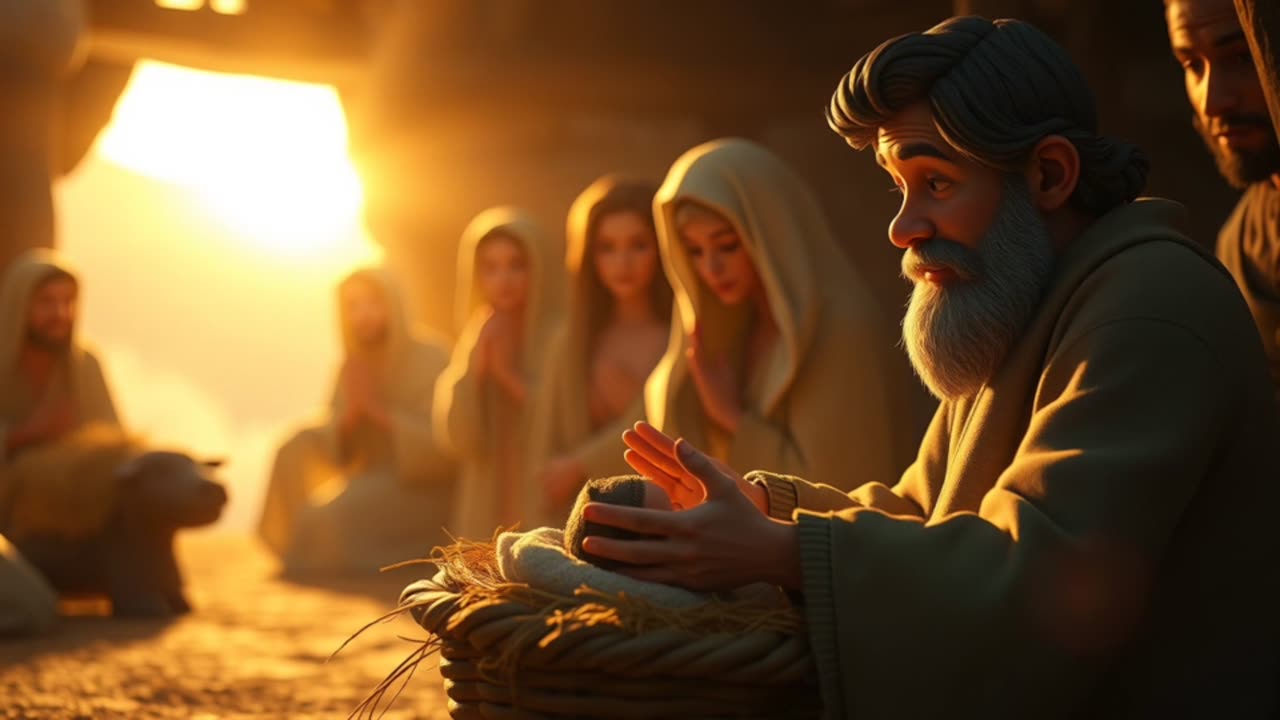
Good Shepherd Blues
From the fields of fear to the fire of praise — hear the Shepherd's Blues, then go tell the good news.
Luke 2:8-11
From the Luke bible quote, here the Shepherd is reimagined from before he hears the good news, and after.
Oh, out in them fields near Bethlehem town,
Out in them fields near Bethlehem town,
Watchin' my sheep under stars, feelin' low down.
Cold wind a-howlin', wolves on the prowl,
Predators lurkin', thieves in the night,
Just a lowly herder, no end to the fight.
Day breaks at dawn, lead 'em to green grass so fine,
Lead 'em to pastures, but the work's never done,
Water from still pools, keep 'em safe from the run.
Youngest in the family, that's my lot in this land,
Humble and tired, with a staff in my hand,
Dreamin' of rest, but it's all just sand.
Then suddenly glory, an angel so bright,
Angel appearin' in the dead of the night,
Scared me to death, thought I'd die from the fright.
"Don't be afraid," he says with a voice like thunder,
Good news for all, a Savior's born yonder,
In David's own city, the Messiah, no wonder!
Now my heart's a-poundin', but it's turnin' to joy,
Turnin' to joy like a long-lost boy,
That babe in the manger, he's the real McCoy.
We rush to the stable, see the child layin' there,
Wrapped in them cloths, with his folks in prayer,
Salvation for all, liftin' my despair.
Back with the flock, but now we celebrate true,
Celebrate true in the way shepherds do,
Praisin' the Lord with a song tried and new.
Playin' my reed flute by the fire's warm glow,
Dancin' and singin' psalms that we know,
Shar'in bread and cheese, let the good news flow.
Tellin' the kinfolk, spreadin' the word far and wide,
Far and wide like the stars in the sky,
Glorifyin' God, with nothin' to hide.
No fancy feasts like Sukkot in the booth,
But joyful hearts dancin', that's our truth,
In ancient Judea, that's how we reboot.
Oh, from blues in the fields to heaven's sweet light,
Heaven's sweet light chasin' away the night,
A shepherd's redemption, everything's right.
### Background
Luke 2:8-11 is a passage from the Gospel of Luke in the New Testament of the Bible, part of the nativity narrative describing the birth of Jesus Christ. The Gospel of Luke, traditionally attributed to Luke, a physician and companion of the Apostle Paul, was likely written between 60-80 AD as an orderly account for a Gentile audience, emphasizing Jesus' role in bringing salvation to all people. In the immediate context, this scene follows the account of Jesus' birth in Bethlehem during a Roman census ordered by Caesar Augustus (Luke 2:1-7). The verses depict shepherds tending their flocks at night in the fields near Bethlehem when an angel suddenly appears, surrounded by the glory of God, causing them fear. This setting highlights humble, everyday people—shepherds, who were often marginalized in society—being the first to receive the divine announcement, contrasting with the imperial power of Rome.
### Meaning
The core message of Luke 2:8-11 is the angelic proclamation of Jesus' birth as "good news that will cause great joy for all the people" (verse 10). The angel reassures the terrified shepherds not to fear, then declares: "Today in the town of David a Savior has been born to you; he is the Messiah, the Lord" (verse 11). Here, "town of David" refers to Bethlehem, linking Jesus to the prophesied Davidic lineage. The titles "Savior," "Messiah" (or Christ, meaning "anointed one"), and "Lord" underscore Jesus' divine identity and mission: to save humanity from sin, fulfill Old Testament prophecies (e.g., Isaiah 9:6-7), and embody God's sovereignty. Thematically, it emphasizes God's glory manifesting in unexpected ways, bringing peace not through earthly rulers like Augustus, but through the humble arrival of the Messiah. This "good news" (euangelion, from which "gospel" derives) is inclusive, extending joy and salvation to all, regardless of social status.
### Application
For contemporary readers, especially in Christian contexts, Luke 2:8-11 applies as a call to embrace the joy of salvation without fear, recognizing Jesus as the personal Savior who enters ordinary lives. It encourages sharing this "good news" with others, much like the shepherds who spread the word after verifying the event (Luke 2:15-20). Practically, it inspires humility, as God chooses the lowly shepherds over the elite, reminding believers to value the marginalized and approach faith with wonder and praise. In daily life, it can motivate acts of kindness, evangelism, and reflection during Christmas, applying the message of peace and joy amid personal or societal fears. Theologically, it invites trust in God's redemptive plan, transforming lives through belief in Christ.
### History
Historically, Luke 2:8-11 has been central to Christian tradition since the early church, forming the basis of the Christmas story alongside Matthew's account. It influenced early liturgies and has been a staple in Advent and Christmas readings. Over centuries, interpretations evolved: in medieval times, it inspired mystery plays and carols like "While Shepherds Watched Their Flocks"; during the Reformation, figures like Martin Luther emphasized its gospel simplicity. In modern eras, it has shaped cultural expressions, such as Handel's *Messiah* (1741), which sets verses from this passage to music, and countless sermons highlighting its anti-imperial themes amid colonialism or wars. Today, it remains pivotal in global Christmas celebrations, with diverse applications in liberation theology (focusing on the poor) and evangelical outreach, affirming its enduring role in proclaiming universal salvation.
https://suno.com/s/85kkRmTEPxQrUu1o
After listening to Shepherd's Blues, share your story: What 'field' have you been watching in the dark? When did the light break through? Post it on social media with #ShepherdsBlues and tag a friend who needs to hear there’s good news coming.
-
 5:27
5:27
oDDBall daily bible quotes
1 month agoCome adore Him Luke 2:16-20
661 -
 28:56
28:56
LegallyArmedAmerica
7 hours ago $2.28 earnedPretti incident: I explain who's at fault and why (Everyone's going to be mad!)
27.6K13 -
 2:36:49
Barry Cunningham
8 hours agoSUNDAY NEWS ROUNDUP: President Trump Attends Wedding | Talk Shows Worried About Tulsi | And More!
70.8K37 -
 2:26:19
Nerdrotic
10 hours ago $6.94 earnedThe REDACTED Files Dropped | Dark Underworld Uncovered | Forbidden Frontier #127
60.4K11 -
 1:08:27
Sarah Westall
9 hours agoThe People Driving Canada’s MAID Program — And Why | Kelsi Sheren
25.4K9 -
 37:16
37:16
The HotSeat With Todd Spears
8 hours agoCrowned and Called with Kendra Spears
34.1K47 -
 2:37:07
IsaiahLCarter
13 hours ago $1.63 earnedCanceling Woke, in 2026 || APOSTATE RADIO 042 (Paul D. Rossi, Matthew Mastronardi)
25.8K1 -
 1:32
1:32
The Dan Bongino Show
13 hours agoDo I have scores to settle on my show? You're damn right
258K348 -
 14:34
14:34
Crowder Bits
1 day agoThis Is Why Democrats Can’t Win Without Open Borders
62.3K44 -
 1:30:59
The Attorney Andrew Branca Show
14 hours agoFederal Court: ICE WINS! MN LOSES! PLUS Federal ID Order!
75K42