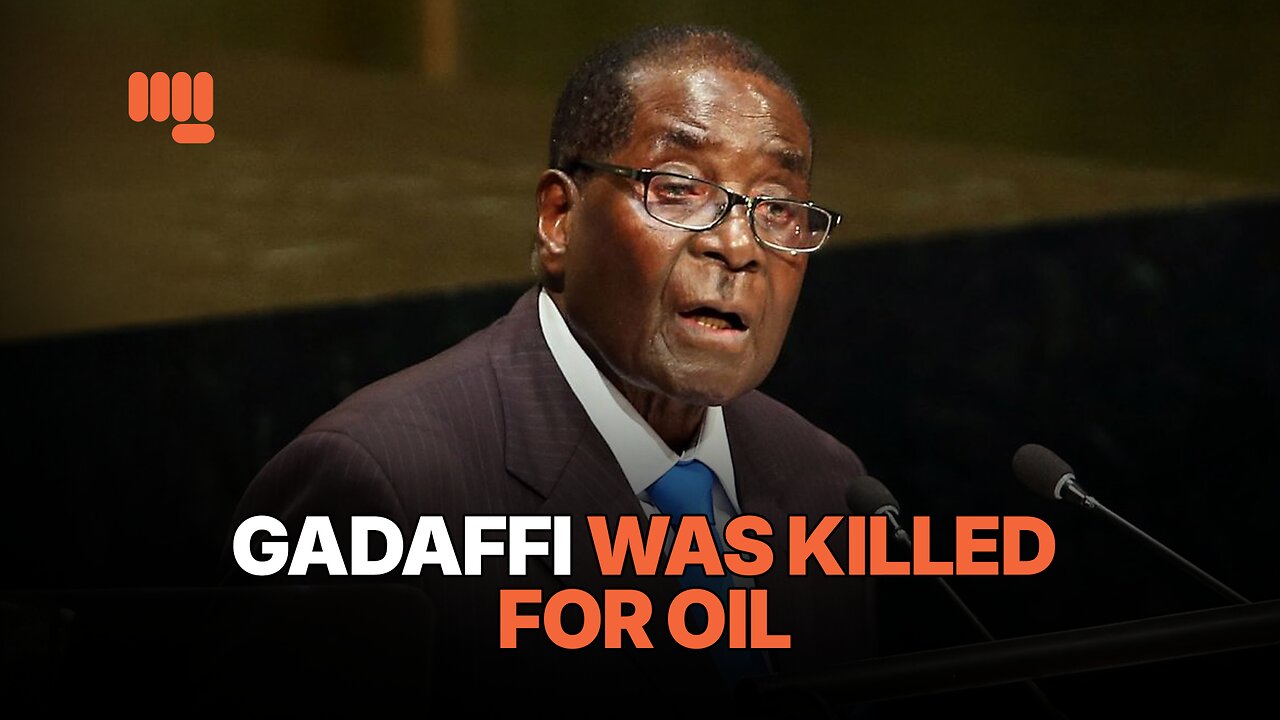
GADAFFI WAS KILLED FOR OIL
24 December marks Libyan Independence Day, the day when the Italian, British, and French colonial powers had to accept a new, independent Libya. Ironically, the anecdote shared in this video portrays how, years later, the same colonial powers would return, completely breaching Libyan sovereignty.
Robert Mugabe, Zimbabwe’s long-time leader and one of the most outspoken figures in post-colonial African politics, used the African Union platform more than a decade ago to deliver one of his sharpest critiques of Western interventionism.
At that AU summit, Mugabe addressed the NATO regime-change intervention in Libya and the killing of Muammar Gaddafi with a clarity that many African heads of state expressed privately, but very few had the courage to voice publicly. He recalled how Western leaders framed Gaddafi as a threat to civilians by fabricating claims that were later proven to be entirely unsubstantiated. They rushed the matter to the UN Security Council, secured the votes they needed, and then launched an offensive military campaign that reshaped Libya for the worse.
Mugabe mocked the sudden enthusiasm for war among European leaders, from Britain to France to Italy, highlighting how quickly humanitarian language turned into a scramble for oil concessions. He spoke about the chaos unleashed across Libya, the killing of Gaddafi and several of his children. He drew parallels between Libya and Iraq and the broader pattern he saw: Western powers entering African and Arab states under the banner of protection, leaving behind turmoil, and positioning themselves to exploit resources while local communities paid the price.
His remarks at that summit were not just about Libya. They were a warning about a system in which African sovereignty remains vulnerable to outside agendas dressed as rescue missions. Mugabe urged African leaders to recognise the pattern: interventions that destabilise, divisions that are inflamed, and resources are extracted while the continent is left to ‘fight each other’, in his words.
-
 1:29:12
Tucker Carlson
11 hours agoThe Shocking Reality of the Treatment of Christians in the Holy Land by US-Funded Israel
120K165 -
![BABY TALK [How to deal with A.W.F.U.L. women]](https://1a-1791.com/video/fww1/17/s8/1/G/L/O/W/GLOWz.0kob-small-BABY-TALK-How-to-deal-with-.jpg) 23:07
23:07
hoemath
10 hours ago $3.99 earnedBABY TALK [How to deal with A.W.F.U.L. women]
51.1K21 -
 18:46
18:46
Cash Jordan
12 hours agoTrump Launches DECAPITATION STRIKE... Ayatollah "TRAPPED" as Mobs Dismantle Tehran
68.5K65 -
 4:52:00
Drew Hernandez
1 day agoTRUMP CALLS ON AMERICA TO MOVE ON FROM EPSTEIN AS DOJ COVERS UP FOR MONSTERS IN EPSTEIN FILES?
68.6K36 -
 2:39:31
ThatStarWarsGirl
10 hours agoTSWG LIVE: Helen of DeTROYt Debate!
63.2K12 -
 2:10:46
TheSaltyCracker
11 hours agoMel Was Right About Hollywood ReeEStream 02-04-26
125K195 -
 48:44
48:44
LFA TV
1 day agoMAKE MEN..MEN AGAIN!
36K7 -
 1:08:07
AlaskanBallistics
11 hours ago $1.14 earnedI Love this Gun PodCast #88
25.5K5 -
 1:11:00
MattMorseTV
11 hours ago $12.91 earned🔴CHAOS in the SENATE.🔴
48.6K213 -
 6:56:14
GritsGG
14 hours ago25 W Streak Camo ✅! #1 Warzone Victory Leaderboard 1205+ Ws!!🔥
21.5K1