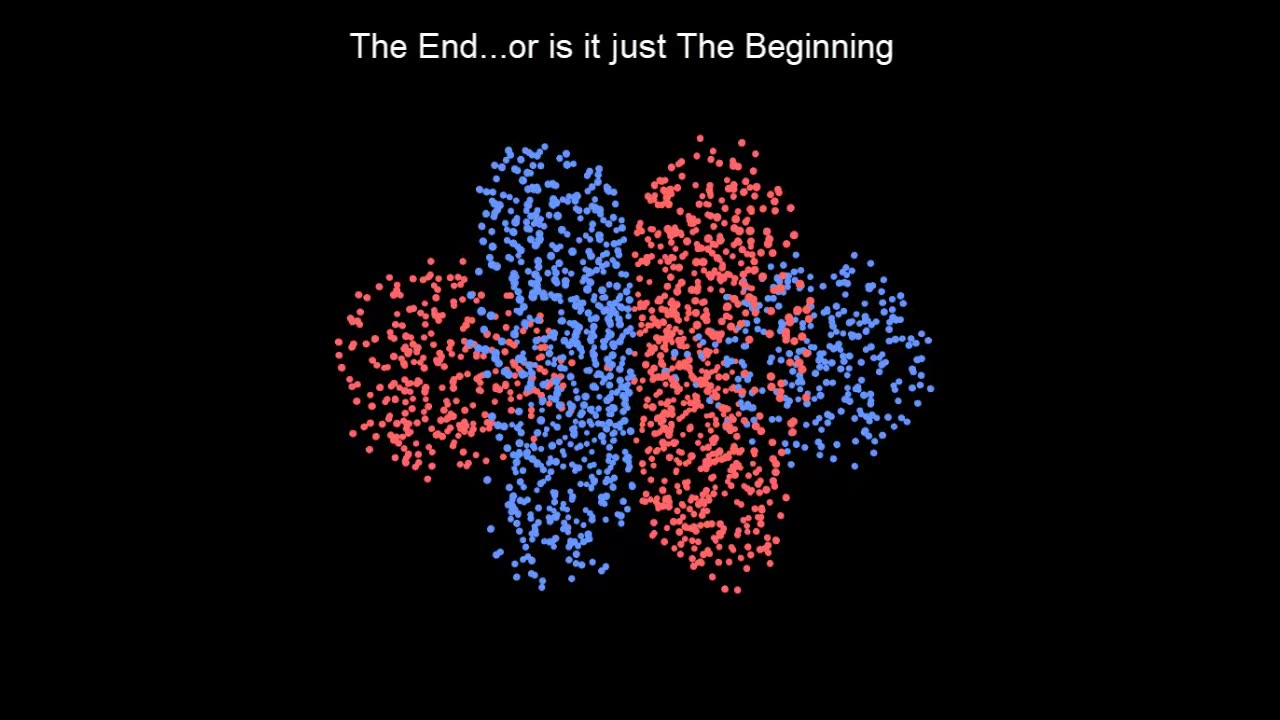
Magnetic Orbitals (Silent Movie)
Dear Rumble: This is one of the videos that a "YouTuber" forced me to take down on YouTube claiming COPYRIGHT infringement. However, no images from his paper or his videos appear in this video. The image in this video are from software that I personally developed and from Wikipedia:
https://en.wikipedia.org/wiki/Atomic_orbital
He also forced me to take down a few more videos which bothers me A LOT, especially since I didn't commit the "crime" that he is accusing me of. To help me sort all of this out and bring clarity to the situation, I had a long and enlightening and very thorough conversation with ChatGPT. Here is a link to that conversation:
https://docs.google.com/document/d/1mOgpir_rPRts-ExIf2K1kIDSVFa3fqRZAK2ljDgpldY/edit?usp=sharing
You can think of this conversation as a lesson in copyright law. It is less about what copyright IS and more about what it ISN'T. I also explain my software method in this discussion so you may find it interesting from a scientific perspective as well.
This conversation has helped me close this chapter in my life. It brought me clarity and comfort. I put this video on Rumble because Rumble does not have the AUTOMATIC bot driven take down method that YouTube has. An actual human being would have to review the copyright claim and make a decision based on THE LAW. So I feel safe here. This may be one of the platforms that I switch to. I am still considering one of the decentralized platforms, but that will require me to re-enter into the world of the block chain and am not sure I am ready to do that. My experience with the NFT world was interesting, but that is not my world.
Will keep you posted,
FractalWoman
PS. Here is the code I wrote to generate the images in this video:
#This software developed by FractalWoman
#Simulates potential measurements around one or more magnetic configurations
# and plot them as "probability distributions" analogous to electron orbitals.
#This software outputs a .json file that can be loaded into my P5JS visualization program:
#https://editor.p5js.org/lgardi22/sketches/7pUvpEcIk
#====================
#Copyright (c) 2025
#====================
#This code works with Python 3.11 and MagPyLib 4.4.0
import numpy as np
import magpylib as mag
# --------------------------
# PARAMETERS
# --------------------------
mag_size = (0.01, 0.01, 0.01) # 1 cm cube
gap = 0.01 # distance between magnet centers
region_factor = 5
samples_max = 4000 # total points for p5.js
B_max_clamp = 0.02 # Tesla
B_threshold = 0.00001 # minimum magnitude to include
measurement_axis = 2 # 0:X-axis 1:Y-axis 2:Z-axis
# Automatic sampling region
x_min, x_max = -region_factor * mag_size[0], region_factor * mag_size[0]
y_min, y_max = -region_factor * (mag_size[1] + gap), region_factor * (mag_size[1] + gap)
z_min, z_max = -region_factor * (mag_size[2] + gap), region_factor * (mag_size[2] + gap)
# --------------------------
# DEFINE MAGNETS
# --------------------------
#define two magnets in vertical orientation.
# N-pole up, magnetized in the Z direction.
top_mag = mag.magnet.Cuboid(
magnetization=(0, 0, 1),
dimension=mag_size,
position=(0, 0, +gap/2)
)
# S-pole up, magnetized in the Z direction.
bottom_mag = mag.magnet.Cuboid(
magnetization=(0, 0, -1),
dimension=mag_size,
position=(0, 0, -gap/2)
)
magnet_system = mag.Collection(top_mag, bottom_mag)
# --------------------------
# RANDOM 3D SAMPLING
# --------------------------
points = []
B_magnitude = []
B_sign = []
attempts = 0
max_attempts = samples_max * 10 # safety to avoid infinite loop
while len(points) < samples_max and attempts < max_attempts:
attempts += 1
# Random 3D point within region
x = np.random.uniform(x_min, x_max)
y = np.random.uniform(y_min, y_max)
z = np.random.uniform(z_min, z_max)
p = np.array([x, y, z])
# Exclude points inside magnets
inside_top = np.all(np.abs(p - np.array([0,0,+gap/2])) <= np.array(mag_size)/2)
inside_bot = np.all(np.abs(p - np.array([0,0,-gap/2])) <= np.array(mag_size)/2)
if inside_top or inside_bot:
continue
# Compute B-field at point
B_vec = magnet_system.getB(p)
B = B_vec[measurement_axis] # get B component based on orientation of the measurement vector
if abs(B) >= B_threshold:
B_clamped = np.clip(abs(B), 0, B_max_clamp)
points.append(p)
B_magnitude.append(B_clamped) #magnetic field strength
B_sign.append(1 if B >= 0 else -1)#positive or negative polarity
points = np.array(points)
B_magnitude = np.array(B_magnitude)
B_sign = np.array(B_sign)
# ------------------------------
# OUTPUT in JSON FORMAT FOR P5JS
# ------------------------------
output_file = "TwoMagnets.json"
with open(output_file, "w") as f:
f.write("[\n") # begin tag for .json file
data = list(zip(points, B_magnitude, B_sign))
last_index = len(data) - 1
for i, (p_val, B_val, sign) in enumerate(data):
# Decide whether to include a comma
comma = "," if i != last_index else ""
f.write(f" [{p_val[0]:.6f}, {p_val[1]:.6f}, {p_val[2]:.6f}, {B_val:.6f}, {sign}]{comma}\n")
f.write("]\n") # end tag for .json file
print(f"Saved {len(points)} points to {output_file}")
-
 2:00:43
FreshandFit
7 hours agoShould Men and Women Live Together in 2026?
173K25 -
 2:02:30
TimcastIRL
13 hours agoMN To LOSE Congressional Seat Over Deportations, Attacks Against ICE Getting WORSE | Timcast IRL
328K414 -
 5:10:30
Drew Hernandez
1 day agoILHAN OMAR HOLDS SHADOW HEARING TO FUEL MINNEAPOLIS INSURRECTION?
57.2K28 -
 5:46:27
SpartakusLIVE
11 hours agoThe Boys are BACK in Town || GloryJean, NurVes, & StevieT
63.5K3 -
 4:44:53
I_Came_With_Fire_Podcast
18 hours agoHealthcare Pays You | Iran Spotlight | Canada Cozies China | w/ Morgan Lerette, former Blackwater
52.9K9 -
 1:04:27
Sarah Westall
10 hours agoSilver 1:1 with Gold? The Hidden Gold That Changes Everything | Bix Weir
57.3K23 -
 2:10:40
PandaSub2000
5 days agoThat One Otter Game | ULTRA BESTIES & GAMES (Original Live Version)
46.1K6 -
 LIVE
LIVE
meleegames
9 hours agoFelicia Day Day - You’re Always Autistic on the Internet (forever)
175 watching -
 1:13:15
Flyover Conservatives
1 day agoThink You Don’t Have Enough Hours in the Day? You Do — 6 Moves That Make Time Work for You - Clay Clark | FOC Show
49.6K2 -
 3:53:57
SynthTrax & DJ Cheezus Livestreams
2 days agoFriday Night Synthwave 80s 90s Electronica and more DJ MIX Livestream REQUESTS AND VISUALS
34.4K2