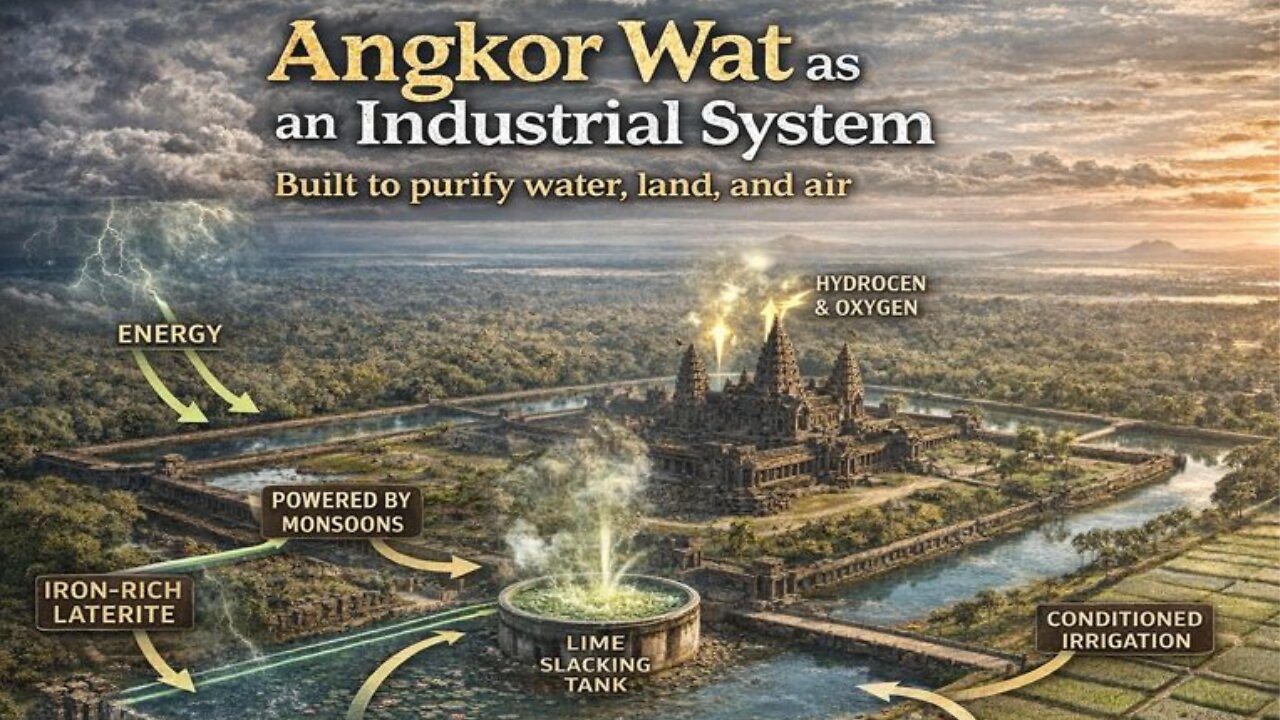
Angkor Wat as an Industrial System
Angkor is often described as the ceremonial climax of Khmer civilization. This account starts from a different premise.
Angkor functioned as a large scale environmental conditioning system, applying chemical processes to land, water, and air in ways closely analogous to modern industrial practice.
Long before Angkor Wat, the Khmer already understood how to manage soil and water chemistry at a local scale.
Early temples, small reservoirs, and village systems neutralized acidic soils, stabilized water, and created fertile rice land.
These methods worked when populations were smaller and impacts remained localized.
From the 9th to the 12th centuries, Angkor expanded into a vast industrial agrarian system.
Centuries of rice intensification, deforestation, canal construction, laterite quarrying, lime burning, and stone building progressively altered soil and water chemistry across more than 1,000 square kilometers.
What had once been manageable locally became a system wide problem.
Monsoon water moved through iron rich laterite soils, becoming hot, acidic, and sediment laden.
Canals routed this flow toward central basins, where barays absorbed heat, slowed movement, and allowed sediment to settle, stabilizing volume and chemistry.
Angkor Wat appears late because it scaled up what the Khmer already knew.
Its layout closely mirrors a modern lime production and water conditioning facility. The vast moat functioned like a primary settling and dilution basin.
Internal pools, including the so called library pools, resemble slaking and mixing tanks where lime could be hydrated and dispersed evenly.
Long galleries and courtyards acted as flow regulators, controlling residence time much like clarifiers in contemporary plants.
Sandstone and laterite surfaces provided chemically active contact areas, aiding neutralization and buffering.
Controlled outlets allowed conditioned water to be released gradually, preventing shock to downstream soils and masonry.
Conditioned water was then distributed to rice fields, maintaining fertility across the plain, while excess water and waste were discharged downstream.
Barays buffered chemistry and heat.
Causeways regulated distribution and load.
Temples functioned as durable processing nodes within a managed hydraulic circuit.
This interpretation extends beyond water alone. Angkor was designed to condition land and air through chemical processes analogous to modern industry.
Electrically active stone, constant moisture, and flowing water drove reactions similar to electrolysis.
In such a process, water exposed to sustained electrical and mineral charge separates into hydrogen and oxygen gases.
Hydrogen disperses upward and outward, acting as a reactive and reducing agent, while oxygen enhance oxidation and purification in enclosed or semi enclosed spaces.
In this model, large domed towers functioned like containment vessels or gas capture chambers, stabilizing and venting outputs much as industrial reactors do today.
How land and soil purification operated at this scale is still under development and requires further digestion.
-
 LIVE
LIVE
SpartakusLIVE
3 hours agoBANISHED to The SHADOW REALM || The People UNITE to UNBAN SPARTAKUS
719 watching -
 LIVE
LIVE
Primes Gaming Channel
1 hour agoVibe Check: Tell me about your week (I'm listening).
66 watching -
 LIVE
LIVE
Total Horse Channel
1 hour agoThe Documentary of Thunder | Denver Broncos Mascot
39 watching -
 LIVE
LIVE
Vitaminsmore
2 hours agoDay 8 of Ys IX: Monstrum Nox!
70 watching -

Sarah Westall
2 hours agoThis Study Just Changed Everything: Nanotechnology Found in Humans
3.53K1 -
 LIVE
LIVE
Cewpins
1 hour agoChill Smoke Sesh: weed & dabs🔥6-Year Twitch Partnerversary Friday!!🍃420💨 !MJ !giveaway
43 watching -
 LIVE
LIVE
Drew Hernandez
20 hours agoPAM BONDI FAILS TO SECURE DON LEMON'S ARREST?
620 watching -
 LIVE
LIVE
StupidlyAwesomeGaming
2 hours agoEver4 Consume A God?
10 watching -
 LIVE
LIVE
Wycca
2 hours ago🟢 THROUGH THE DARK PORTAL 🟢 | WoW: Burning Crusade Classic Anniversary with Mohadeeb | EP 3
23 watching -
 LIVE
LIVE
S0lidJ
1 hour ago🟢Live -S0lidj- Goopin w/ Jorba4
58 watching