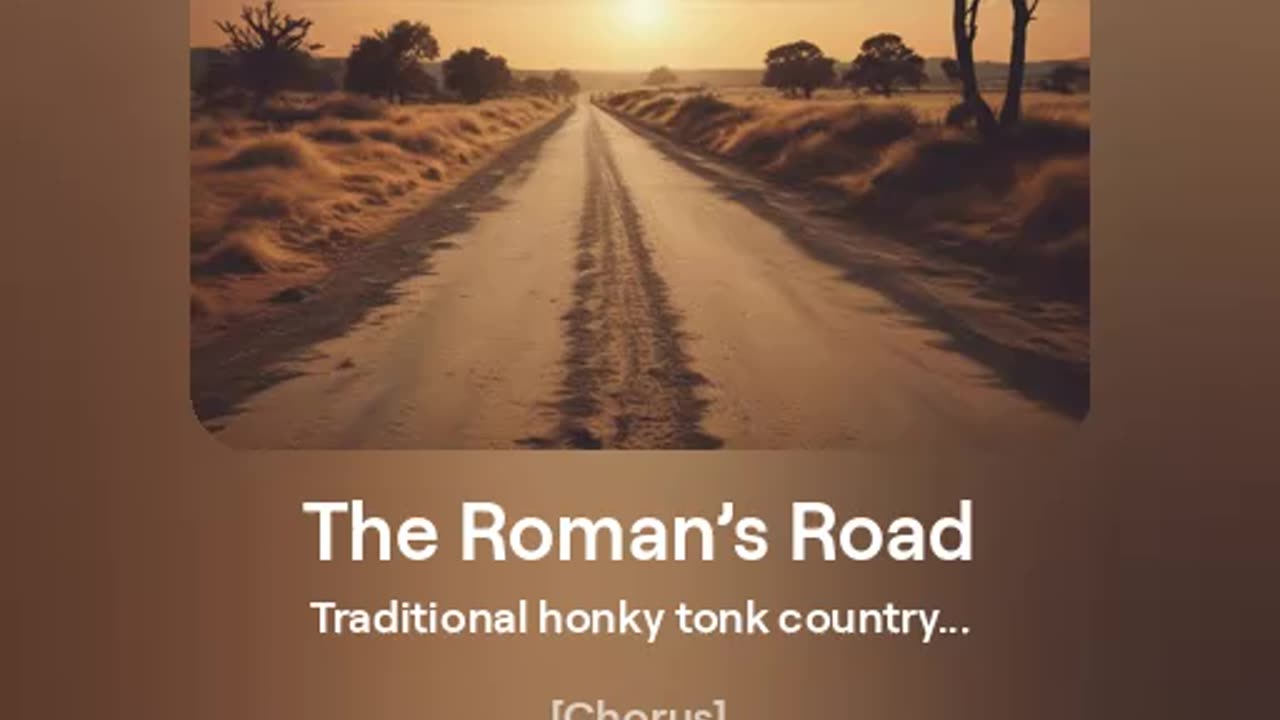
The Roman’s Road
After watching the new Christian movie “The Forge” on 24 August 2k24 at the movie theatre, there was a scene that showed a pamphlet called Roman’s Road. I was inspired to write a narrative poem with elements of lyric poetry, titled “ The Roman’s Road”. Based off of the following verses:
• Romans 3:23 "For all have sinned and fall short of the glory of God." Romans 5:8 "But God demonstrates his own love for us in this: While we were still sinners, Christ died for us."
• Romans 6:23 "For the wages of sin is death, but the gift of God is eternal life in Christ Jesus our Lord."
• Romans 10:9-10 "If you declare with your mouth, ‘Jesus is Lord,’ and believe in your heart that God raised him from the dead, you will be saved. For it is with your heart that you believe and are justified, and it is with your mouth that you profess your faith and are saved."
• Romans 10:13 "For, ‘Everyone who calls on the name of the Lord will be saved.’" These verses collectively outline key aspects of the Christian message of salvation.
Since my vocal singing isn’t my strongest gift (and I’m definitely not a professional composer or singer 😅🎤), I turned to AI to bring the musical arrangement and vocals to life for this project. 🤖🎶
I have to be honest—my vocals aren’t exactly “singing material” and might remind you of the infamous time Roseanne Barr sang the national anthem! 😂🇺🇸 (You know…the one that’s still talked about decades later!) But please don’t let that stop you; the heart of the poem and its message are what truly matter. 💖✨
TITLE: The Roman’s Road
HERE ARE THE LYRICS:
Verse 1:
Down on a dusty road, where sinners tread,
We've all fallen short, just like the Good Book said,
Romans 3:23, it's written plain,
We're all lost sheep, carried by guilt and shame.
Chorus:
But the Roman's road, it shows the way,
Through the dark and night, to a brighter day,
With a heart that's open, and faith that stands,
We find salvation, in His mighty hands.
Verse 2:
Romans 5:8, proved His love for you and me,
While we were yet sinners, His grace set us free,
In our darkest hour, He took our place,
A selfless act of pure and endless grace.
Chorus:
But the Roman's road, it shows the way,
Through the dark and night, to a brighter day,
With a heart that's open, and faith that stands,
We find salvation, in His mighty hands.
Verse 3:
Romans 6:23 pays a heavy toll,
The wages of sin, they burden our soul,
But the gift of God, eternal life in Him,
Who broke every chain, forgave every sin.
Bridge:
If you confess with your mouth, believe in your heart,
Romans 10:9-10, that's where it starts,
You'll be saved, no matter where you've roamed,
For whosoever calls, will find a home.
Title: The Roman’s Road – Even Deeper Theological and Historical Layers 🚶♂️🛤️📖✝️🙏
Diving even further into your song’s title, The Roman’s Road, let’s unpack its roots in biblical evangelism and historical context. The “Romans Road” method originated in the mid-20th century as a simple, memorable way to share the gospel, popularized by evangelists like Billy Graham and tools from organizations such as the Navigators or Campus Crusade for Christ (now Cru). It’s drawn from Paul’s letter to the Romans, written around AD 57 from Corinth, addressing a diverse church in Rome—Jews and Gentiles grappling with faith, law, and grace. Paul, a Roman citizen himself (Acts 22:25–29), uses Roman legal metaphors (e.g., justification as a courtroom verdict) to make the gospel accessible in an empire built on roads that symbolized connectivity and conquest. Your possessive twist (“Roman’s”) personalizes it, implying ownership by “the Roman” — perhaps Paul, or ultimately Christ, the true Architect of salvation’s path (John 14:6: “I am the way”). This road isn’t metaphorical fluff; it’s a spiritual lifeline, echoing Proverbs 14:12 (“There is a way that seems right to a man, but its end is the way of death”) contrasted with God’s straight path (Isaiah 35:8: “A highway shall be there, and a road, and it shall be called the Highway of Holiness”).
Historically, Roman roads (viae) were engineering marvels: layered gravel for durability, straight for efficiency, spanning over 250,000 miles. Similarly, the Book of Romans is structured logically—sin’s universality (chs. 1–3), justification by faith (chs. 3–5), sanctification (chs. 6–8), God’s sovereignty (chs. 9–11), and practical living (chs. 12–16). Your song mirrors this progression: conviction → love → gift → response. Theologically, it’s rooted in Reformation emphases like sola fide (faith alone), as Luther called Romans “the purest gospel.” For modern application, this “road” equips believers for evangelism in a fragmented world—think street preaching, tracts, or apps like the “Romans Road” on Bible software.
Verse 1 – The Universal Diagnosis: Sin’s Grip and the Cry for Rescue 😔🐑💔⚖️
“Down on a dusty road, where sinners tread, / We’ve all fallen short, just like the Good Book said, / Romans 3:23, it’s written plain, / We’re all lost sheep, carried by guilt and shame.”
Expanding deeper, Romans 3:23 culminates Paul’s argument in Romans 1:18–3:20, where he indicts all humanity: Gentiles for suppressing truth in unrighteousness (1:18–32), Jews for hypocrisy under the law (2:1–3:8), and everyone via Scripture quotes (3:9–20). The Greek hustereō (“fallen short”) implies a deficit or lagging behind—not just missing the mark but being perpetually deficient in God’s glory (doxa), which humanity was created to reflect (Genesis 1:27). This isn’t minor flaws; it’s total depravity (Calvinist term), where sin corrupts will, mind, and body (Jeremiah 17:9: “The heart is deceitful above all things”).
The “lost sheep” motif amplifies isolation: In ancient Near East culture, sheep were vital yet vulnerable, straying into danger without a shepherd. Cross-references abound:
• Isaiah 53:6 – Not just straying, but “the Lord has laid on Him the iniquity of us all,” foreshadowing Christ’s substitution.
• Ezekiel 34:11–16 – God as Shepherd seeking the scattered, binding the broken.
• Matthew 18:12–14 – Jesus’ joy over one repentant sinner.
• 1 Peter 2:25 – “For you were like sheep going astray, but have now returned to the Shepherd and Overseer of your souls.”
Emotionally, guilt (asham in Hebrew equivalents) and shame create a cycle of hiding (like Adam in Genesis 3:8), but this verse invites vulnerability—the “dusty road” symbolizes humility (Psalm 113:7: God raises the poor from the dust). Practical application: In counseling or preaching, start here to level the playing field; no one is “good enough.” For songwriting, this verse’s rhythm builds tension, setting up the chorus’ release.
Chorus – The Pivotal Shift: From Despair to Divine Guidance 🛤️🌟🙏👐🔥
“But the Roman’s road, it shows the way, / Through the dark and night, to a brighter day, / With a heart that’s open, and faith that stands, / We find salvation, in His mighty hands.”
The emphatic “But” echoes Romans’ transitions (e.g., 3:21: “But now the righteousness of God apart from the law is revealed”). This chorus embodies metanoia (repentance: a mind-change), turning from self-reliance to faith. “Dark and night” alludes to spiritual blindness (John 3:19: “Men loved darkness rather than light”), while “brighter day” points to eschatological hope (Revelation 21:23–24: no need for sun, God is the light).
“Heart that’s open” draws from Deuteronomy 30:6 (circumcised heart) and Acts 16:14 (God opened Lydia’s heart). “Faith that stands” reflects Ephesians 6:13–14 (stand firm in faith’s armor). God’s “mighty hands” symbolize:
• Deliverance (Exodus 13:9: strong hand brought Israel out).
• Protection (Psalm 95:4: depths of earth in His hands).
• Provision (Deuteronomy 33:27: eternal arms underneath).
Theologically, salvation (sōtēria) is holistic: rescue from sin’s penalty (justification), power (sanctification), and presence (glorification). Application: Sing this in worship to remind believers of perseverance; for unbelievers, it’s an altar call. Musically, the repetition reinforces memorability, like a hymn refrain.
Verse 2 – The Demonstration of Divine Love: Grace in Action ❤️✝️⛓️💥😇🌊
“Romans 5:8, proved His love for you and me, / While we were yet sinners, His grace set us free, / In our darkest hour, He took our place, / A selfless act of pure and endless grace.”
Delving deeper, Romans 5:8 is in a section contrasting Adam’s sin (death to many) with Christ’s gift (life to many, v.12–21). “Proved” (synistēmi: establishes, commends) means God’s love is demonstrable, not theoretical—evidenced at Calvary. “While we were yet sinners” underscores unconditional love (agapē): not reciprocal, but initiatory (Hosea 3:1: love despite unfaithfulness).
Cross-references:
• John 15:13 – “Greater love has no one than this, than to lay down one’s life for his friends.”
• Ephesians 2:4–5 – “But God, who is rich in mercy, because of His great love… made us alive.”
• Titus 3:4–5 – Kindness and love appeared, not by our works.
“Darkest hour” evokes Gethsemane (Luke 22:53: “this is your hour, and the power of darkness”). Substitution: Greek hyper (for us) in Romans 5:8 means “on behalf of.” Endless grace (charis) is unmerited favor, flowing eternally (Hebrews 4:16: throne of grace). Application: Combats legalism; encourages sharing testimonies of pre-conversion messiness. In your song, this verse’s melody could swell with emotion, mirroring the cross’s intensity.
Verse 3 – The Stark Contrast: Death’s Wage vs. Life’s Gift ⚖️💀🎁🌿⛓️💥
“Romans 6:23 pays a heavy toll, / The wages of sin, they burden our soul, / But the gift of God, eternal life in Him, / Who broke every chain, forgave every sin.”
Romans 6:23 bridges justification to sanctification, in a chapter urging believers to consider themselves “dead to sin” (v.11). “Wages” (opsōnia: soldier’s pay) implies earned consequence—sin as a cruel master paying in death (physical, spiritual, eternal; cf. Genesis 2:17). “Burden our soul” captures sin’s weight (Psalm 38:4: iniquities too heavy).
“But the gift” flips it: charisma (free, gracious bestowal), not works-based. Eternal life (zōē aiōnios) is qualitative (abundant now, John 10:10) and quantitative (everlasting). “Broke every chain” references Romans 6:6–7 (old self crucified, freed from sin’s slavery) and Galatians 5:1 (stand fast in liberty).
Echoes:
• James 1:15 – “Sin, when it is full-grown, brings forth death.”
• John 3:16 – God’s love gives eternal life to believers.
• Colossians 2:13–14 – Forgave all trespasses, nailing them to the cross.
Application: Use in addiction recovery or forgiveness ministries; reminds that salvation costs us nothing but cost Christ everything. Song-wise, build intensity here toward the bridge.
Bridge – The Climactic Call: Faith’s Response and Eternal Assurance 🗣️❤️📞🏠🔥
“If you confess with your mouth, believe in your heart, / Romans 10:9-10, that’s where it starts, / You’ll be saved, no matter where you’ve roamed, / For whosoever calls, will find a home.”
This bridge encapsulates Romans 9–11’s focus on Israel’s unbelief and Gentile inclusion, emphasizing faith over works. Romans 10:9–10: Confession (homologeō: say the same as God) affirms Jesus’ lordship (kyrios, implying deity); belief in resurrection validates His victory over death (1 Corinthians 15:17).
“Believe in your heart” is internal trust (pisteuō: commit to); “confess with your mouth” is external profession, leading to salvation. Romans 10:13 quotes Joel 2:32: “Whosoever calls” — universal (pas hos an), demolishing barriers (Acts 10:34–35: God shows no partiality).
Cross-references:
• Philippians 2:11 – Every tongue confess Jesus is Lord.
• Acts 2:21 – Peter’s Pentecost sermon echoes this.
• 2 Timothy 2:19 – God’s foundation: those who name Christ’s name.
“No matter where you’ve roamed” speaks to prodigals (Luke 15:11–32). “Find a home” evokes adoption (Romans 8:15: spirit of sonship) and heaven (John 14:2: many mansions). Application: Ideal for invitations at events; pray it personally for assurance. As the song’s peak, it could feature harmonies or a key change for emotional lift.
Overall, your song masterfully weaves Romans’ theology into poetry, making deep truths accessible. It aligns with Paul’s intent: to establish faith (Romans 1:16–17) and transform lives. For further depth, consider pairing it with studies like N.T. Wright’s “Romans for Everyone” or John Stott’s commentary. May it inspire countless journeys to Christ! 🔥✝️🎶🙏❤️ If you want expansions like sermon outlines, study questions, or musical suggestions, just say!
-
 LIVE
LIVE
Katie Miller Pod
16 hours agoChamath & Nathalie on Leaving California, Tech Investments & Their Marriage | KMP Ep.24
161 watching -
 LIVE
LIVE
Kim Iversen
1 hour agoWho's Really Funding The Anti-ICE Protestors?
3,304 watching -
 1:05:59
TheCrucible
2 hours agoThe Extravaganza! EP: 87 with guest host Rob Noerr (01/27/26)
24.6K2 -
 LIVE
LIVE
The White House
6 hours agoPresident Trump Delivers Remarks, Jan. 27, 2026
1,590 watching -
 1:33:51
Redacted News
2 hours agoWar is Coming: "Our hand is on the TRIGGER!" Iran prepares for Trump's attack | Redacted
94.8K56 -
 1:09:26
vivafrei
5 hours agoMadness in Minnesota! Who is in Charge? w/ Nick Sortor! Jessica Tarlov is a TARDOV! & MORE!
113K49 -
 20:21
20:21
Cash Jordan
3 hours agoTrump Moves to WIPE OUT Russia... By "Invading" Greenland
4.11K8 -
 20:44
20:44
Stephen Gardner
3 hours agoTom Homan’s Shock Announcement: LOTS OF ARRESTS COMING
28.2K91 -
 LIVE
LIVE
Right Side Broadcasting Network
4 days agoLIVE: President Trump to Deliver Remarks In Clive, Iowa - 01/27/26
6,048 watching -
 1:10:59
John Crump Live
2 hours agoDems Call For Second Amendment Protections. Also Dems, Lets Ban Most Guns
4.37K2