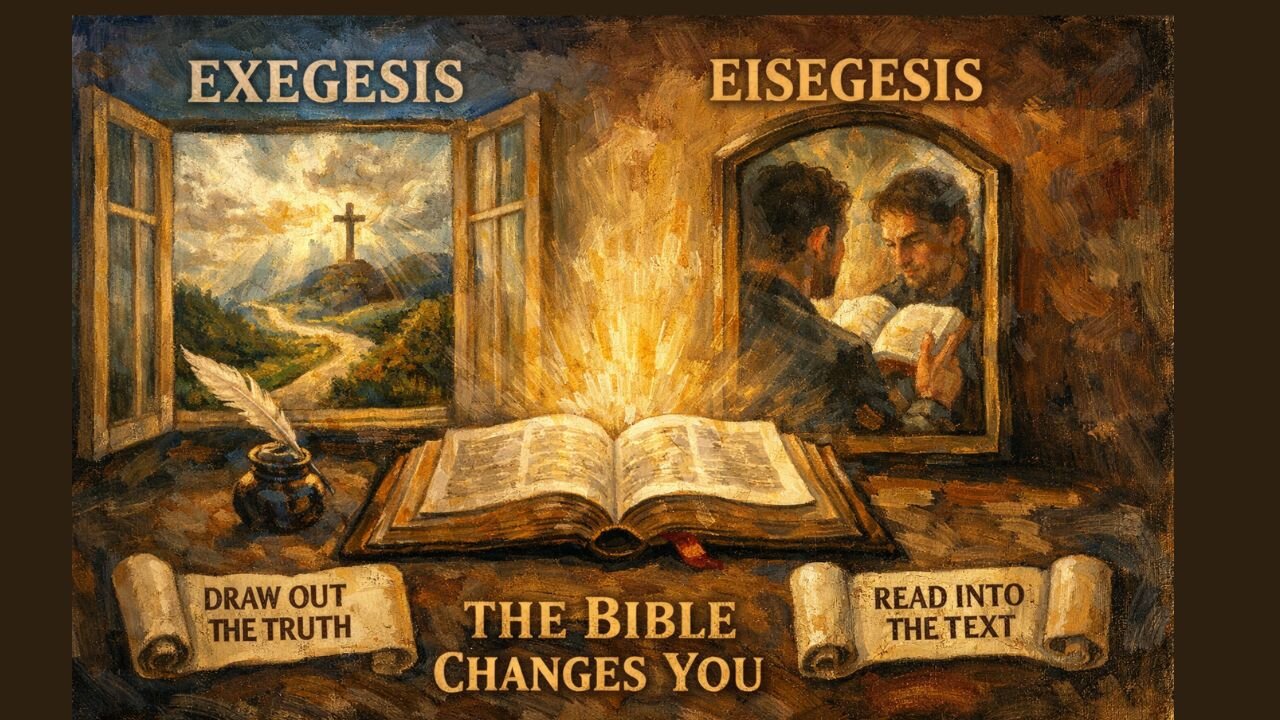
The Bible Changes You: Exegesis vs. Eisegesis and the Way We Read Scripture
The Bible Changes You: Exegesis vs. Eisegesis and the Way We Read Scripture
In this episode, we’re unpacking one of the most essential practices in Christian life: how we read and interpret the Bible. At the heart of this conversation are two critical approaches—exegesis and eisegesis. Understanding the difference between them can shape how we experience Scripture, how we grow in faith, and how we relate to God's word. This episode offers a practical, thoughtful exploration of why the Bible must be read to discover God—not simply to confirm what we already believe.
Top Topics:
What Are We Really Looking for in Scripture?
We often come to the Bible with a personal agenda—seeking comfort, validation, or answers about ourselves. But the deeper question should be: What does this passage tell us about God? When we shift our focus from ourselves to Him, we begin to understand the transformative power of Scripture.
Exegesis vs. Eisegesis—Why It Matters
Exegesis means drawing meaning out of the text as it was originally intended. It involves understanding the historical context, the author's purpose, the genre, and how the passage fits within the broader story of the Bible. Eisegesis, on the other hand, happens when we read our own assumptions, desires, or cultural perspectives into the text. It often starts with what we want to believe and finds verses to support it. Understanding the difference helps preserve the integrity of God’s Word.
How Different Traditions Approach Interpretation
Catholic, Orthodox, and Protestant traditions all recognize the value of exegesis but apply it differently. The Catholic Church emphasizes interpretation within the magisterium and tradition. The Orthodox Church prioritizes the communal and liturgical reading of Scripture. Protestants often empower individual believers to read and study the Bible with the aid of context, commentaries, and community. Each approach reveals something valuable, but all caution against the dangers of personal interpretations that distort Scripture.
Why ‘Looking for Ourselves’ Can Be Misleading
It’s natural to want to find ourselves in biblical stories. But when we make ourselves the main character, we reduce the Bible to a self-help book with God in a supporting role. Instead, the goal is to look for God first. His mercy, holiness, patience, and faithfulness reveal more about who we are than any self-focused reading ever could.
Takeaways:
Reading the Bible through the lens of exegesis requires humility and a willingness to be shaped by God’s word—not the other way around. When we let the Bible speak on its own terms, we discover who God is and how He relates to His people. That revelation then helps us understand ourselves more truthfully. The Bible isn’t there to reflect our image back to us; it’s there to reflect God’s character and transform ours. By keeping God at the center of our reading, we’re drawn into the bigger story—His story—and find our true place within it.
This episode is an invitation to read the Bible faithfully, thoughtfully, and with the right questions. Not “What does this say about me?” but “What does this tell me about God?” When we get that order right, transformation naturally follows.
Download blank templates, schedules here:
https://schmern2.notion.site/Downloads-Template-Word-and-Excel-Schedule-67439d14449d4c20bfe00efe069f78b8
Logos RAMPS Workflow - RAMPS Bible Study - The Bible in Small Steps in Logos Workflows
Jill’s Links
https://jillfromthenorthwoods.com/
https://www.youtube.com/@smallstepswithgod
https://www.buymeacoffee.com/smallstepspod
https://twitter.com/schmern
Email the podcast at [email protected]
“Scripture quotations are from the ESV® Bible (The Holy Bible, English Standard Version®), © 2001 by Crossway, a publishing ministry of Good News Publishers. Used by permission. All rights reserved. The ESV text may not be quoted in any publication made available to the public by a Creative Commons license. The ESV may not be translated in whole or in part into any other language.”
Scripture quotations marked CSB have been taken from the Christian Standard Bible®, Copyright © 2017 by Holman Bible Publishers. Used by permission. Christian Standard Bible® and CSB® are federally registered trademarks of Holman Bible Publishers.
“The Scriptures quoted are from the NET Bible® http://netbible.com copyright ©1996, 2019 used with permission from Biblical Studies Press, L.L.C. All rights reserved”.
Bible Maps and images used with permission from https://www.bible.ca/maps/ or https://www.freebibleimages.org/illustrations/bj-ot-world/
Copyright 2014 Faithlife / Logos Bible Software. Free for non-commercial use by individuals or organizations. May be presented before live audiences; may be posted on social media; may be re-distributed. May not be used commercially. May not be modified or included in published works without permission; contact [email protected]. Attribute as: “Copyright 2014 Faithlife / Logos Bible Software ()”.
By choosing to watch this video or listen to this podcast, you acknowledge that you are doing so of your own free will. The content shared here reflects personal experiences and opinions and is intended for informational and inspirational purposes only. I am not a licensed healthcare provider, psychiatrist, or counselor. Any advice or suggestions offered should not be considered a substitute for professional medical or mental health advice. You are solely responsible for any decisions or actions you take based on this content.
-
meleegames
11 hours agoFelicia Day Day - You’re Always Autistic on the Internet (forever)
35.4K -
 LIVE
LIVE
Shield_PR_Gaming
2 hours ago01/17/26 | Grinding! | Bienvenidos a todos!
300 watching -
 17:37
17:37
MattMorseTV
1 day ago $12.94 earnedWalz just got NIGHTMARE NEWS.
38K149 -
ZachTheRipper
11 hours agoArc Raiders Gooping King
139 -
 3:48
3:48
TruthStream with Joe and Scott
19 hours agoOver the Rainbow music video by Joe Rosati ~ 2026 cover of the 1939 classic
62.3K28 -
 3:11:09
PandaSub2000
2 days agoSilent Hill F | ULTRA BEST AT GAMES (Edited Replay)
24.5K -
 LIVE
LIVE
Ninety7Bravo
2 hours ago🔴 LIVE | Black Tusk Missions Part 4 | The Division 2 | 17 Jan 2026 🔴
125 watching -
 2:09:32
Side Scrollers Podcast
21 hours agoSide Scrollers Podcast Live | Friday January 16th 2026
130K26 -
 LIVE
LIVE
Lofi Girl
3 years agolofi hip hop radio 📚 - beats to relax/study to
460 watching -
 1:28:16
The Michelle Moore Show
23 hours ago'Music Industry Insider Sexually Assaulted By Christian Pop Star Shares His Journey of Healing and Rebuilding' Guest, Randall Crawford: The Michelle Moore Show (Jan 16, 2026)
31.3K6