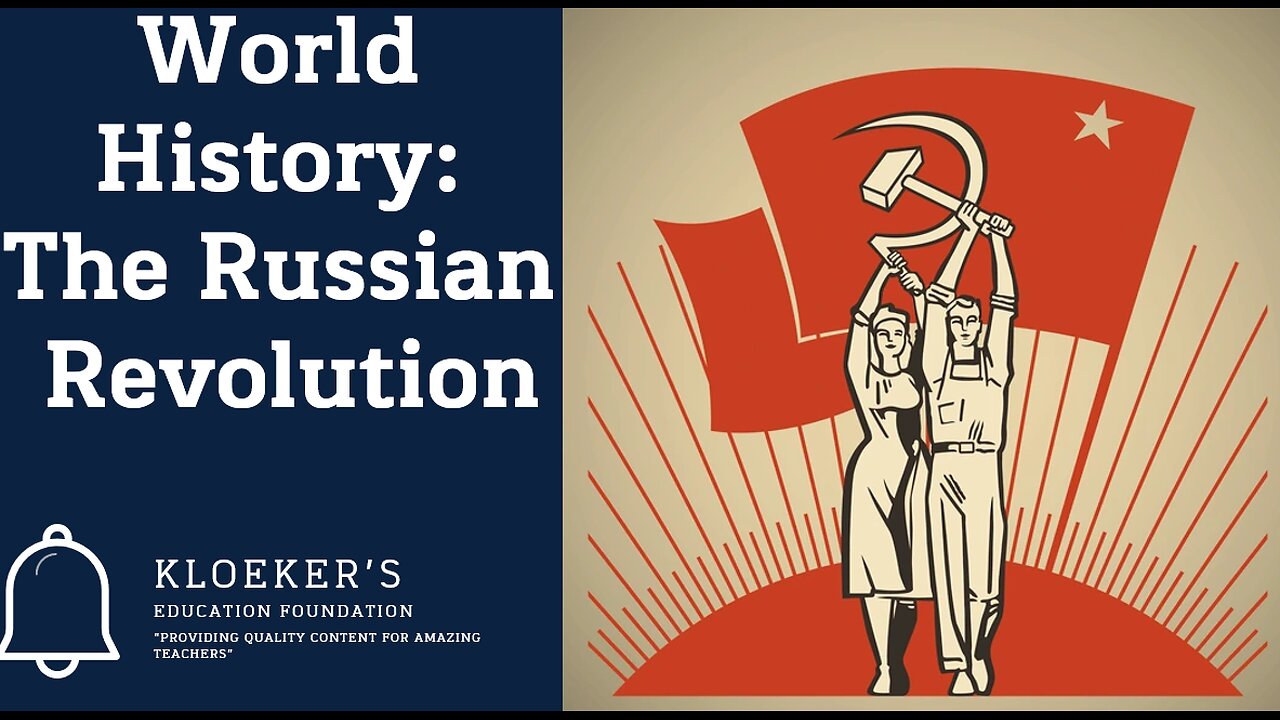
World History: The Russian Revolution Lesson
In this lesson, students examine the causes, key events, and long-term consequences of the Russian Revolution, a transformative moment that reshaped Russia and introduced communism as a governing system for the first time. The lesson explores how industrialization, social inequality, war, and weak leadership contributed to widespread unrest and revolutionary change.
Students analyze the ideological roots of communism and socialism, the collapse of czarist rule under Nicholas II, the rise of the Bolsheviks under Vladimir Lenin, and the political, economic, and social consequences of the revolution, including civil war and the creation of the Soviet Union.
🧠 Topics Covered
Ideological Foundations
Communism and socialism as responses to industrial inequality
Ideas of Karl Marx and Friedrich Engels
The Communist Manifesto (1848)
Proletariat vs. bourgeoisie
Abolition of private ownership of the means of production
Transitional role of socialism toward communism
Conditions in Russia
Widespread poverty and inequality
Weak leadership of Czar Nicholas II
Defeat in the Russo-Japanese War (1905)
Bloody Sunday (1905) and the massacre of unarmed workers
Rapid industrialization and poor working conditions
World War I & Collapse of the Monarchy
Heavy Russian losses (over 5.5 million casualties by 1917)
Food and fuel shortages
March 1917 strikes and riots
Abdication of the czar
Failure of the provisional government to end the war
Rise of the Bolsheviks
Bolshevik promises of “Peace, Land, Bread”
Return of Vladimir Lenin to Russia
Bolshevik seizure of power in November 1918
Renaming of the Bolshevik Party as the Communist Party
Early Communist Policies
Redistribution of farmland to peasants
Factory control by workers’ councils (soviets)
State control of major industries and banks
Treaty of Brest-Litovsk ending Russia’s role in World War I
Civil War & Formation of the USSR
Civil War between Red Army and White Army (1918–1920)
Foreign intervention by Western powers
Famine and over 15 million deaths
Creation of the Union of Soviet Socialist Republics (USSR) in 1922
Centralized government in Moscow
New Economic Policy (NEP) and limited capitalism
Power Struggle After Lenin
Death of Lenin in 1924
Rivalry between Joseph Stalin and Leon Trotsky
Stalin’s rise to power
🎯 Lesson Objective
Students will analyze the causes, events, and consequences of the Russian Revolution and evaluate how revolutionary ideology, war, and political instability led to the creation of the first communist state and reshaped global politics.
🧾 Matching Classroom Resources
📘 World History: The Russian Revolution PowerPoint
https://www.teacherspayteachers.com/Product/World-History-The-Russian-Revolution-PowerPoint-12647493
📝 World History: The Russian Revolution Guided Notes (FREE)
https://www.teacherspayteachers.com/Product/World-History-The-Russian-Revolution-Guided-Notes-12647499
📚 World History: The Russian Revolution Vocabulary Activity
https://www.teacherspayteachers.com/Product/World-History-The-Russian-Revolution-Vocab-Activity-12647510
📚World History: Russian Revolution Unit 22 Bundle
https://www.teacherspayteachers.com/Product/World-History-Russian-Revolution-Unit-22-Bundle-12647522
All resources are available through Kloeker’s Education Foundation.
🔗 Explore More Content
Teachers Pay Teachers: https://www.teacherspayteachers.com/store/kloekers-education-foundation
YouTube: https://www.youtube.com/@KloekersEducationFoundation/videos
Rumble:
https://rumble.com/user/KloekersEducationFoundation
🔖 Hashtags
#WorldHistory #RussianRevolution #Communism #Socialism #Lenin #USSR #WorldWarI #KloekersEducationFoundation
-
 0:29
0:29
Gaming on Rumble
2 hours agoRumble Shorts Teaser Trailer
311 -
 2:01:20
Steven Crowder
4 hours agoWhite Replacement is Real: But It's Much Bigger than You Think
336K182 -
 2:01:41
The Dan Bongino Show
5 hours agoI'm Back (Ep. 2443) - 02/02/2026
1.94M2.82K -
 LIVE
LIVE
Dr Disrespect
2 hours ago🔴LIVE - DR DISRESPECT - ARC RAIDERS - VENATOR PROTOCOL
2,049 watching -
 LIVE
LIVE
Sean Unpaved
1 hour agoSuper Bowl Week Is Here! | UNPAVED
60 watching -
 21:05
21:05
Neil McCoy-Ward
2 hours ago🚨 WARNING! BANK FAILURE & WHY They Crashed Gold & Silver DELIBERATELY! 🔥
6.6K2 -
 LIVE
LIVE
Wendy Bell Radio
5 hours agoNo Way Out
6,384 watching -
 LIVE
LIVE
LFA TV
17 hours agoLIVE & BREAKING NEWS! | MONDAY 2/2/26
2,717 watching -
 LIVE
LIVE
The Mel K Show
2 hours agoMORNINGS WITH MEL K - 2-2-2026.Truth Tsunami Hits the Homeland
1,092 watching -
 LIVE
LIVE
The Shannon Joy Show
3 hours ago🔥SJ LIVE Feb 2 - Epstein Docs - Chaos As Cover Up? Epstein Docs Reveal Steve Bannon & Epstein Alliance.
283 watching