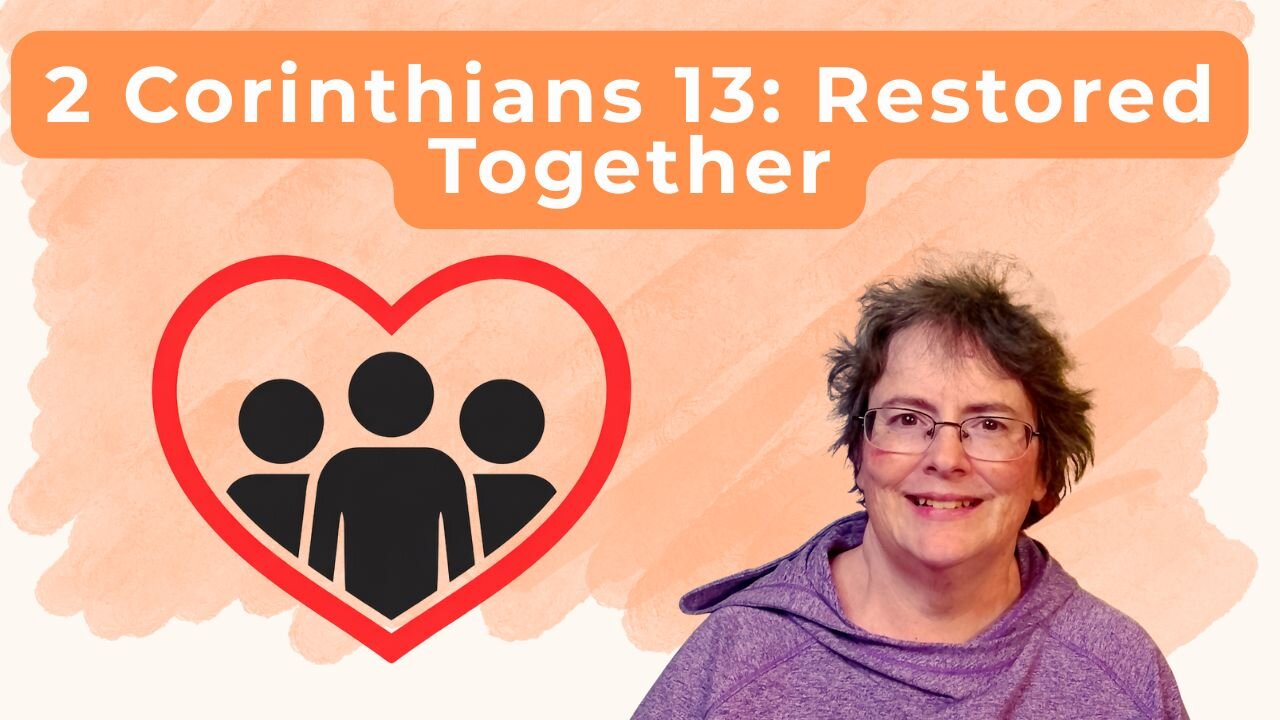
Restoration Over Rebuke: Paul’s Loving Confrontation
Restoration Over Rebuke: Paul’s Loving Confrontation
In this episode, we reflect on Paul’s powerful message in 2 Corinthians 13 as he prepares for a third and final visit to the Corinthian church. Rather than simply scolding or condemning, Paul brings a deeply spiritual tone of concern, correction, and restoration. His words aren’t fueled by anger but by love—a father’s love for his spiritual children. We explore the tension between truth and grace, strength and weakness, and examine what it truly means to reflect Christ in our daily lives. Paul’s challenge to the Corinthians to examine their faith is just as timely for us today.
Top Topics Covered:
1. Paul’s Return with Purpose
Paul writes with serious intent before his next visit, making it clear that his correction is not based on hearsay or gossip. His reference to Deuteronomy 19:15 highlights the importance of witnesses in matters of serious accusations. Paul wants the Corinthians to understand that what he’s saying is based on truth, not personal vendettas, and his tone reflects the urgency of spiritual accountability.
2. The Power in Weakness
One of the most striking themes is Paul's reminder that Christ was crucified in weakness but now lives by the power of God. Paul draws a parallel between Christ’s suffering and his own. Though he may appear weak to the world—shabby, poor, persecuted—he speaks with the authority of one empowered by God. The message is clear: strength in God often looks like weakness to the world.
3. Self-Examination of Faith
Paul calls the Corinthians to a sober moment of introspection: "Examine yourselves to see whether you are in the faith." This is not about perfection or works, but a heart check. Are their lives truly reflecting Christ? This powerful charge extends to us today—are we walking in the truth or just going through the motions?
4. Correction as a Tool for Restoration
Paul stresses that his discipline is not about tearing down, but building up. He writes these things in advance, hoping that when he comes in person, there will be no need for harshness. This entire passage is a reminder that spiritual correction, when done in love, is one of the greatest forms of care a leader or fellow believer can offer.
5. A Final Blessing of Peace and Unity
The tone softens in the final verses as Paul encourages joy, restoration, peace, and mutual comfort. He ends with the blessing that includes the Trinity—Father, Son, and Holy Spirit—showing the complete unity and love of God that he desires the church to embody.
Takeaways:
This chapter is a heartfelt blueprint for how we should handle confrontation and correction in Christian community. Paul models how authority should be used—not to dominate, but to build up and restore. His challenge to test ourselves in the faith is an invitation for all believers to consider whether their lives reflect the character and presence of Christ. We’re reminded that speaking truth in love isn’t harsh—it’s holy. The greatest acts of love sometimes come in the form of hard words delivered in gentleness. And above all, God’s grace, love, and fellowship are with us, calling us back into unity with Him and with each other.
In a world where truth is often softened or avoided, this chapter offers a bold and beautiful reminder: real love doesn’t ignore sin—it confronts it with compassion and a call to come home.
Download blank templates, schedules here:
https://schmern2.notion.site/Downloads-Template-Word-and-Excel-Schedule-67439d14449d4c20bfe00efe069f78b8
Logos RAMPS Workflow - RAMPS Bible Study - The Bible in Small Steps in Logos Workflows
Jill’s Links
https://jillfromthenorthwoods.com/
https://www.youtube.com/@smallstepswithgod
https://www.buymeacoffee.com/smallstepspod
https://twitter.com/schmern
Email the podcast at [email protected]
“Scripture quotations are from the ESV® Bible (The Holy Bible, English Standard Version®), © 2001 by Crossway, a publishing ministry of Good News Publishers. Used by permission. All rights reserved. The ESV text may not be quoted in any publication made available to the public by a Creative Commons license. The ESV may not be translated in whole or in part into any other language.”
Scripture quotations marked CSB have been taken from the Christian Standard Bible®, Copyright © 2017 by Holman Bible Publishers. Used by permission. Christian Standard Bible® and CSB® are federally registered trademarks of Holman Bible Publishers.
“The Scriptures quoted are from the NET Bible® http://netbible.com copyright ©1996, 2019 used with permission from Biblical Studies Press, L.L.C. All rights reserved”.
Bible Maps and images used with permission from https://www.bible.ca/maps/ or https://www.freebibleimages.org/illustrations/bj-ot-world/
Copyright 2014 Faithlife / Logos Bible Software. Free for non-commercial use by individuals or organizations. May be presented before live audiences; may be posted on social media; may be re-distributed. May not be used commercially. May not be modified or included in published works without permission; contact [email protected]. Attribute as: “Copyright 2014 Faithlife / Logos Bible Software ()”.
By choosing to watch this video or listen to this podcast, you acknowledge that you are doing so of your own free will. The content shared here reflects personal experiences and opinions and is intended for informational and inspirational purposes only. I am not a licensed healthcare provider, psychiatrist, or counselor. Any advice or suggestions offered should not be considered a substitute for professional medical or mental health advice. You are solely responsible for any decisions or actions you take based on this content.
-
 2:09:32
Side Scrollers Podcast
17 hours agoSide Scrollers Podcast Live | Friday January 16th 2026
91.4K17 -
 14:08
14:08
Nikko Ortiz
14 hours agoMost Painful Internet Clips...
7.76K6 -
 17:37
17:37
MattMorseTV
1 day ago $9.45 earnedWalz just got NIGHTMARE NEWS.
19.9K134 -
 3:48
3:48
TruthStream with Joe and Scott
16 hours agoOver the Rainbow music video by Joe Rosati ~ 2026 cover of the 1939 classic
45.7K26 -
 LIVE
LIVE
Lofi Girl
3 years agolofi hip hop radio 📚 - beats to relax/study to
408 watching -
 1:28:16
The Michelle Moore Show
19 hours ago'Music Industry Insider Sexually Assaulted By Christian Pop Star Shares His Journey of Healing and Rebuilding' Guest, Randall Crawford: The Michelle Moore Show (Jan 16, 2026)
16.7K3 -
 3:11:09
PandaSub2000
2 days agoSilent Hill F | ULTRA BEST AT GAMES (Edited Replay)
12.5K -
 2:00:43
FreshandFit
6 hours agoShould Men and Women Live Together in 2026?
166K20 -
 2:02:30
TimcastIRL
12 hours agoMN To LOSE Congressional Seat Over Deportations, Attacks Against ICE Getting WORSE | Timcast IRL
322K386 -
 5:10:30
Drew Hernandez
1 day agoILHAN OMAR HOLDS SHADOW HEARING TO FUEL MINNEAPOLIS INSURRECTION?
53.2K24