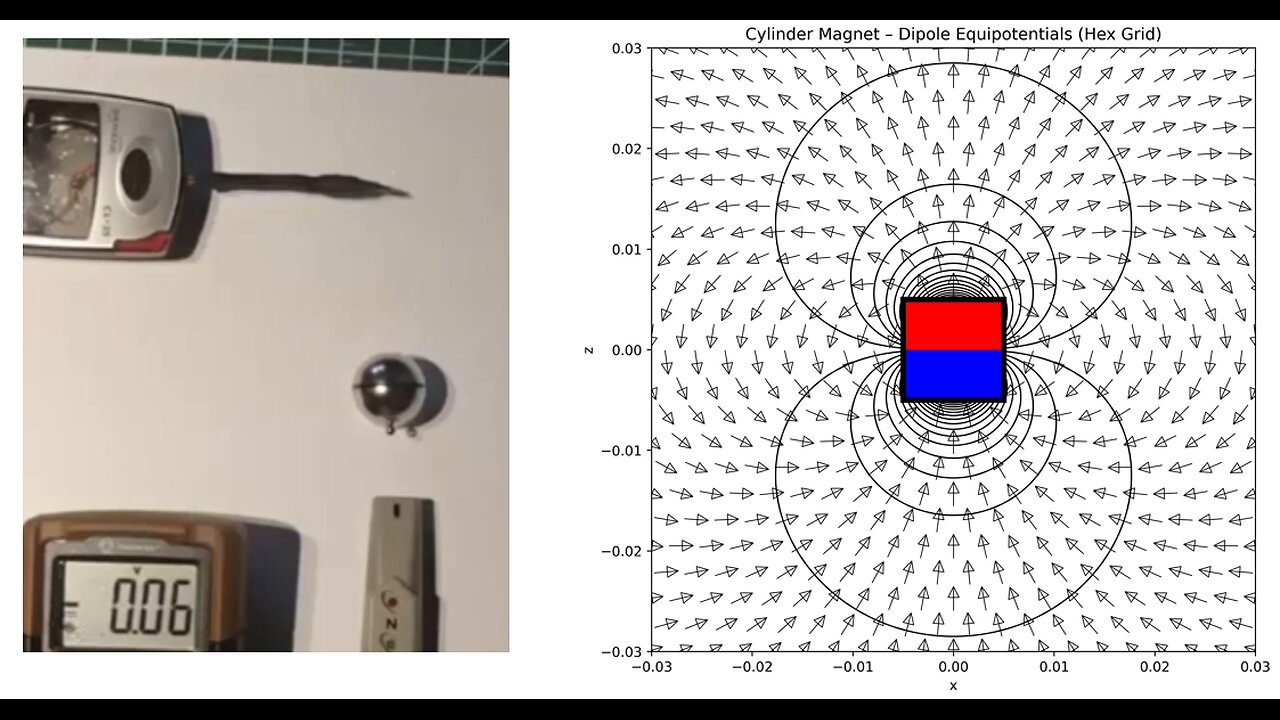
Demystifying the Hall Sensor / Demystifying Copyright (c)
Have you ever got hit with a copyright strike for a video when you know that 100 percent of the content in your video was created by YOU? This is surprisingly common, especially when the content involves scientific experiments, math, or visuals generated by software, because many people don’t realize that experimental outputs aren’t copyrightable. Copyright law only protects artistic expressions, not scientific data, mathematical patterns, or the results of experiments.
In this video, I use the concept of the Hall sensor and its interaction with the REAL magnetic field to explain why the images my software produces are just projections of magnetic field vectors and not content directly copied from someone else's work. I also break down why the patterns generated by experiments are dictated by science and math, not artistic expression, and what that means for creators in the world of science.
If you’ve ever been curious about Hall sensors, magnetic field imaging, experimental science, or copyright rules, this video is for you. By the end, you’ll understand why scientific outputs are part of shared knowledge and not subject to copyright claims. You’ll also gain a clearer understanding of how Hall sensors interact with magnets and how spherical harmonics tie it all together.
Disclaimer:
This video is for educational and commentary purposes only. All simulations and visualizations presented in this video are based on standard physics principles and mathematical formulae using software developed independently by the author. Any similarity to images or figures in published research is incidental and reflects the underlying math and physics and not outright copying. ZERO content from anyone else's papers, videos or books were used in this video.
-
 LIVE
LIVE
MattMorseTV
1 hour ago🔴The EU just FOUND OUT.🔴
7,022 watching -
 LIVE
LIVE
Tactical Advisor
23 minutes agoUnboxing Gun Packages/Shot Show | Vault Room Live Stream 051
453 watching -
 LIVE
LIVE
LFA TV
6 hours agoTHE CREST REPORT LIVE ON LFA | 1.17.26 @1PM EST
3,136 watching -
 LIVE
LIVE
Jeff Ahern
58 minutes agoThe Satruday show with Jeff Ahern
250 watching -
 LIVE
LIVE
GritsGG
57 minutes agoWin Streak Camo TODAY! #1 Warzone Victory Leaderboad 875+ Ws!!🔥
123 watching -
 26:02
26:02
Stephen Gardner
2 hours agoYou Won’t Believe What Trump Just Learned About MASSIVE Congressional Fraud!
48K53 -
![Mr & Mrs X - Trans & Antifa Are Connected & The [DS] Is Using Them To Push The Insurrection - EP 22](https://1a-1791.com/video/fww1/64/s8/1/W/1/k/R/W1kRz.0kob-small-Mr-and-Mrs-X-Trans-and-Anti.jpg) 52:11
52:11
X22 Report
6 hours agoMr & Mrs X - Trans & Antifa Are Connected & The [DS] Is Using Them To Push The Insurrection - EP 22
73.5K15 -
 LIVE
LIVE
JdaDelete
2 hours agoZero Tolerance - Sega Saturday
48 watching -
 LIVE
LIVE
Amarok_X
2 hours ago🟢LIVE WARZONE | SATURDAY SHENANIGANS | PREMIUM CREATOR | VETERAN GAMER
119 watching -
 32:40
32:40
The Rubin Report
21 hours agoProof That Medications Are Making Mental Health Crisis Worse | Dr. Josef Witt-Doerring
185K116