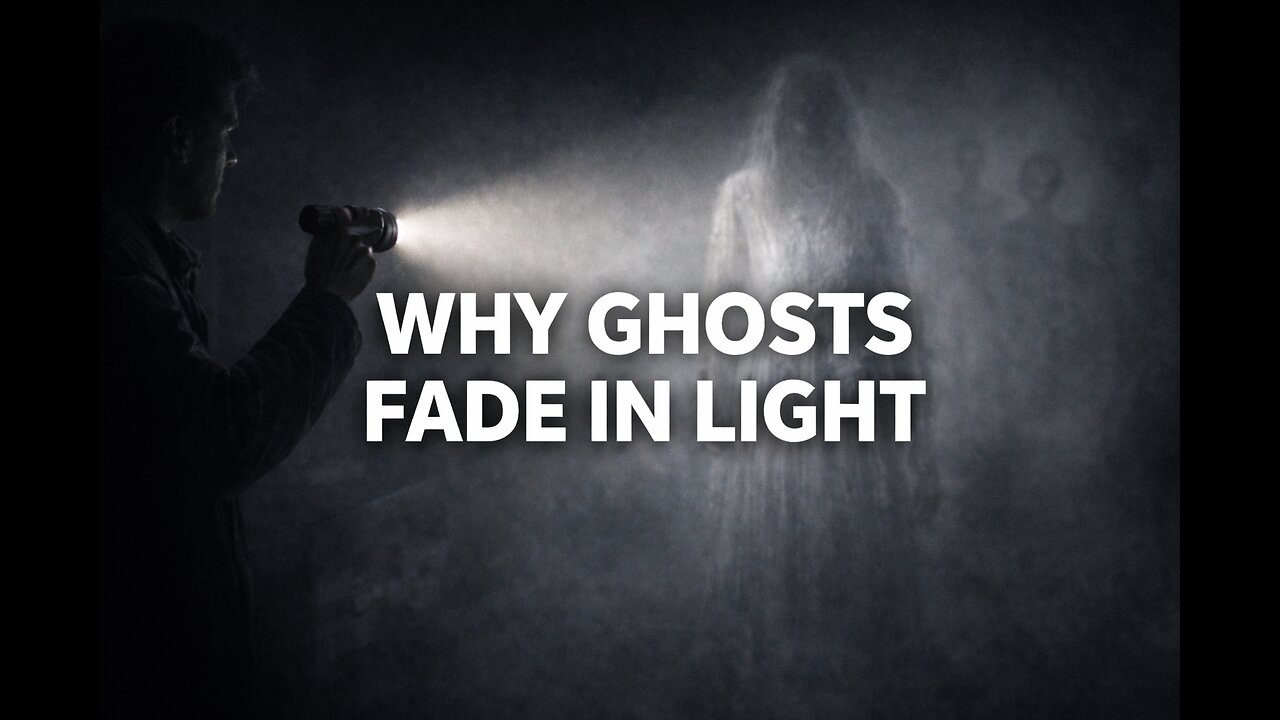
The Paradox (Part 10)
Across cultures, people report the same pattern: a “ghost” looks clearer in dim rooms, dusk corridors, or single-lamp light — then fades the moment a bright light turns on. This video explores a grounded hypothesis: bright light doesn’t “kill” anything — it can raise the noise floor and flatten contrast, making a weak signal impossible to detect.
Using real optics and detection concepts (signal-to-noise ratio, scattering, refraction, polarization, coherence), we propose that an apparition may not emit light, but modulate existing light in subtle ways — like a faint fingerprint on the optics of a quiet room. We also cover the body’s bioelectric order (membrane polarization) and the idea of the living body as a stabilizing sink, then connect it to perception: low light changes how vision integrates detail, while harsh overhead light adds glare, scatter, reflections, and rapid adaptation that can drown a “whisper.”
Most importantly, this is a testable model with predictions: dim vs bright light, polarizer rotation, uniform backgrounds, and sudden vs gradual illumination. We end with a human thought: the eye may be more than a sensor — a low-bandwidth “state link” for bonding — and that same quiet channel might detect faint residual traces when conditions are right.
-
 8:58
8:58
Ben Bankas
2 days ago $0.38 earnedBen Bankas on The Ice Lady | Standup Comedy
113K58 -
 LIVE
LIVE
Tundra Tactical
9 hours ago🛑🚨Dan Wesson DWX GIVEAWAY Starts TODAY!! 🚨🛑 Tundra Tactical Recaps Shot Show 2026
349 watching -
 LIVE
LIVE
Akademiks
1 hour agoNothing is Real! J Cole album FULL breakdown! Drake & Kendrick otw? 50 cent unleases on TI n JAY Z
2,675 watching -
 UPCOMING
DLDAfterDark
1 hour agoGun Talk At The Armory - After Hours - Tip Topic - If $ Weren't An Issue What Gun Would You Carry?
135 -
 13:55
13:55
Adam Does Movies
11 hours ago $0.04 earnedStar Trek: Starfleet Academy Blows Glitter Chunks!
226 -
 LIVE
LIVE
Rallied
4 hours ago $1.76 earnedSolo Challenges + High Vibrations
969 watching -
 UPCOMING
BlackDiamondGunsandGear
47 minutes agoAfter Hours Armory / Customer Story Time
20 -
 2:39:36
Mally_Mouse
1 day ago🔥🍺Spicy HYDRATE Saturday!🍺🔥- Let's Play: Toy Story 2 (1999)
73.6K2 -
 7:18
7:18
Turning Point USA
2 hours agoJoin us LIVE tomorrow evening for The All American Halftime Show!
24.3K25 -
 LIVE
LIVE
SpartakusLIVE
4 hours agoNew SMG is META || #1 MOST Humble Streamer 2024-25
163 watching